Ladies trip to Tibet – where do I begin. Unfortunately, I am writing this in February, 10 months after the trip. My posts are best when I have the time to blog about our adventures immediately upon returning home. But, life gets in the way. I even debated about going on this trip as life was too busy. However, I realized it was now or never. Jim went to Tibet with John in July 2009. See Jim’s Tibet trip at Lhasa to Katmandu . John and Mary were moving back to Michigan at the end of the school year. This was on Mary’s “bucket list” before leaving China. The adventure trip ladies included Mary, Jennifer, Judy and myself.
Day 1 – April 3: Travel Day
Before the trip begins, special visas must be obtained. A letter on Company letter head was required from Jim’s Company stating he was employed with proper visas in China. When we travel, I always fill out the departure paperwork before arriving at the airport. A habit to be organized when traveling with children. We have a stack at the house ready for our next departure out of China. After we checked in, I realized/remembered we weren’t leaving China…it didn’t feel that one. We had special visas and paperwork to get through security. After security, we had to check in at another desk – something I have never done in the past. Well, good thing we aren’t leaving China. Yes, there are many politics when you are in China and going to Tibet – interesting already and we haven’t even left the airport!
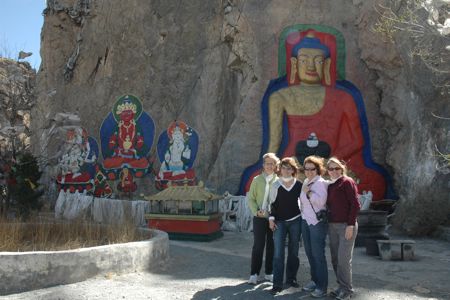
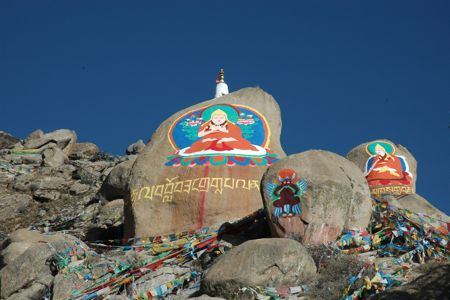
Our flight left Shanghai with travel through Xian to Lhasa. Upon arriving in Lhasa, we were picked up by our guide, Dukar, and driver. On the way to the hotel, we stopped at the Nethang Rock to visit the craved Buddha.
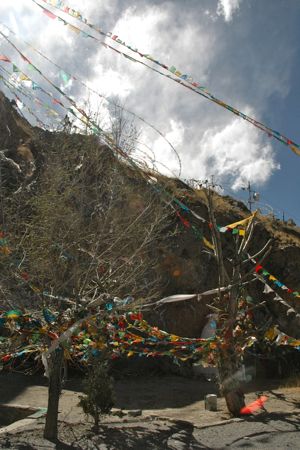
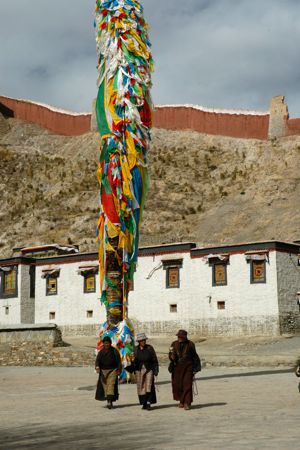
We were seeing the prayer flags along the river, road and homes.
Traditionally, prayer flags come in sets of five, one in each of five colors. The five colors represent the elements, and the Five Pure Lights and are arranged from left to right in specific order: blue, white, red, green, and then yellow. Different elements are associated with different colors for specific traditions and purposes.
Blue symbolizes sky/space
White symbolizes air/wind
Red symbolizes fire
green symbolizes water
Yellow symbolizes earth
According to Traditional Tibetan medicine, health and harmony are produced through the balance of the five elements.
Traditionally, prayer flags are used to promote peace, compassion, strength, and wisdom. The flags do not carry prayers to gods, a common misconception; rather, the Tibetans believe the prayers and mantras will be blown by the wind to spread the good will and compassion into all pervading space. Therefore, prayer flags are thought to bring benefit to all.
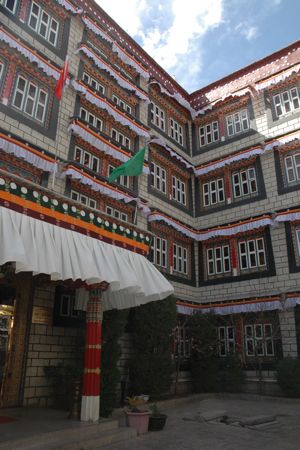
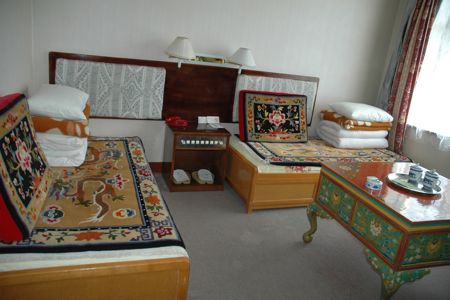
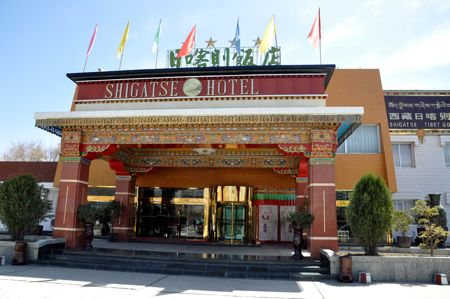
Our hotel was located in the Barkhor old town area. It was a traditional, local hotel. It was basic and clean. Jennifer and I would be roommates for our adventures through Tibet.
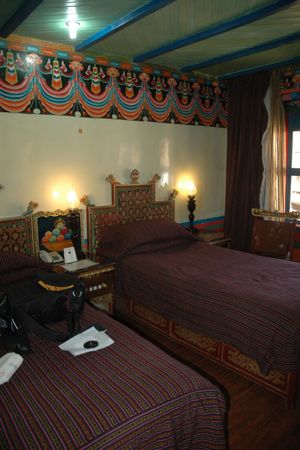
We checked into our rooms and left for an early dinner. We didn’t have lunch as China airline meals don’t even look edible! We had dinner at The Lhasa Kitchen recommended by our guide…it was ok. We all loved the Yak meet. I have had yak meet when we traveled to Yunnan as a family. Yak is a leaner meat than cow. After dinner, we did a short walk around the old town. The stalls were packing up for the night.
We retired back to our room after a long day. The beds were hard, but we are used to this from traveling in China.
Day 2 – April 4: Lhasa
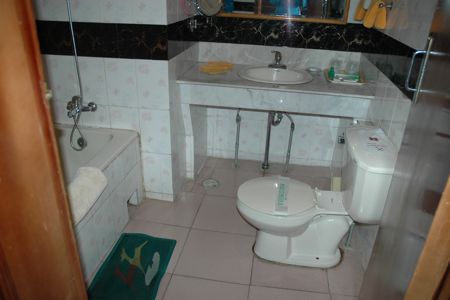
After a long travel day, I was ready for a nice morning shower. However, that didn’t happen. Our shower had no hot water and no water pressure. We couldn’t even take a cold shower as there wasn’t enough pressure to run the shower – welcome to the local hotel! Jennifer and I went to the front desk to request a different room.
We meet downstairs for breakfast. There are other tour groups staying at our hotel. However, the other groups are large groups with an older (retired age) crowd. We are four ladies traveling together which gives us a few stares. The best item at breakfast was the toast. Hum, we may be a few pounds lighter when we arrive back at Shanghai at this rate.
Our first stop on the tour was Portala Palace.
The Potala Palace was the chief residence of the Dalai Lama until the 14th Dalai Lama fled to Dharamsala, India, after an invasion and failed uprising in 1959.
Lozang Gyatso, the Great Fifth Dalai Lama, started the construction of the Potala Palace in 1645. The building measures 400 meters (1, 300 ft) east-west and 350 meters (980 ft) north-south, with sloping stone walls averaging 3 meters (10 ft) thick and 5 meters (16 ft) thick at the base, and with copper poured into the foundations to help proof it against earthquakes.
Thirteen stories of buildings – containing over 1, 000 rooms, 10, 000 shrines and about 200, 000 statues – soar 117 metres (384 ft) on top of Marpo Ri, the “Red Hill”, rising more than 300 m (about 1, 000 ft) in total above the valley floor.
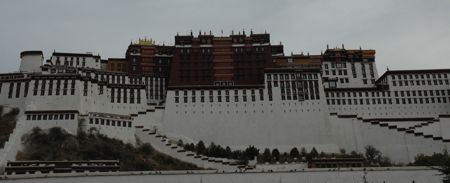
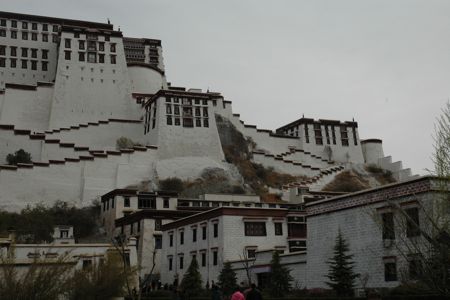
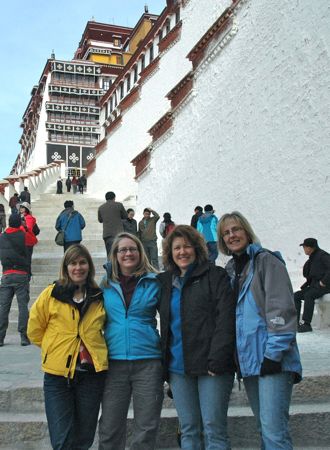
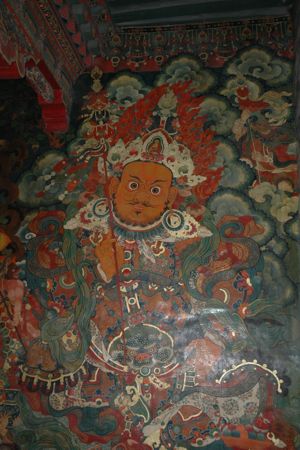
The history and the many different Buddhas is overwhelming. After we finished the tour with our guide, Dukar, I wasn’t very impressed with his skills or knowledge as a tour guide. For me, the most important aspect of a tour guide is to get that odd tidbits of information. Our guide was pointing out all the different Buddahs, but not adding much more information. Jennifer read a few books before our trip. Our guide wasn’t real pleased with her knowledge or questions.
Photos are not allowed inside the palace which explains the outside photos only of Portala Palace.
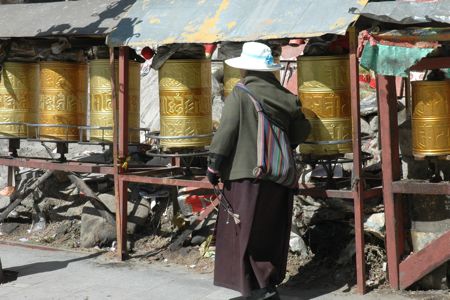
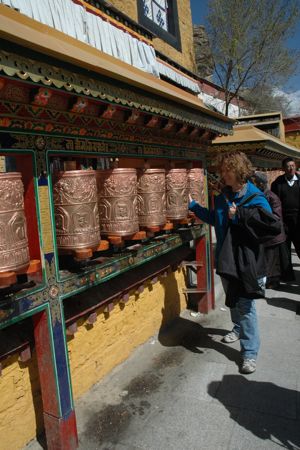
The stationary prayer wheels were outside the Palace. We joined the locals in spinning the row of prayer wheels.
According to the Tibetan Buddhist tradition regarding prayer wheels, spinning such a wheel will have much the same meritorious effect as orally reciting the prayers. Prayer wheels are used to accumulate wisdom and merit (good karma) and to purify negativities (bad karma).
After touring the Palace, we went back to Barkhor old town for lunch. We ate at the New Mandela which was a thumbs up for all of us. We were hungry and the yak dishes were delicious. Mary was having a little trouble with the altitude. She was taking a natural supplement from a local Chinese pharmacy recommended by her driver. Jennifer, Judy and I had the pills shipped in from the USA to Parkway Health…for a premium, of course. We started taking the pills before we left and we were doing fine. At an altitude of 3, 490 metres (11, 450 ft), Lhasa is one of the highest cities in the world. The altitude is one reason it is hard to travel to Tibet with children.
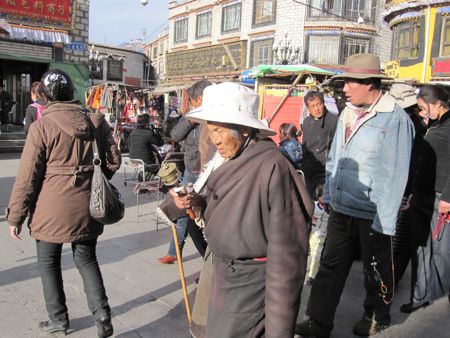
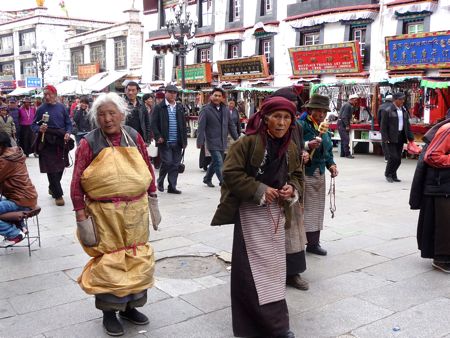
The Barkhor is an area of narrow streets and a public square in the old part of the city located around Jokhang Temple (said to be the most sacret temple for all Tibetans) and was the most popular devotional circumabulation for pilgrims and locals. The walk is about one kilometre (over half a mile) long and encircled the entire Jokhang.
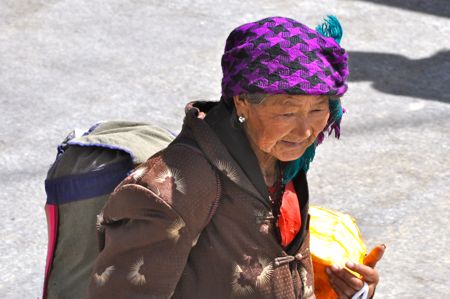
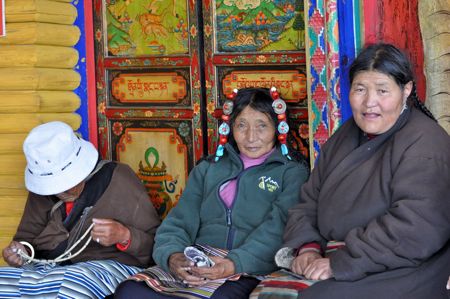
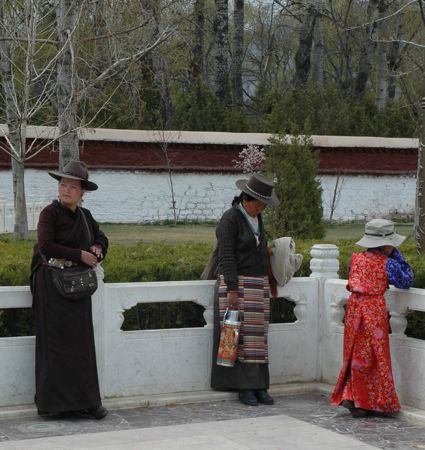
Barkhor old town square is an amazing interesting place – almost impossible to put it into words. First you have the Tibet people – kind, gently and happy people.
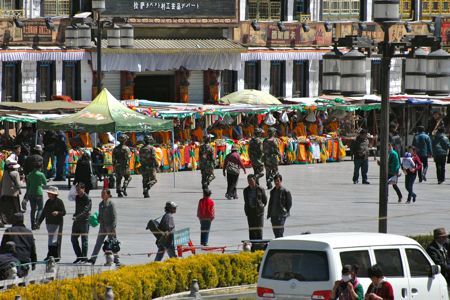
Then, you have the Chinese police presence which is very strong. We were told we were not allowed to take any photo with the police. It helps to keep up the pretense Tibet is not an occupied region. At one point, Judy was taking photos of the local people. A police officer walked over to verify she was not taking photos of the police standing nearby.
Uniformed police walk the square with guns. Most of these policemen look to be about 15 years old and would have no idea how to use the gun they are carrying. They march through the square and are posted on the street corners along with the entrances to the square. They are posted on the top of buildings to keep a watchful eye on the Tibetan people.
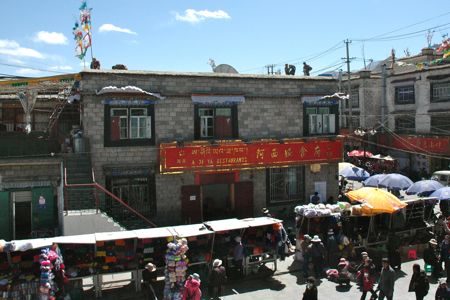
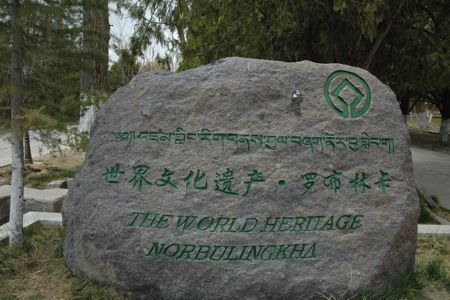
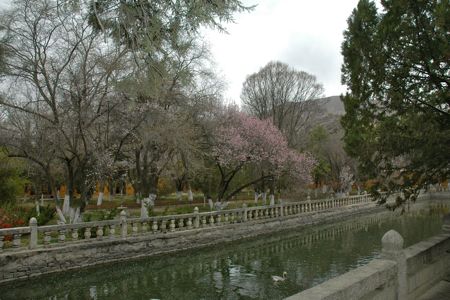
After lunch, we toured the summer palace – Norbulingkha. Seeing the Potala Palace this morning, we could understand the need for a summer place. The Potala Palace is dark and cold feeling as it is built in the side of a mountain. The Norbulingkha was very open with many outdoor spaces to enjoy the beauty of Tibet.
Norbulingkha literally means “The Jewelled Park”. Norbulingkha is a palace and surrounding park built from 1755. It served as the traditional summer residence of the successive Dalai Lamas from the 1780s up until the 14th Dalai Lama’s exile in 1959. Norbulingkha covers an area of around 36 hectares (89 acres) and considered to be the largest man made garden in Tibet.
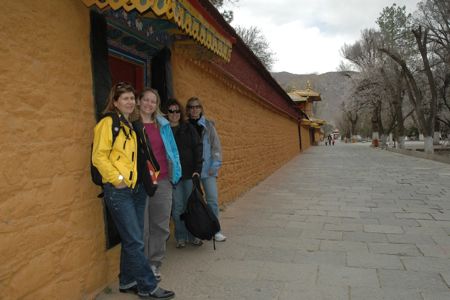
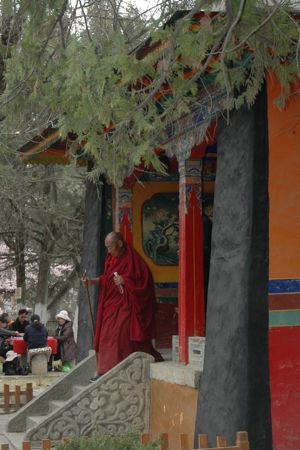
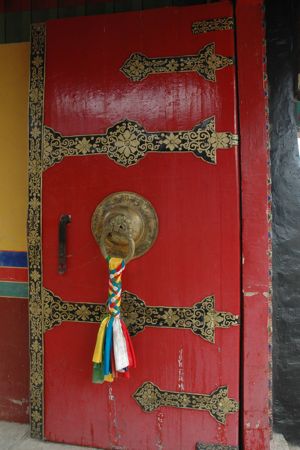
The gardens, trees and waterways were very peaceful at the Summer Palace.
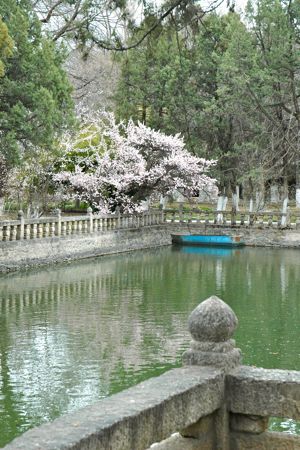
After touring the summer palace, we went back to our hotel before dinner. Our hotel is on the edge of the old town square. We did a little shopping before dinner – we ARE on a ladies trip. We all like to have the time to look before buying. We enjoyed dinner at Tashi, a recommendation from the Lonely Planet book.
Day 3 – April 5: Lhasa
After our toast breakfast, Dukar picked us up at 9am to start our tour for the day. It was a beautiful, sunny morning. Our first stop is the Drepung Monastery.
Drepung Monastery, literally “Rice Heap†monastery, located at the foot of Mount Gephel, is one of the “great three” Gelukpa university monasteries of Tibet. The other two are Ganden and Sera. Drepung is the largest of all Tibetan monasteries and is located on the Gambo Utse mountain.
Freddie Spencer Chapman reported, after his 1936-37 trip to Tibet, that Drepung was at that time the largest monastery in the world, and housed 7, 700 monks, “but sometimes as many as 10, 000 monks.” According to local sources, today the population at the monastery in Lhasa is about 300 monks, due to population capping enforced by the Chinese government.
Drepung monastery was shut down by Chinese authorities on 14 March 2008, after monk-led protests against Chinese rule turned violent and businesses, shops and vehicles were looted and torched.
As we climbed the steps/hill to the Monastery, many children are asking for money. It is common to give each child 1rmb. The Buddhist belief is to give to help. When you visit the temples, everyone leaves 1rmb at the various Buddha statutes for luck/prayer/protection. It is also common practice to “make change” – dropping a 10rmb note and taking 9rmb.
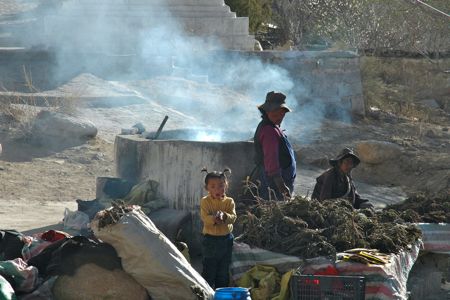
At the base before entering the Monastery, there are many “homes” in the rock. These are monks that do not have the “rights” of the monks that reside in the Monastery. Being a Monk is special to the Tibetan people. Many children are monks as their parents make this decision for them. Our guide had said it would be a privilege if his son would become a monk. The reason is his son would provide good fortunate to all his family in this life and the next life.
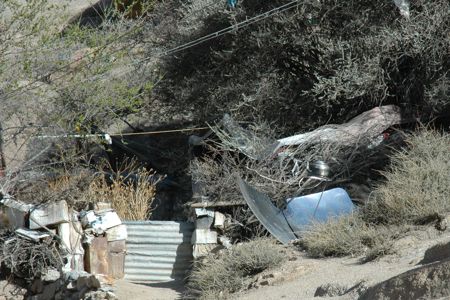
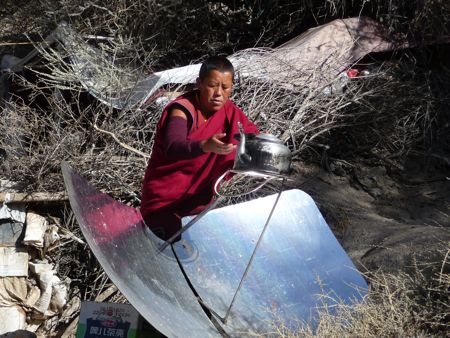
The Monk is heating up his water for tea with solar panels. We saw these panels everywhere.
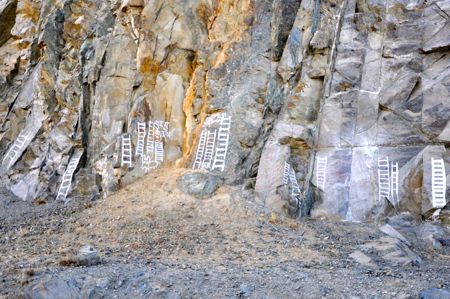
We saw many white ladders on rocks here and along the road. Our guide had said it represents a challenge or a challenging time in a families life. The ladder represents the climb to resolve the problem.
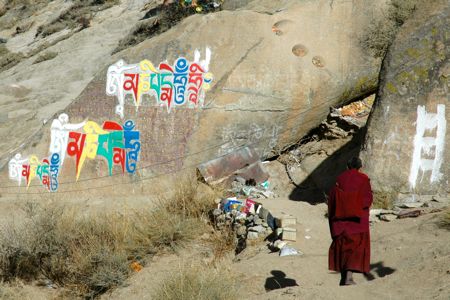
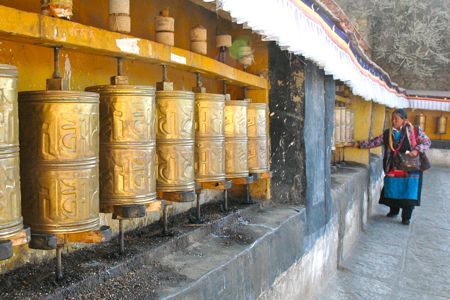
Prayer wheels are common at the entrance of Monasteries.
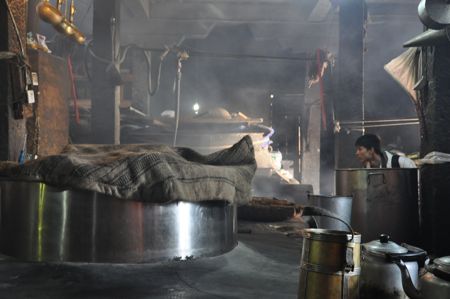
As with all the Monasteries, no photos are allowed inside. Most of the rooms are dark and blacked from many years of candle burning. Many places will allow photos for a fee. The kitchen was an interesting place at this monastery. We decided this room was worth the fee. The room was smoked filled with a few monks sitting in the corner drinking tea.
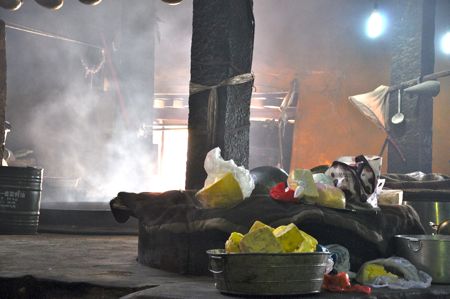
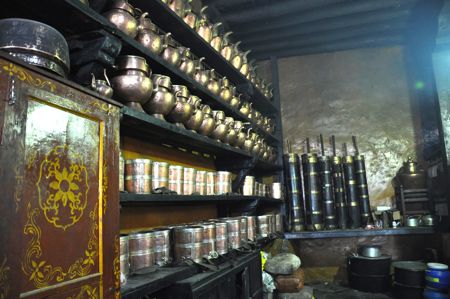
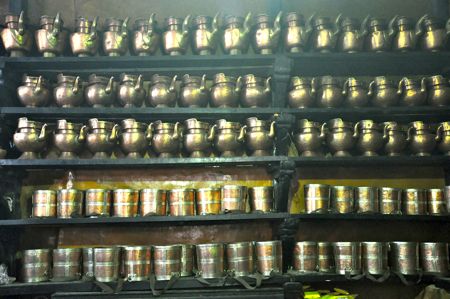
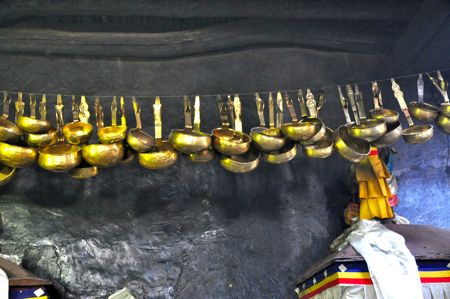
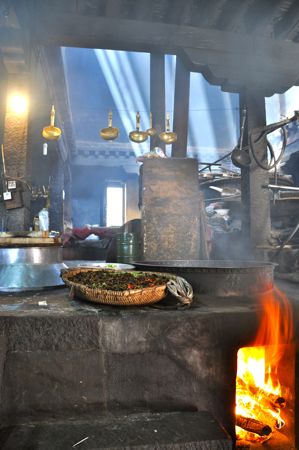
It was nice to leave the kitchen to get fresh air. However, the Monks sitting in the kitchen didn’t seem to mind the smoke. We continued touring the Monastery before walking back down the hill to the van.
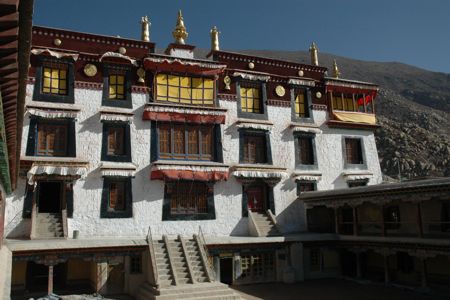
After our tour of the Monastery, it was lunch time. We went back to the old town square to the New Mandela for lunch. We enjoyed the yak dishes and the view. The restaurant is on the second floor which gives us a view of the local people in the square.
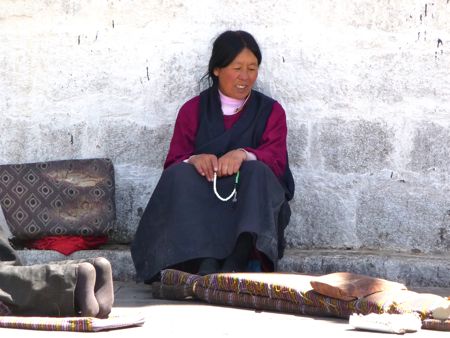
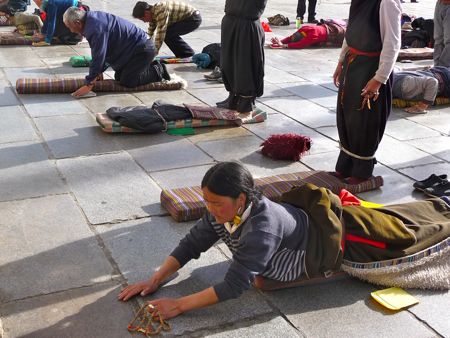
We walked through the square to the Jokhang Temple. This temple is where the pilgrims postulate themselves on the ground in front of the temple and also walk clockwise around the outer walls of the Barkhor with prayer wheels spinning.
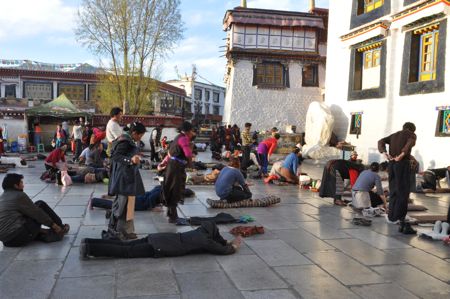
The Jokhang temple sits on Barkhor Square in the old section of Lhasa. The entire temple complex occupies approximately 25, 000 sq.meters. For most Tibetans, it is the most sacred and important temple in Tibet. The temple’s architectural style is a mixture of Indian vihara design, Chinese Tang Dynasty design, and Nepalese design.
According to tradition, the temple was built for the two brides of the king, Princess Wencheng of the Chinese Tang Dynasty and Princess Bhrikuti of Nepal. Both wives are said to have brought important Buddhist statues and images from China and Nepal to Tibet as part of their dowries, and they were housed here. Many Nepalese artists worked to construct this temple.
Pilgrims circumambulate the temple as part a pilgrimage to the site. The circumabulation route is known as the “kora” in Tibetan and is marked by four large stone incense burners placed at the corners of the temple complex. After circumambulating the exterior, pilgrims make their way to the main hall of the temple which houses the Jowo Shakyamuni Buddha statue, perhaps the single most venerated object in Tibetan Buddhism.
There are two pot-bellied stone “sangkang” (incense burners) in front of the Jokhang temple. According to the Lonely Planet book, “the northern stele is inscribed with the terms of the Sino-Tibetan treaty of 822. The inscription guarantees mutual respect of the boarders of the two nations – an irony seemingly lost on the Chinese authorities.”
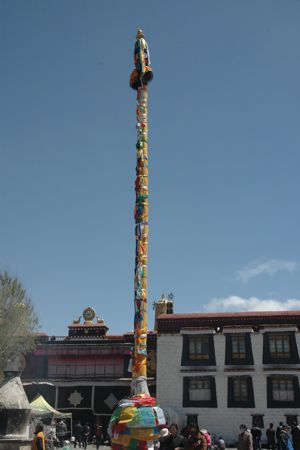
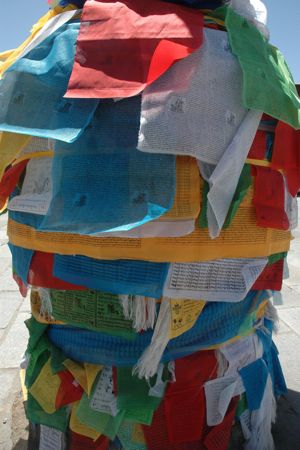
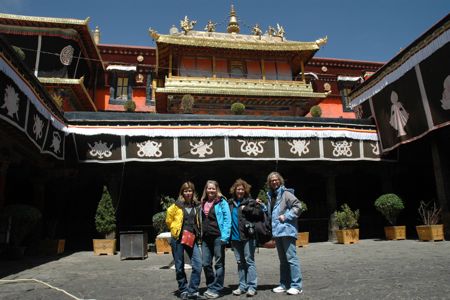
The courtyard in the center of the temple. Still no photos of the interior.
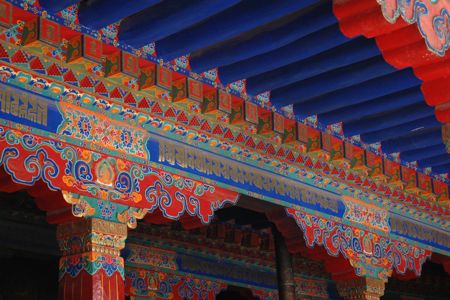
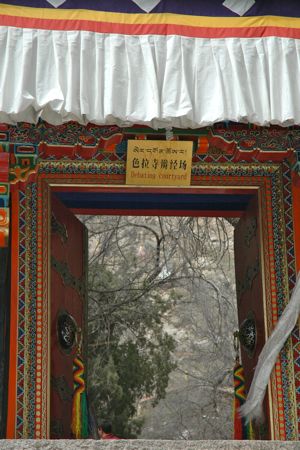
We piled back into the van for our trip to the Sera Monastery for the monk debate. This was an interesting tour. First, we walk up to the Monastery where people have been lined up. Our guide motions us to walk past the people in line. We squeeze by them and they gracefully let us pass with a smile. We live in China where no one would let you pass, therefore, we all amazed. At first, we thought we were just “line jumping” to the front entrance…but, no we keep passing everyone through the Monastery in these small halls. It is crowded and everyone lets us pass with a smile- we all had our jaws hanging with surprised looks. After squeezing by these people through various rooms, we come to the reason the people formed the queue – to get a blessing. A Monk is saying a prayer and putting a black smudge on the nose. From where we began the line jumping to this point must have been at least a 4 hour wait. Amazing! We left the Monastery to go to the debating court.
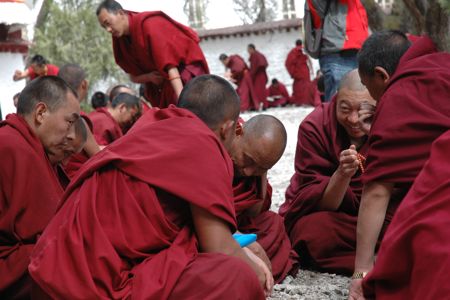
The monk debating court was again a very interesting event.
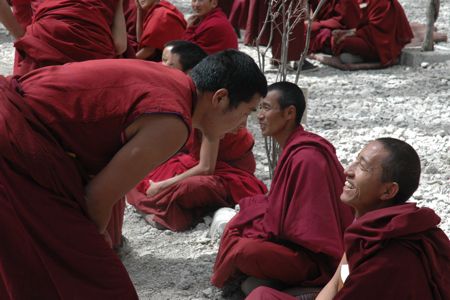
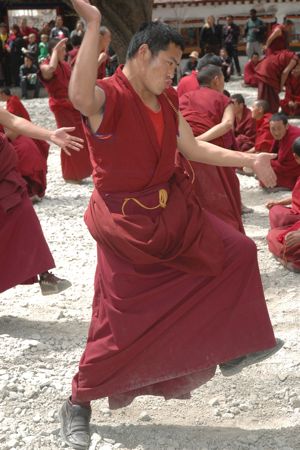
Young Tibetan monks debate in the traditional Tibetan style embellished with hand clapping and emphatic gestures. There are two parties to the debate: a defender and a questioner, each with clear roles and strict rules of behavior which assure an orderly exchange of questions and answers. The defender is usually a novice, while the questioner is a more experienced debater.
The questioner, who is standing, begins the questioning in a very low and barely audible voice. He bends gently forward toward the defender, who is sitting, as a sign of humility and respect. At this point, the questioner is wearing his robe in the customary style, with the left shoulder covered, and the right shoulder bare. These initial gestures and soft speech are part of a skillful strategy designed to bring about a false sense of security in his opponent.
The defender presents his thesis. The questioner raises doubts. As the back and forth exchange of questions and answers progresses, the debate grows increasingly animated, impassioned, and physically intense, with plenty of forceful clapping and spirited verbal exchanges.
The debate court was a lovely garden with the center court for the Monks.
The monk debat was lively and full of enthusiasm. The questioner slaps his hands as he presents the question to the monk sitting, the defender.
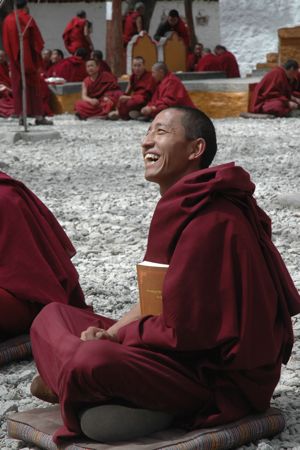
The elder Monks sat quietly debating without all the question slapping.
These two girls have a the black smudge down the bridge of their noses.
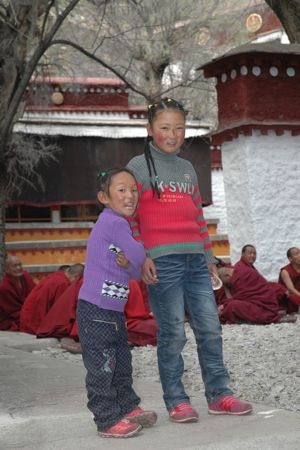
Walking back from the Debate court.
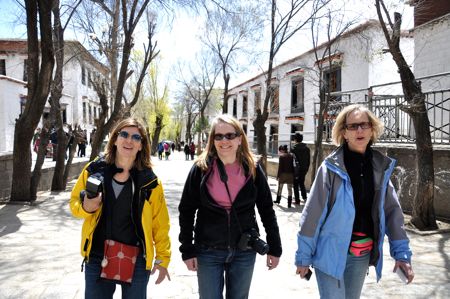
After the debate, we drove back to Barkhor Square for shopping and dinner. It is a ladies trip which means we need to come home with a few good buys. I did buy a prayer wheel. I knew Jim bought one when he was here, but I could not remember what it looked liked. I found a small prayer wheel with Yak skin that I thought was different and interesting. Really not sure what we will do with them when we get home, but they are unique to Tibet. Jim’s wheels are still sitting in the corner of his office on the floor.
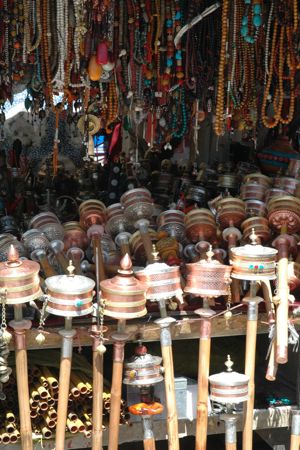
I also found a bell for Jim. Jim has a collection of bells from various trips. Again, not sure what we will do with all the bells, but they are all different and fun.
Day 4 – April 6: Drive to Gyangtse
We packed our bags and skipped the hotel breakfast as Jennifer found a local coffee house – a Tibet Starbucks! The ladies were in need of some good coffee. They were all happy campers as we pile into the van for our day-long road trip. We started our trip at 9am.
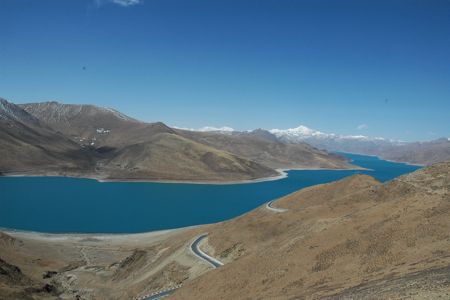
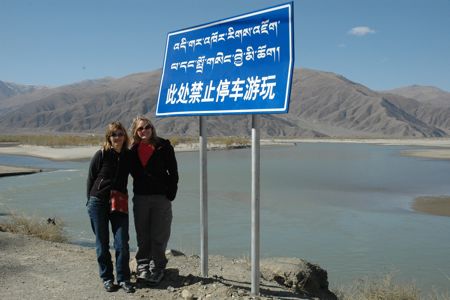
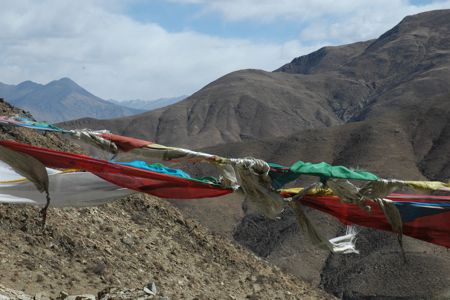
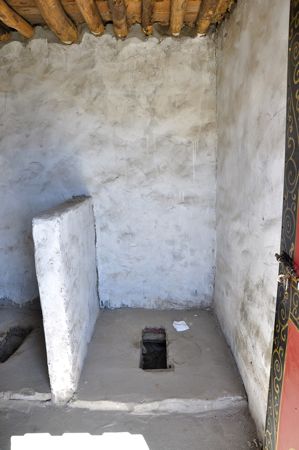
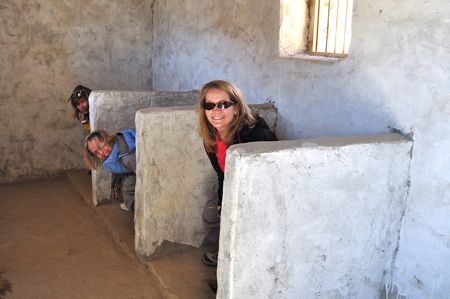
We did stop for a bathroom break at the lake. The bathroom was interesting, but we have seen it all traveling in China. Bathrooms do become a photo opportunity when traveling in China. In fact, this “more nature” bathroom with holes to the dirt smelled much better than the China tile bathrooms.
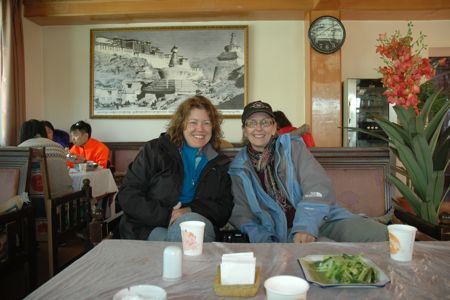
We stopped for lunch at a local place in one of the small villages. It was basic and cheap. We had contribute money to our “food Kitty” which we put Jennifer in charge. We all put in money to cover food at about 300rmb ($50) a day, per person. At this point, we were spending about 300rmb for all meals for all four ladies! Lunch was cheap, of course. We haven’t had many vegetables on this trip as the Tibetan people like their meat. The only vegetable was bok choi, not one of my favorites.
Back on the road to climb to the glacier. Judy and I had taken the back seat in our old van transportation. At one point, we turned onto a dirt road. Judy and I just looked at each other and laughed. It was already a very bumping ride in the back seat – we were hanging on during this pass. Luckily, it was a short dirt road pass.
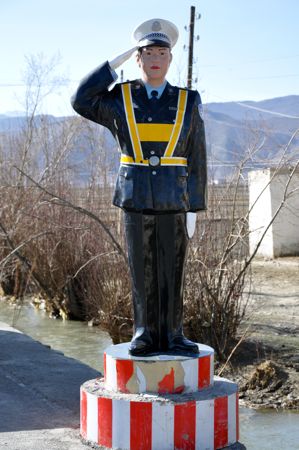
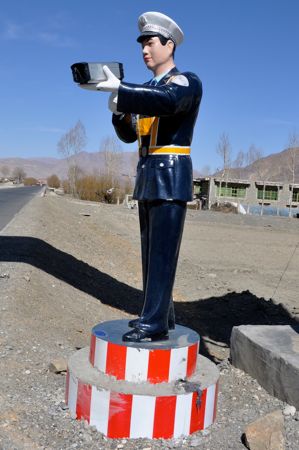
As we hit the “back roads” of Tibet, we began to see the police statues along the road. Peter Hessler has a book, “Country Driving”. He mentions the police statues. We began taking photos of the ALL different police as we drove. Dukar wasn’t very happy to pull over for our photos.
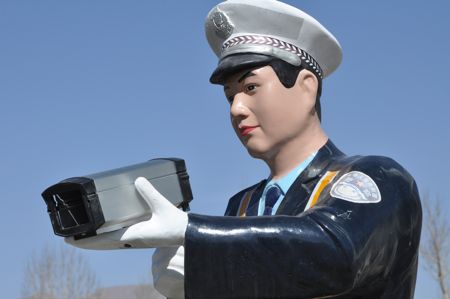
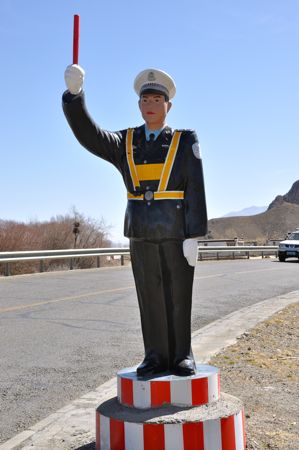
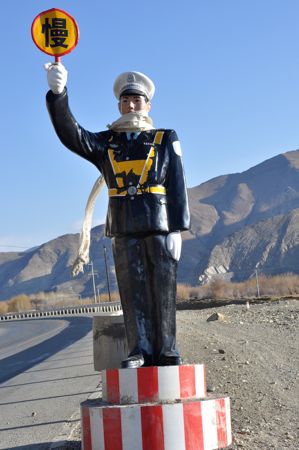
We continued the drive to Kharola Glacier at 5, 560 meters (18, 241 ft).
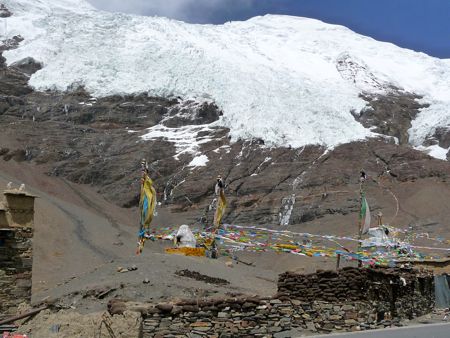
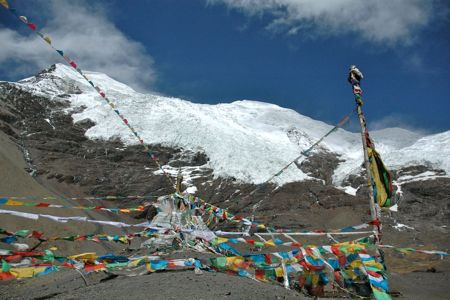
At the Glacier, we walked around to take photos. As we were working our way towards the snow, Jennifer stepped on the prayer flags. She got the look from our guide – no stepping on the flags. At this point, we are all joking about how many faux pas we have done on this trip. Jennifer seems to lead the forbidden act so we learn from her mistakes. Other faux pas we have done are pointing at the Buddha, stepping ON the door stump (you need to step OVER) and only the first person rings the bell near the door.
A small one-room hut is located near the Kharola Glacier. As many Tibet people are nomadic, a young women and her son were living in the hut. Life is very different for them.
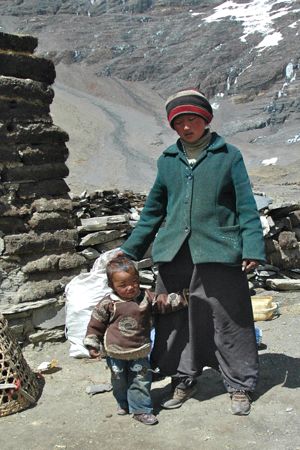
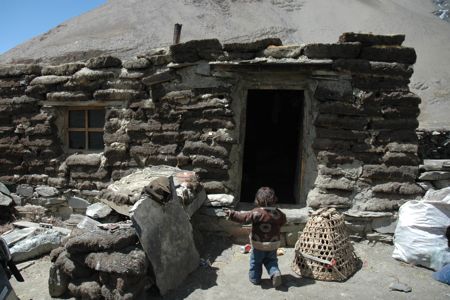
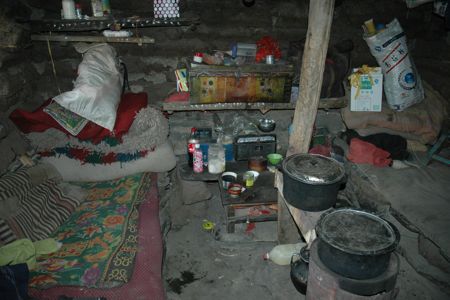
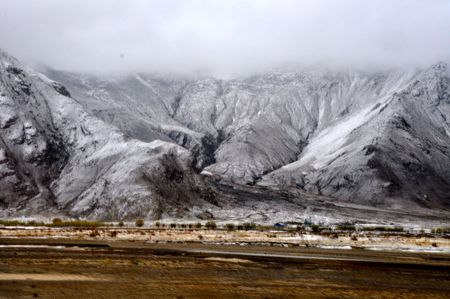
The view coming down from the Glacier.
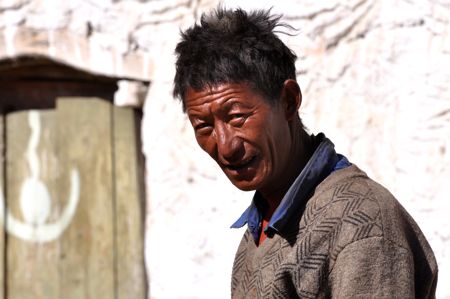
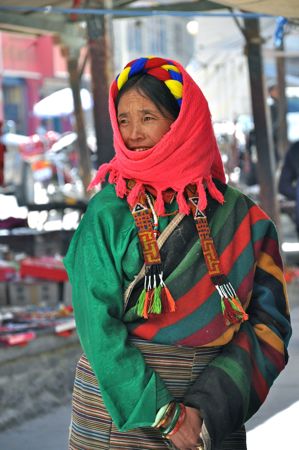
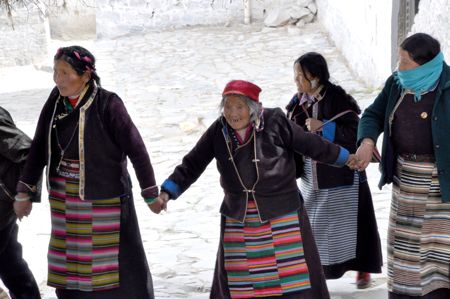
The people of the countryside.
The next stop was the town of Gyangtse. We were staying in the BEST hotel in town. Ok, this is the worst hotel I have stayed in during all my China travels. Thankfully, it is only one night. It is also cold in Gyangtse and we have no heat in our room – it may be a long night! However, in contrast to the small hut above, I am thankful for all the blessings in my life and an opportunity to travel to countries like Tibet. It is good for the soul to have a “reality check” in life.
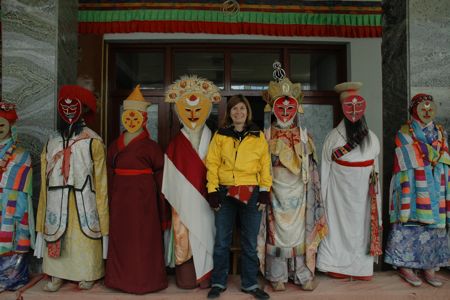
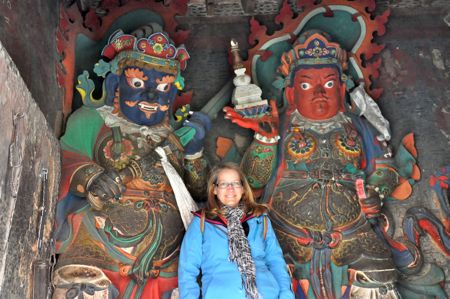
A fun photo in the hotel lobby with these traditional dressed “people” with Mary in the middle!
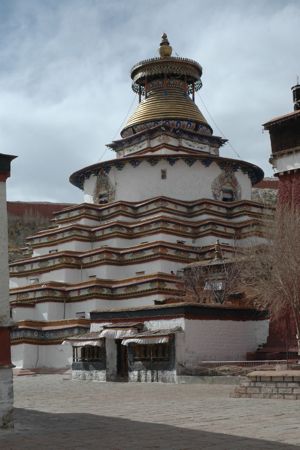
After checking into our “lovely” hotel room, we were off to tour the Palkhor Chode Monastery. Judy had decided to stay behind. She had too much bok cho at lunch…she was feeling the need to stay close to a bathroom.
Kumbum is a spectacular stupa temple, whose name means “Place of 100 Thousand Images”, was the centerpiece of Palkhor Chode Monastery and the pride of Gyantse. The great pagoda is consisted of 9 tiers, over 32m, has more than 77 chapels and shrines. It is considered one of the most stunning architectural wonder in Tibet.
Our guide took us to his favorite place for dinner. This was the first time dinner was not family style. I had the yak sizzler for dinner – it was bit disappointing, but ok.
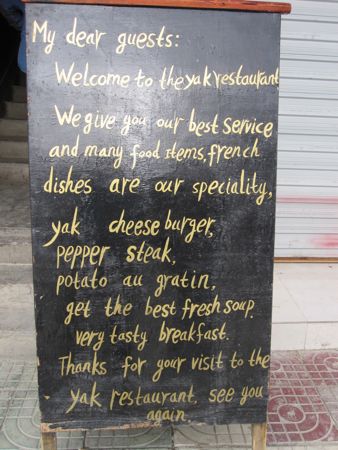
Our guide, who is not earning any brownie points with me, left us at the restaurant because we were taking too long. He said it was a short walk back. I was on the phone with Jim when we drove to the restaurant and everyone who knows me knows I have no sense of direction. I am the last person you want to be lost with – good thing our family has Jim to save us. As we were walking back, I thought we needed to walk one block and turn right, but I wasn’t paying attention since I was on the phone. Well, we were lost walking the short distance to the hotel. It was cold and we didn’t have gloves or hats to keep us warm. Surprising, I was right and we found our way home. After our long walk in the cold, we returned to our cold rooms.
Jennifer and I climbed into our “carpet beds” for our nights rest needed after a long drive. Around midnight, I had yak sizzler revenge – a good case of yak food poising. I was up every half hour visiting the bathroom. The bottle water at room temperature tasted as if it came out of the fridge. It was a long night. I would spend 15 minutes shivery after every bathroom run until I warmed up. The temperature in Gyantse this day ranged from a high of 11c (51f) to a low of -6c (21f) at night. The explains the long, cold night.
Day 5 – April 7: Gyangtse to Shigatse
After a very long night, I skipped breakfast and the morning tour of town. When we piled back into the van for our drive to Shigatse, Jennifer said if I was too sick we could stay another night. My reply was a big NO, I was just fine for a drive as the next hotel had to be better or least hoping it would be. This was the worst food sickness I have had in China.
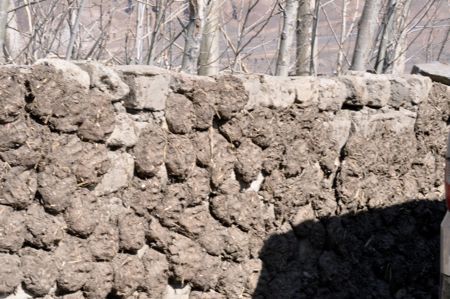
We stopped at a local home on the way to Shigatse. I stayed in the van as I was in no shape to “tour”. As I sat in the van, I noticed all the dug on the walls drying with the hand prints. I asked the ladies to take a photo when they got back to the van.
We arrived in Shigatse and check into our room around 1pm. Oh, it was so much nicer and there was heat! The tour today was at the Tashi Lunpo Monastery and shopping in town. I stayed in the heated room to sleep as I was up all night. I skipped dinner and saw nothing of the town of Shigatse. But, I felt so much better the next day.
Day 6 – April 8: Drive to Lhasa
Our guide likes to begin the day at 9am. We said no, we want to get back to Lhasa for a final shop. We left at 7:30am. We voted no on stopping for lunch at the same place Judy got sick. We were on the same road back to Lhasa. We were hoping to take a faster highway, but it was closed. To pass time, Judy was reading to us from my Lonely Planet guide book. I had a Lonely Planet tour book purchased in Hong Kong, 5th edition. Our guide, Dukar, had an older Lonely Planet book he kept hidden by covering the cover. The older version has a letter from the 14th Dalai Lama. This book is forbidden in Tibet. As Judy was reading to us, this book does not sugar coat the Tibet uprising and the Chinese “takeover” of Tibet. There is so much interesting information in this Lonely Planet tour book. It was a nice way to spend the long drive. All of the information was more relevant as we were here seeing it and could relate to it all. Judy read to us from the book about the “kora”. The pilgrimage circuit around the Barkhor Square. It read…”let yourself be dragged by the centrifugal force of the pilgrims”. We all agreed with the centrifugal force. We also talked about the hardship the Tibetan people have faced. Through this hardship, the people are always smiling. It became our new motto of the trip, “keep smiling”.
We arrived back into Lhasa around 2pm. We checked back into the same hotel, dropped our bags and went for our final shop in the old town of Barkhor. We joined the “centrifugal force” and walked the square with the Tibetan people.
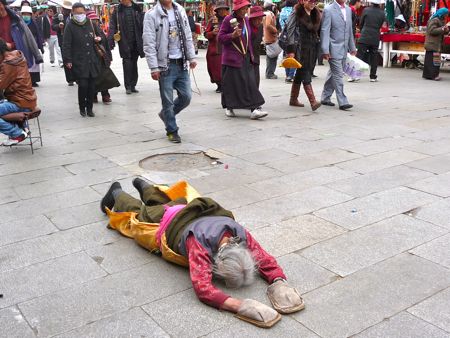
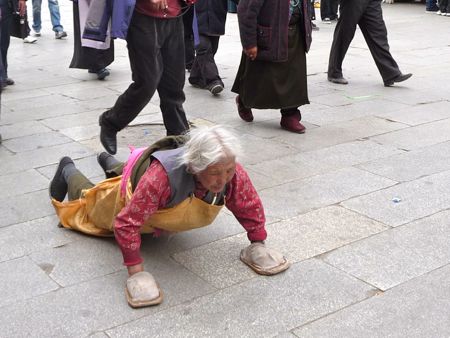
This women was postulating around the entire Barkhor Square – one kilometer, over half a mile. She has a cover to protect her clothes from the dust. She is wearing knee pads and hand guards. She starts standing, down to her knees to a flat body position on the ground and back to standing…all the way around the Square. And, as you can see, she is not young! I am sure if us four ladies gave it a go, we wouldn’t make it very far.
We had dinner at the cafe around the corner (name ??). It was a more “western” restaurant with cute decor. The food was very good and we were all in the need of some good food after our road trip food adventure. We enjoy the time to sit and visit before going back to the room to pack for our travel to Nepal.
Day 7 – April 9: Travel to Katmandu and Sites of the City
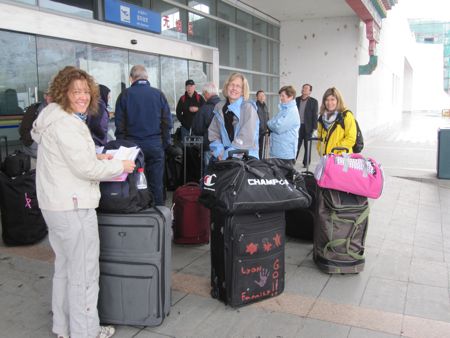
We arrived at the airport before the doors opened. We were leaving Tibet to fly to Kathmandu, Nepal.
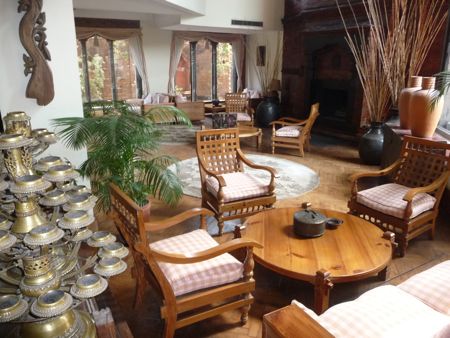
We arrived in Katmandu which was a big contrast from Tibet. Katmandu had the feel of “India light”. Our guide, Arjun, picked us up at the airport to take us to our hotel. We “splurged” for the nicer hotel in town, the Dwarika Hotel. We walked off the streets into our calm, peaceful hotel. It felt like walking out of India into Bali – well worth the splurge. The splurge was $280 per night which equaled $140 per person, per night.
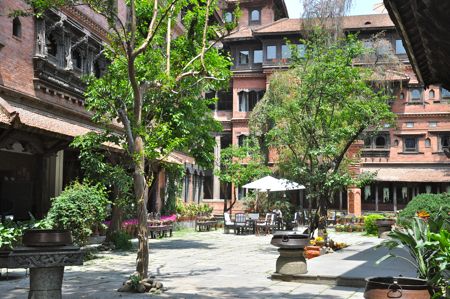
The hotel had beautiful gardens located in various courtyards. We sat in the court yard enjoying a long, delicious meal. Our guide, Arjun, was on a time table and very politely trying to get us to hurry…but, we were enjoying the courtyard too much.
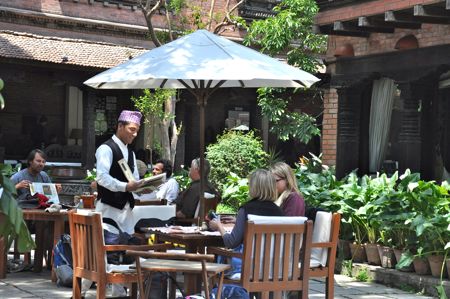
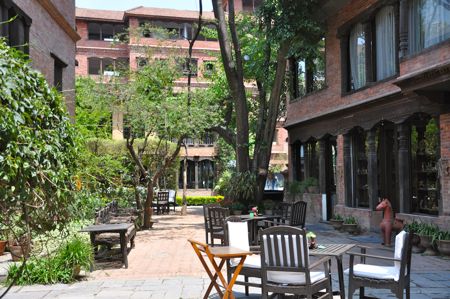
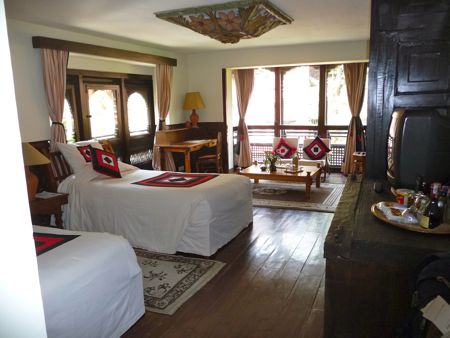
Jennifer and I continue to be room mates. She is a bit annoying – she gets ready in 10 minutes. Out of the shower and ready to go with that curly hair that always looks good. It does work in my favor in that I get more bathroom time. Really, she is a great room mate!
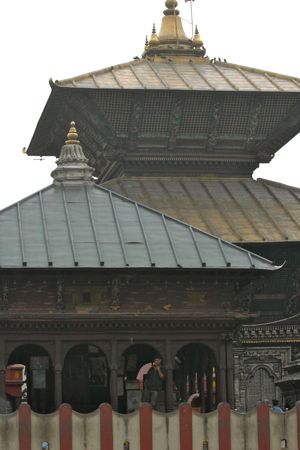
Our first stop in Kathmandu for the day was the Pashupatinath Temple.
The Pashupatinath (Pashu = all living beings, pati = master and God) temple is the largest Hindu temple of Lord Shiva (Pashupati) in the world and regarded as the most sacred. The temple area is filled with hundreds of ancient lingam, shrines, icons and statues to the different Hindu Gods. Non-believers are not allowed in the temples.
Since we couldn’t get close to the temple, this is the best photo of this sacred temple.
Near the Temple, the devout Hindu monks, the Sadhu live.
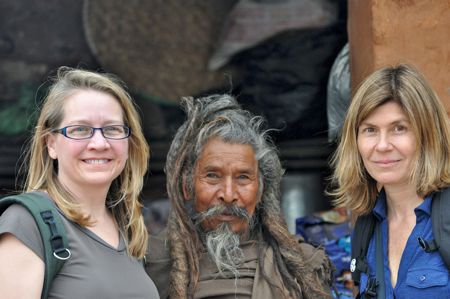
The Indian monks known as Sadhu, uncut their hairs with their religious beliefs and the dreadlocks of the hair is very “sacredâ€. It symbolizes spiritual understanding and matted hair is a symbol of “control of powerâ€.
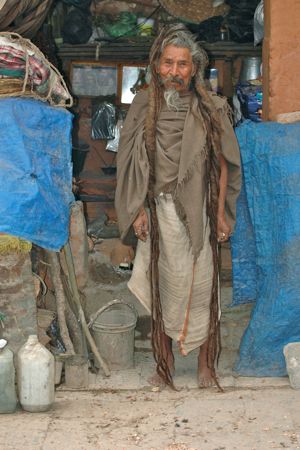
The man below is known for having the longest hair among the Sadhu people living near the temple. We didn’t want to get too close! Of course, our worry of lice was probably not an issue since lice like clean hair.
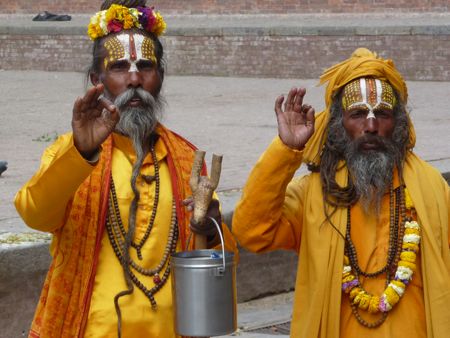
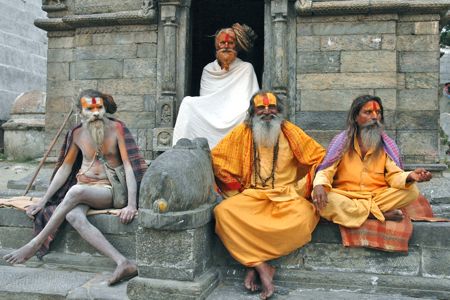
The Sadhu believers with traditional colors and face paint meditate near the Temple.
The sÄdhu is solely dedicated to achieving moká¹£a (liberation), the fourth and final aÅ›rama (stage of life), through meditation and contemplation of brahman. SÄdhus often wear ochre-colored clothing, symbolizing their sanyÄsa (renunciation).
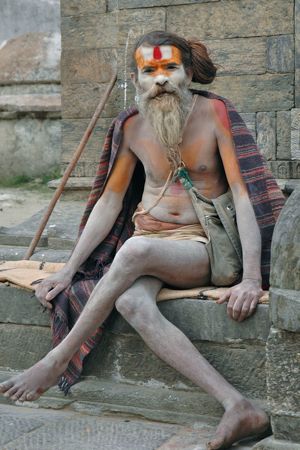
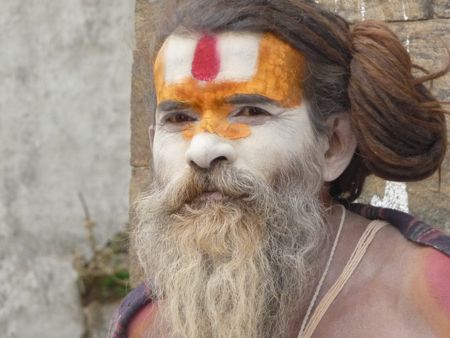
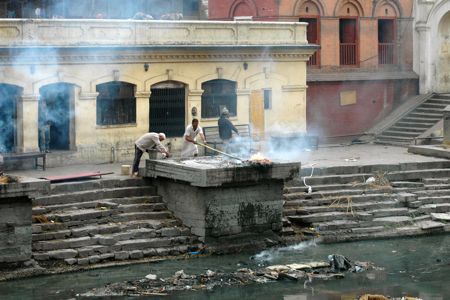
We walked down to the Bagmati River which is considered to be a holy river. This is the place where cremation of bodies and Hindu rituals of the dead are performed on the bank of the river. Once the body has been ceremonial burn, the ashes are then dumped in the river.
Pashupatinath is Nepal’s most renowned Hindu cremation site. In Hindu culture, after the person is dead, the dead body is wrapped in cloth and placed on bamboo litter and bodies are delievered by barefoot pallbearers accompanied by the male relatives. The eldest son from the family performs the cremation ceremony and the dead body is burnt. A few hours later the ashes are collected and swept in the river which will join the Holy Ganges eventually.
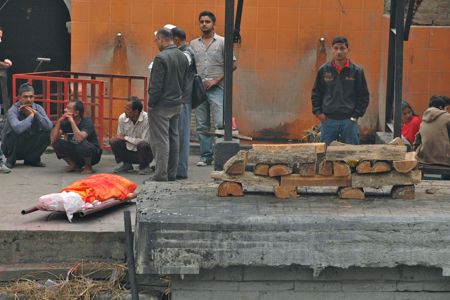
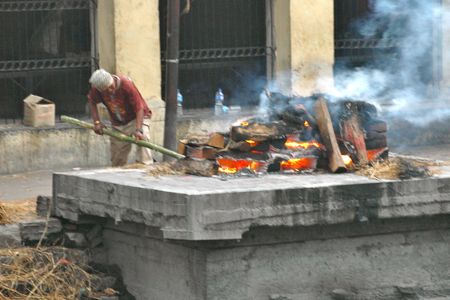
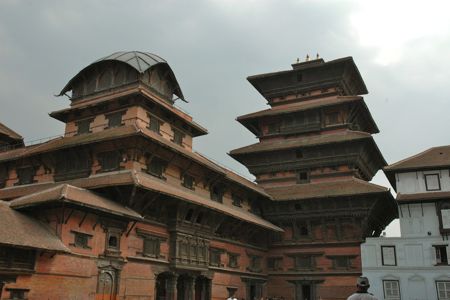
Kathmandu Durbar Square is one of the important historic destinations in Nepal. This massive complex is home to palaces, temples and courtyards. The original center of Kathmandu is often named as Basantapur, Hanuman Dhoka or Durbar Square all denoting the same location. Kathmandu Durbar square has various historical royal and governmental institutions mixed with temples of different styles and ages.
We walked around Durbar Square. There are many temples and people in the square. Arjun had said it is common for the square to be crowded daily.
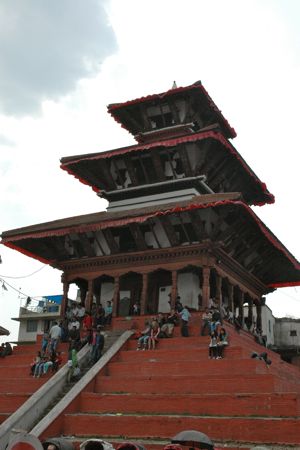
The Manju Deval is a triple story temple dedicated to the god Shiva and was constructed in 1692.
All the buildings and temples have beautiful cravings on the doors, jams, windows and roof braces.
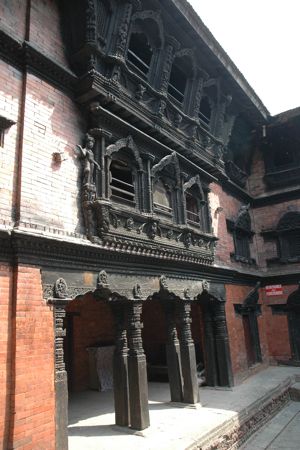
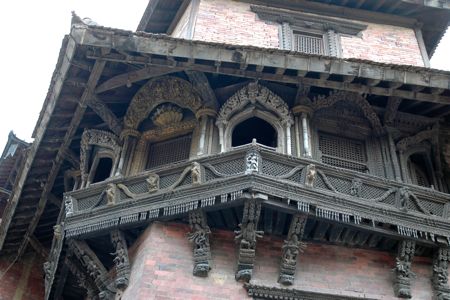
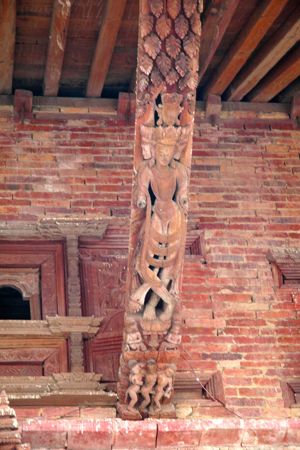
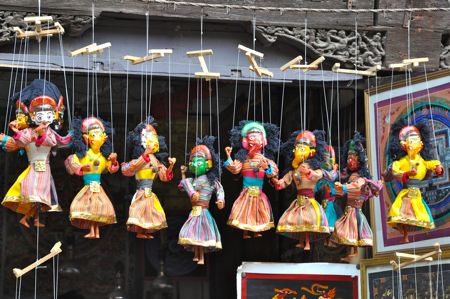
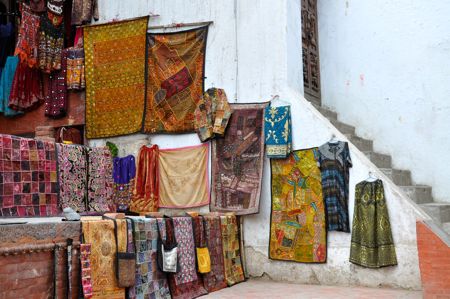
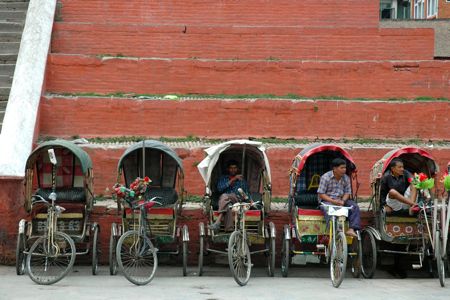
The various scenes around the Square.
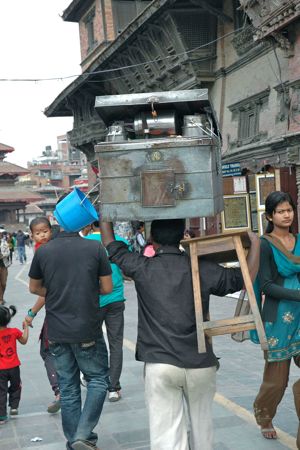
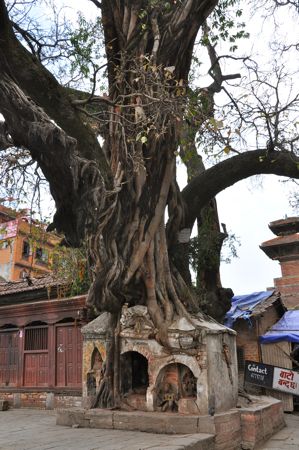
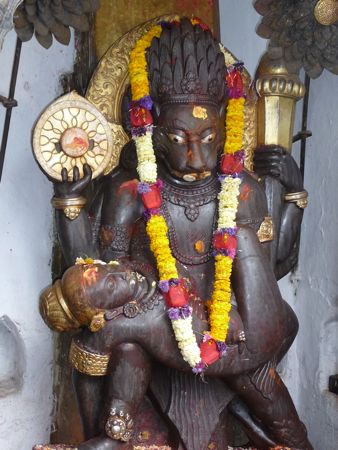
One of the main attraction of Durbar Square is Hanuman Dhoka Palace Complex. The striking palace was named in honor of the monkey god, Hanuman, and a statue of the unusual deity stands at the main entranceway. In 1672, during Pratapa Malla’s reign, an image of Hanuman was placed in front of the portal to keep away evil spirits and disease. The figure still looks threatening though centuries of anointing with mustard oil and cinnebar (vermilion) have eroded its features.
Good thing I took a photo of the monkey. I only took the photo because Arjun took the time to point out the statue as if it was important. It looked just as ugly up close!
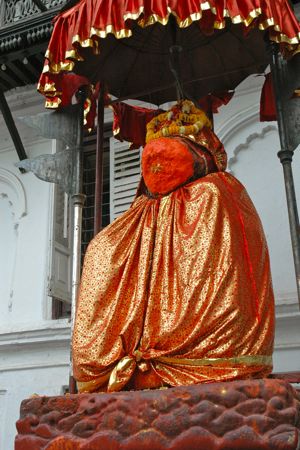
An entrance gate to Hanuman Dhoka Palace.
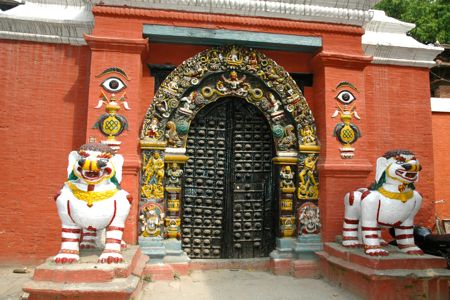
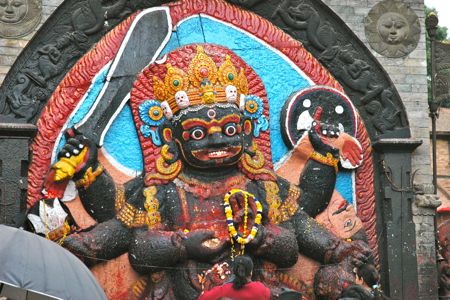
Kala Bhairav is a massive stone statue of Shiva in his frightening aspect.
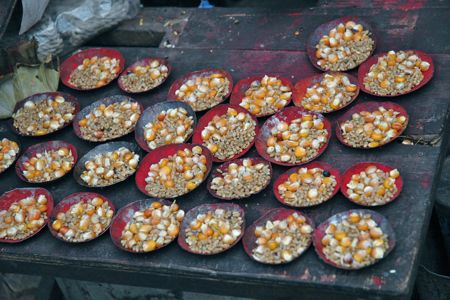
Offerings being sold to offer to Kala Bhairav.
At the southern end of the Durbar Square there is the Kumari Chowk. The Kumari House, where the Living Goddess of Nepal resides. The living Goddess, Kumari, is a young girl who is chosen from the Shakya community through an ancient and mystical selection process to become the human incarnation of Hindu Goddess, Taleju.
We left Durbar Square to drive to the Boudhanath Stupa, the oldest and biggest Buddhist monuments of Nepal.
Boudhanath Stupa is Nepal’s most distinctive monuments. Simple, massive and powerful, it rises above the number of buildings, the painted eyes gazing solemnly over the countryside. Stupas are essential to Buddhism as the cross is to Christianity, a tangible symbol of the Buddha’s enlightened mind.
With a diameter exceeding 100 meters (328 ft) and a wall-to-wall length roughly equaling a football field, Boudha is among the largest stupa in the world – certainly the biggest in Nepal. The monument rises 36 meters (118 ft) above the street. The form and the alternated squares and circles represents a three-dimensional mandala, which is comprised of abstract religious concepts. Every portion has symbolic significance: the base, dome, square harmika, spire, and pinnacle represent the five elements; the 13 tiers of the spire stand for the stages to enlightment, while the umbrella atop is the symbol of royalty.
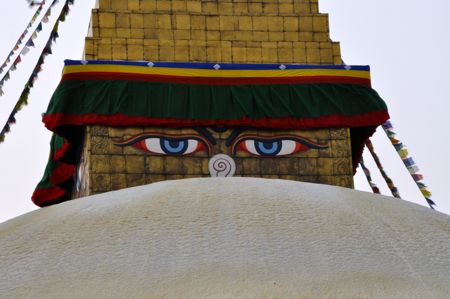
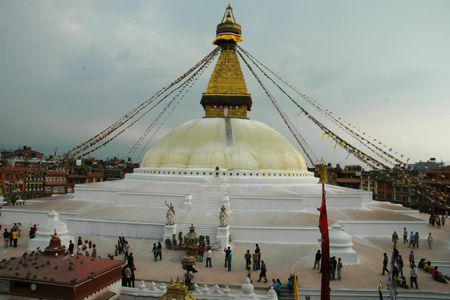
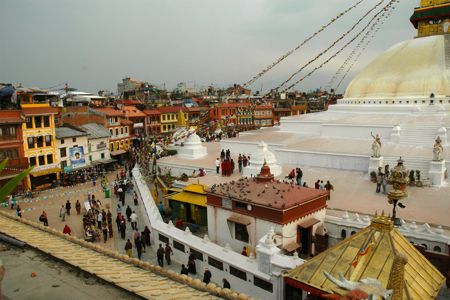
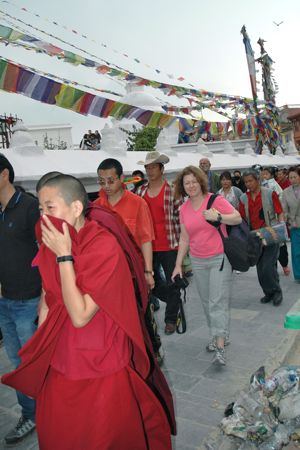
Many people walk around the stupa in the pilgrimage circuit of the “kora”.
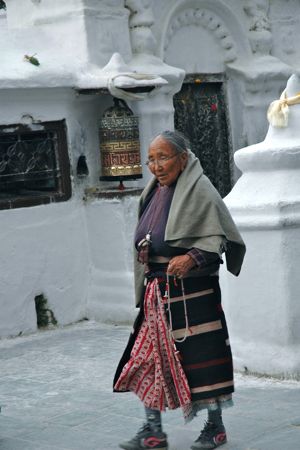
We joined the people to be “dragged by the centrifugal force of the pilgrims”.
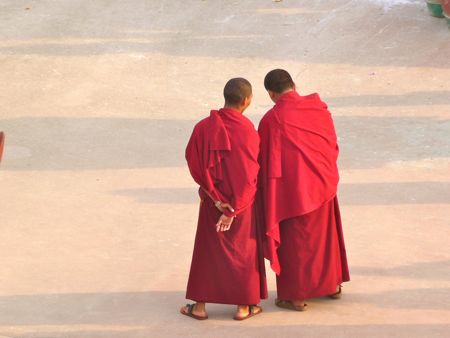
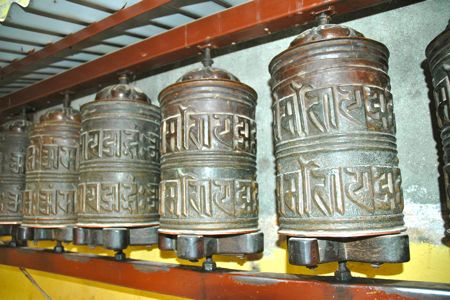
Prayer wheels along the stupa wall.
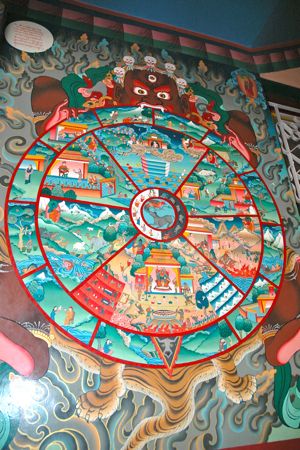
Here at the Boudhanath Stupda, we shopped for thankas. Thankas referring to any banners hanging in temple Monastery and family shines. This painting on the wall represents the “the wheel of Life”.
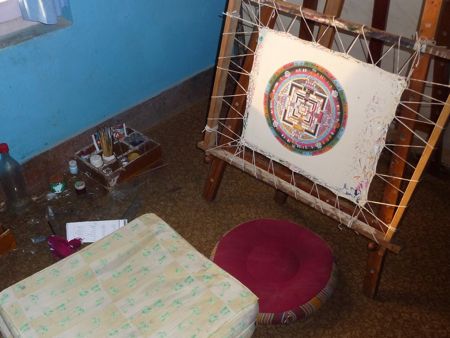
Another famous tankas is mandalas. I purchased a kalachakra mandala similar to the one below. It takes many years to learn the talent to paint a mandala. When purchasing a mandala, the price is based on experience of the artist. You can see the difference in the work.
We went back to the hotel for another delicious meal. Of course, these meals are costing us more than we spent the WHOLE time we were in Lhasa.
Day 8 – April 10: Everest Flight & Temples of Katmandu
Jennifer, Judy and I are paying the big bucks for the flight over Everest. The cost for the flight is $160 for one hour. We are here and this is one way to see the famous mountain range. We were being picked-up at 6am for our flight. We arrive at the airport to a long line to get through security to get in the front door. Everything had to be scanned to entry the airport. Many young people have packs for trekking in the Neal countryside. We ask if this is the line we must go through for our flight – yes. When we finally got through security, we collect a number/ticket for the flight time. We just missed the first flight of the day because there were three people in our party and only two seats left. We were on the next flight. We went to the waiting area to listen for our number. Our number is called and we board the bus. We sit and sit and sit on the bus. Three other buses fill up with people and leave. Finally, the last people board the bus – with evil stares from us sitting and waiting. Apparently, we had to wait for them since they had a ticket for this flight. They must have grabbed breakfast or something after getting their number.
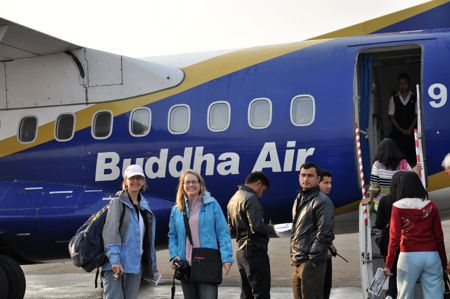
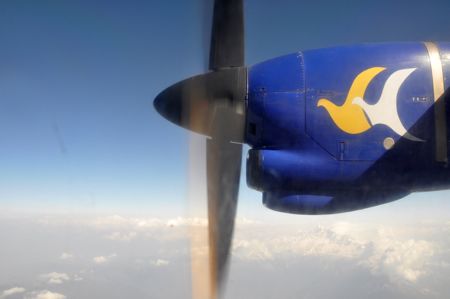
The seat assignments are handed based on when you pick up your ticket. We just missed the last flight, so we were in rows 1 and 2. There are 4 seats per row, 2 seats per side. However, only the window seat is assigned. Therefore, Jennifer and I were in row 1 on both sides of the plane. Judy was behind me in row 2. By chance or bad luck, we received the worst seats on the plane. The propeller is right out our window. The people we waited for 45 minutes have the best seats in the back of the plane. We joked about who had the bad karma!
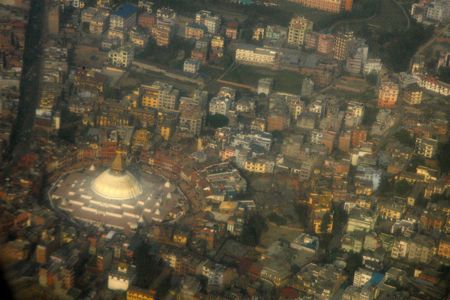
As we left the airport, we could see the Boudhanath Stupa. An interesting photo from above.
The mountain range consists of many peaks. In total, there are eight mountains which have the height more than 8km (26, 300 ft). They are as follows:
Mt. Everest – 8, 848
Mt. Kanchenjunga – 8, 586
Mt. Lhotse – 8, 516
Mt. Makalu – 8, 463
Mt. Choyyou – 8, 201
Mt. Dhaulagiri – 8, 167
Mt. Manasalu – 8, 163
Mt. Annapurna – 8, 091
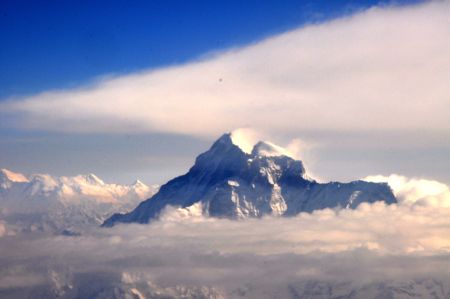
The mountain ranges were beautiful to see, even with our bad seats.
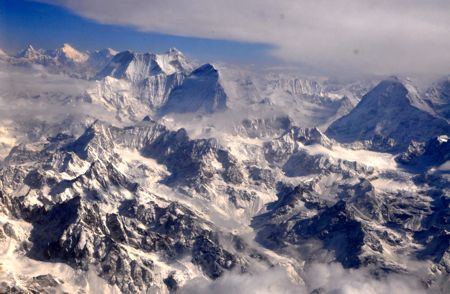
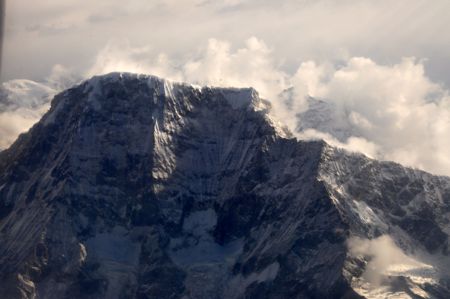
The weather changes fast in the mountains. The sun came out and with in minutes the fog rolled in and the peak was lost in the fog.
Upon returning to the hotel, we grabbed a quick breakfast. This hotel has a great breakfast – a first on this trip as we have been joking about the toast and coffee breakfasts.
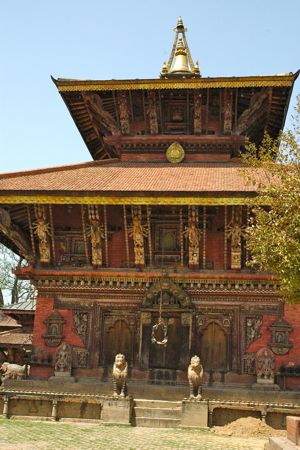
Arjun picked us up after breakfast. Arjun is very nice. He has knowledge and is willing to answer any questions. He is what a tour guide should be unlike our Tibetan tour guide, Dukar. He does try to keep us on a schedule. Our first stop of the day is the temple of Changunarayan. It is thought to be the oldest in the Kathmandu Valley.
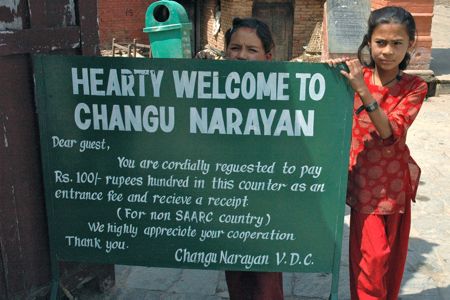
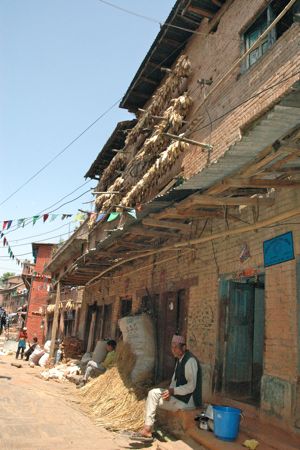
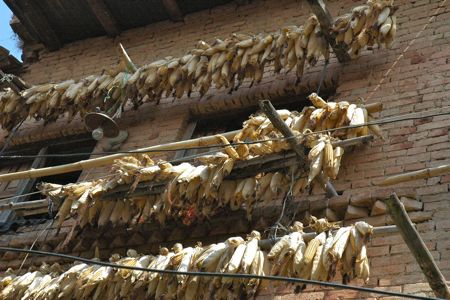
We walked through the local village. This village was located 22 km outside Kathmandu in the countryside.
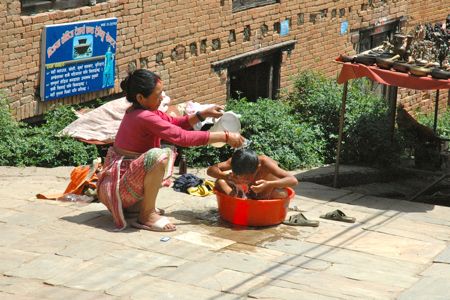
The villagers queue their water containers waiting for the water supply to fill the family’s water needs for the day.
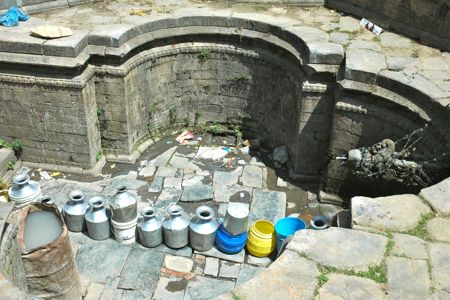
I think our children have no room to complain when we ask them to go take a bath!
At the top, is the temple of Changunarayan.
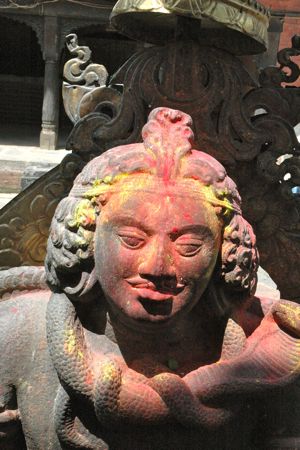
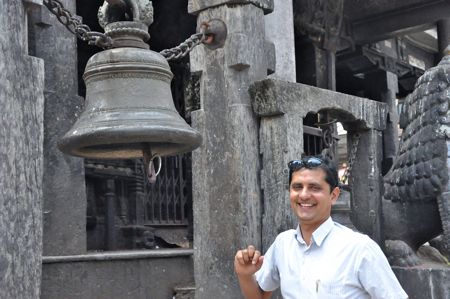
We drove down the mountain to Bhaktapur, an ancient town with approximately half million people. The city is dominated by Newar people, the dominant ethnic group of the Kathmandu Valley. We spent the afternoon touring around Bhaktapur Dubar Square. The literal meaning of Durbar Square is a place of palaces.
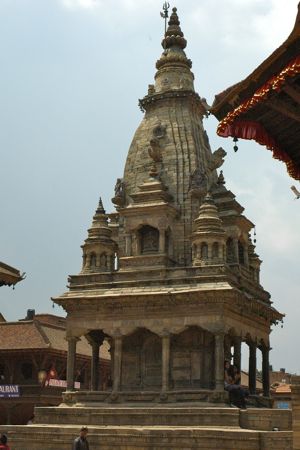
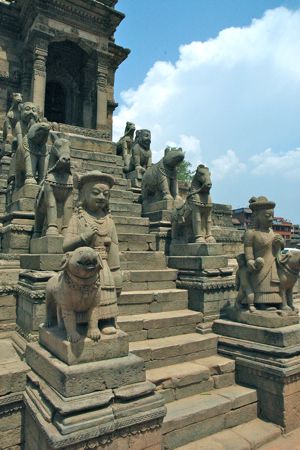
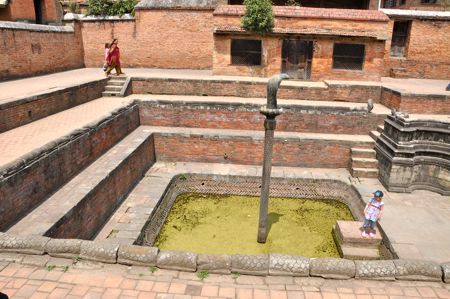
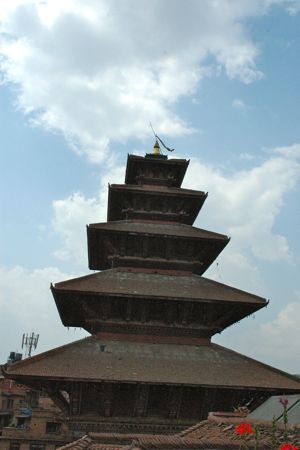
The Bhairav Temple is a five story Nyatapole temple. It is the tallest temple in Nepal.
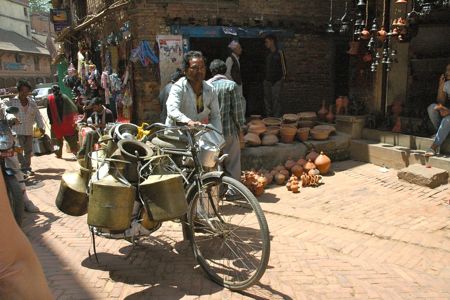
Bhaktapur is known for the handicraft of pottery. There were many pottery makers in the Square. The pottery was drying in the sun.
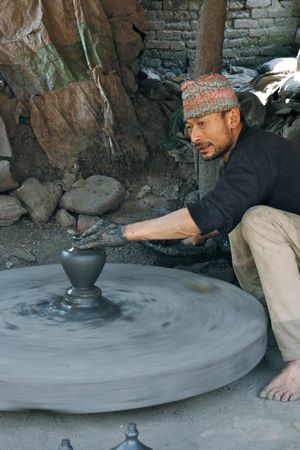
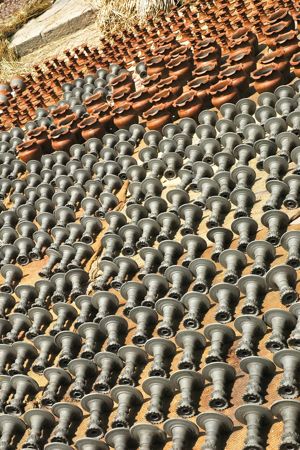
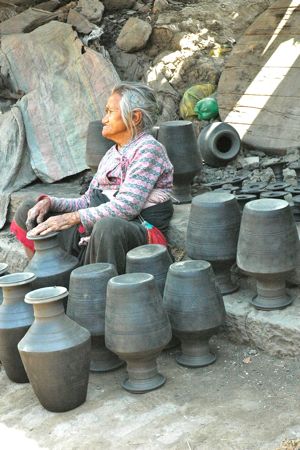
The people around the square.
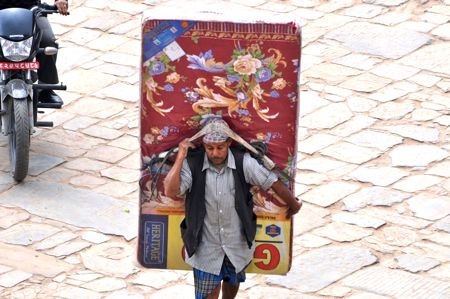
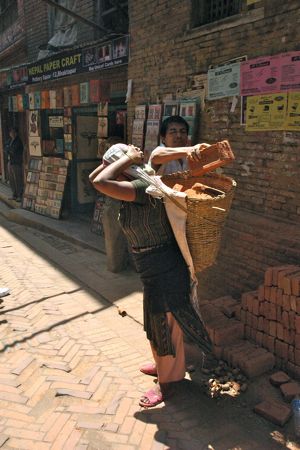
Usually on our home improvement projects, I am the brick mover of the individual bricks and Jim is the mover of the load. I guess I can’t complain about moving bricks anymore!
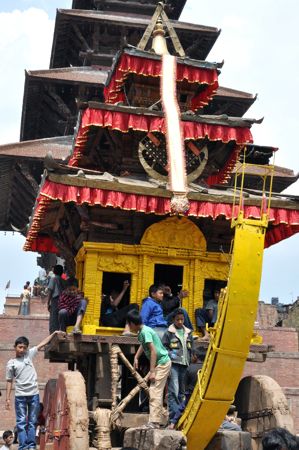
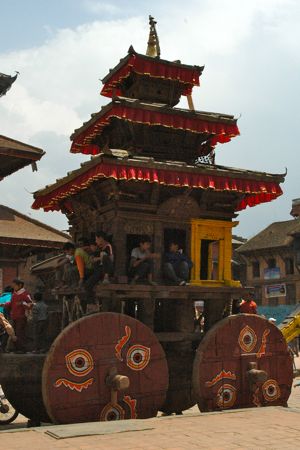
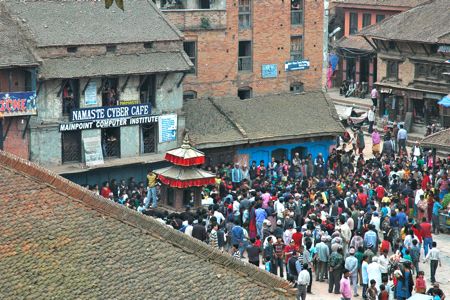
The City was getting ready for a festival in the Square. The children seemed excited about the activities of the day.
Arjun took us to a roof-top lunch spot. We could watch the action below while enjoying a cold drink and some good food. It was a beautiful day to enjoy the roof top dining.
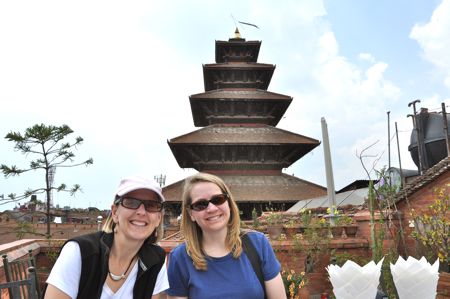
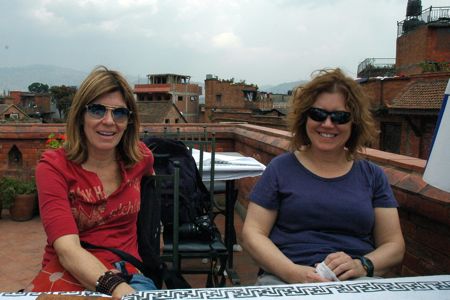
We had to leave the sunshine roof for our next temple on our agenda. We four ladies are similar to herding cats!! Notice we have not done any shopping – it is not on the agenda!
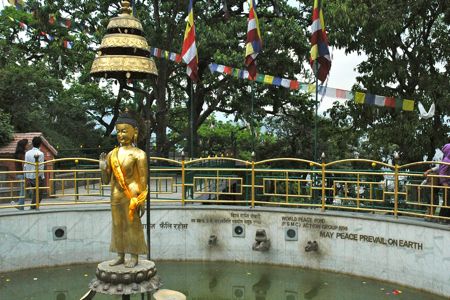
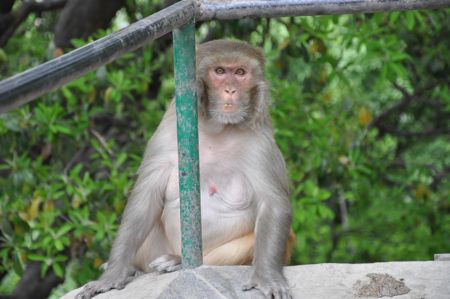
Swayambhunath Stupa is one of the most oldest Shrine in Nepal. The monument is believed to be self created and the history of the monument backs to the 5th Century. It is also known as the Monkey temple as there are holy monkeys living in parts of the temple in the north-west.
At the enterance is this fountain. It reads, “May peace prevail on Earth”.
The sacred monkeys roam around the temple. People help to take care of the monkeys since they are sacred.
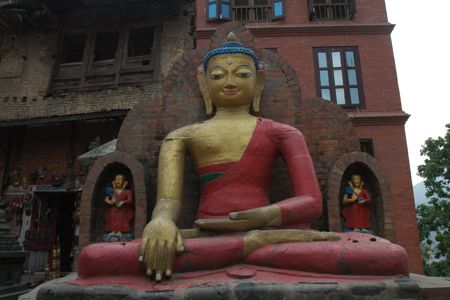
The square is filled with many different temples and stupas.
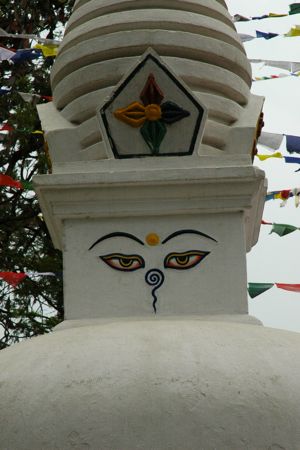
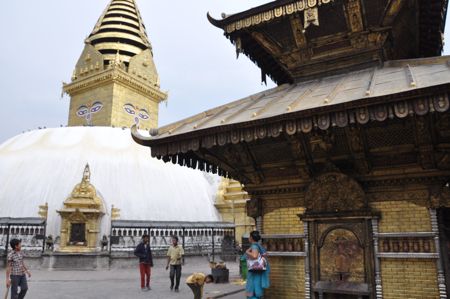
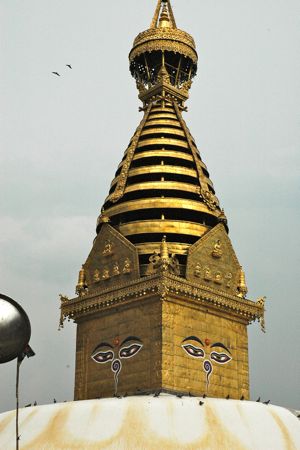
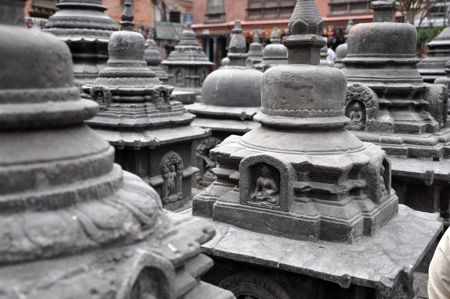
Many prayer flags are strung between the temples.
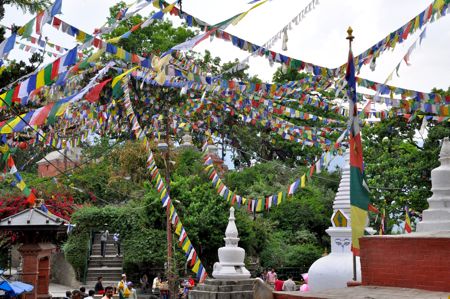
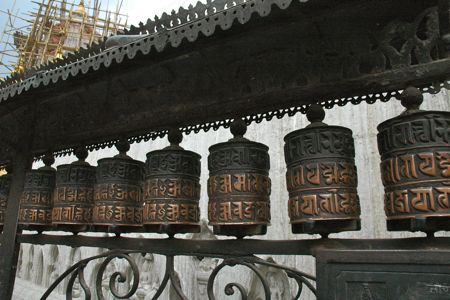
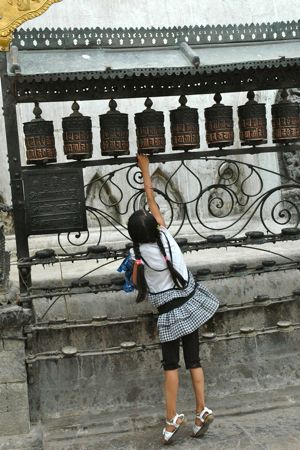
Prayer wheels are found throughout the Square.
This reminds me of Eleri trying very hard to reach.
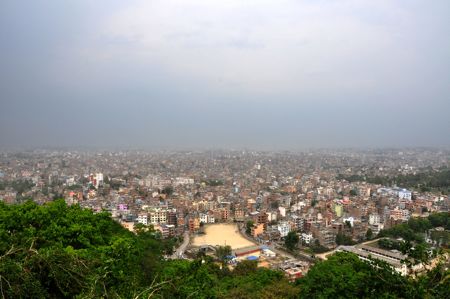
The view over the City. It wasn’t a clear, blue sky day, but still a nice view of the Kathmandu City.
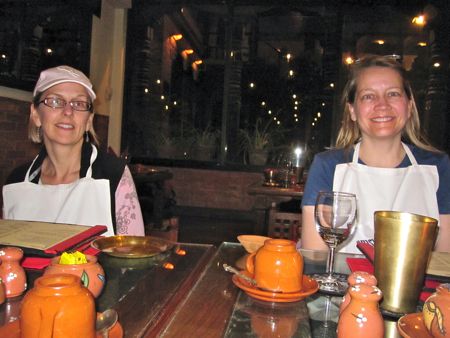
We drove back to the Dwarika Hotel for dinner at the Krishnarpan restaurant. Located across the courtyard, we enjoyed a long dinner with good Nepalese food.
Day 9 – April 11: Traditions of Katmandu
First on the agenda was a drive 26 kilometers out of town to the Dakshinkali Temple. On Tuesday and Saturday, local people bring animals to offer the blood to the Goddess. Words or photos can not describe the offering of the animals and the chaos of people.
Dakshinkali Temple is one of the most famous and popular Hindu shrine dedicated to Goddess Kali, “The Black One”. Dakshinkali temple is of great importance among those who need her blessing and also among the blessed ones. There is a strong believe in the ability of goddess to make wishes come true.
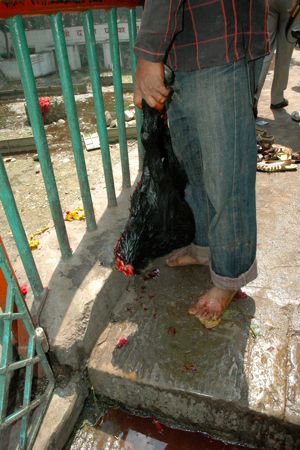
Saturdays in Dakshinkali are like cheerful temple fair, with crowds of worshippers dressed in their best clothes, tea stalls doing good business and people dragging goats and chickens for the sacrifice to the Goddess.
Temple is loacted down the flight of steps open to the sky and is decorated with the canopy of gilded snakes. The black stone image of Kali shows her squatting on a corpse, symbolizing victory over time. She holds other terrifying emblems such as skull cup, a severed head, and a sword. Along the sides are enshrined images of Ganesh, the Ashta Matrika, and a plain stone Bhairab.
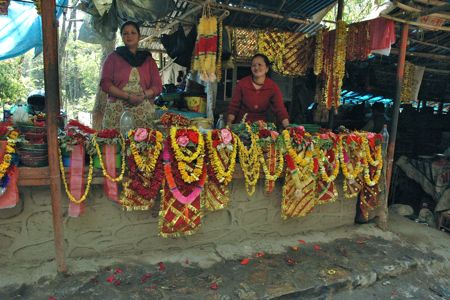
We arrived along with bus loads of people to the temple. As you walk towards the temple, the road is filled with people selling flowers, chickens and other items for the offerings.
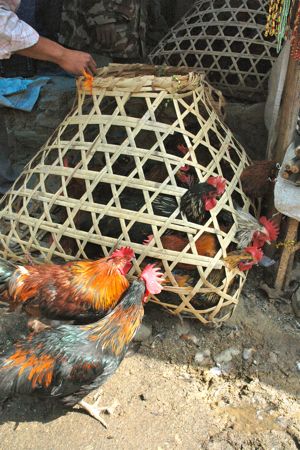
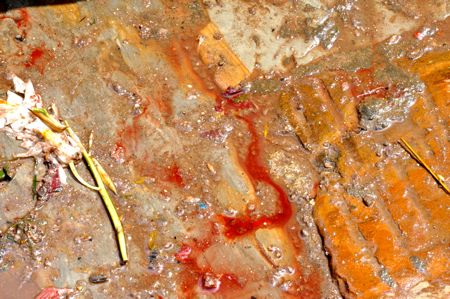
Once you cross the bridge over the river which is flowing with blood, you come upon the offering site. People hand over the animal to offered with prayer. The animal is given back to the people to take home for dinner. The meat is not wasted as blood is the mere offering.
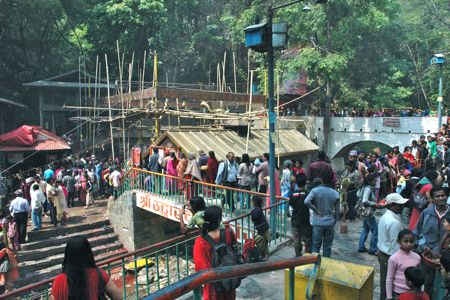
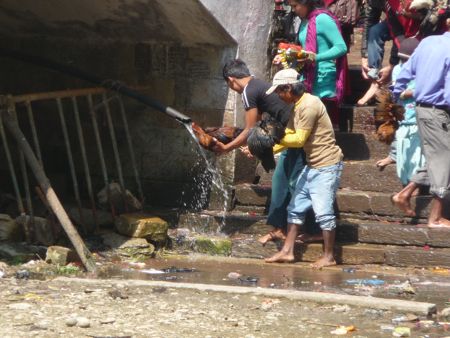
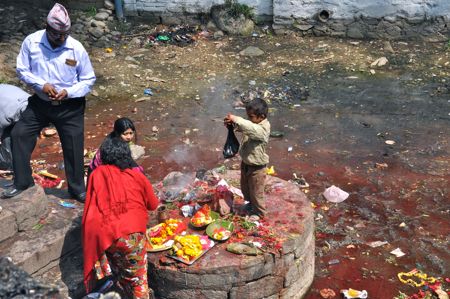
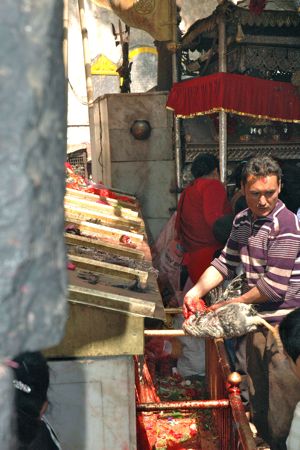
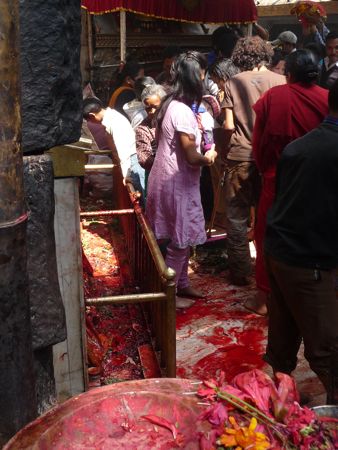
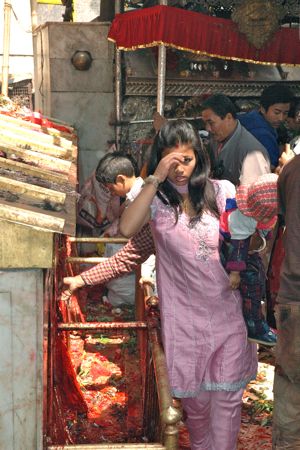
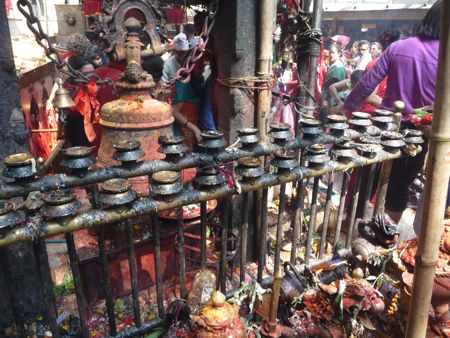
The temple is full with people. There is blood running all over the ground and sidewalks. Most people have no shoes. We thought maybe the people believed the feet can be easily washed while a good pair of shoes can not. We tried to step carefully. We all washed our shoes at the end of the day.
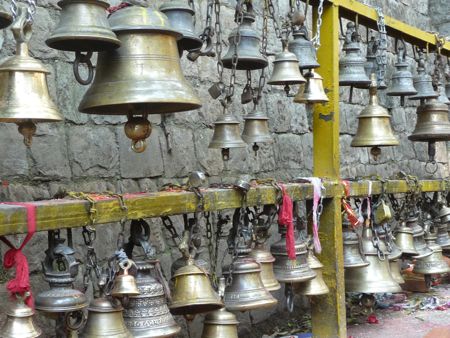
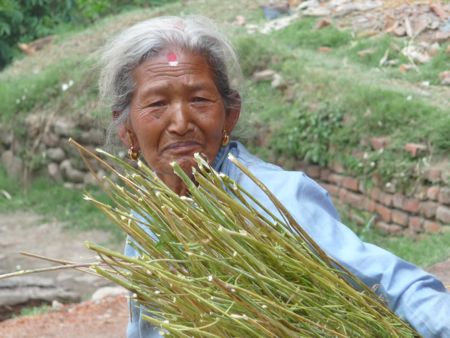
We left the Dakshinkali Temple to drive to a local village. Arjun has had the ladies on ‘the tour” of Kathmandu. We were joking with Arjun that our husbands must have called and told him to NOT take us near any shopping. We told Arjun we needed some shopping time. We had two villages on our agenda, but due to the ladies needing some shopping time, we would only visit one village. We went to Bungamati Village. When we arrived, Arjun pointed out the plants growing wild along the side of the road. The ladies had fun with this photo op.
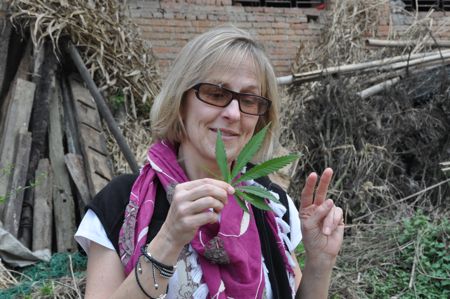
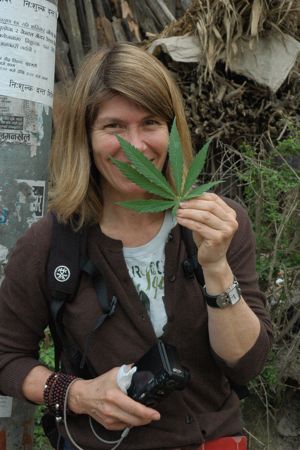
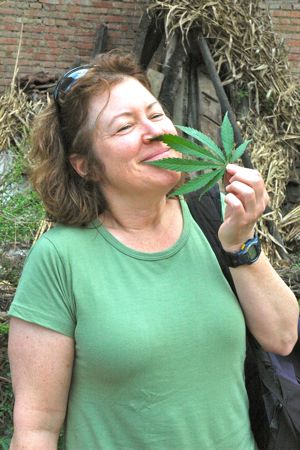
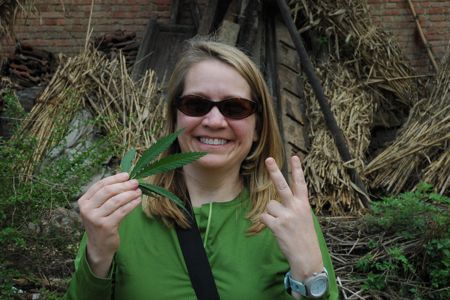
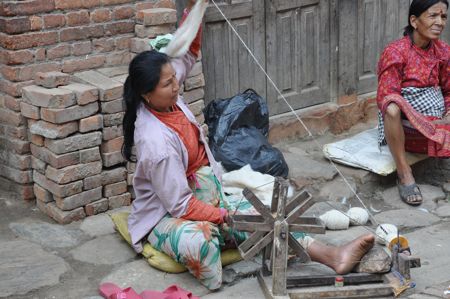
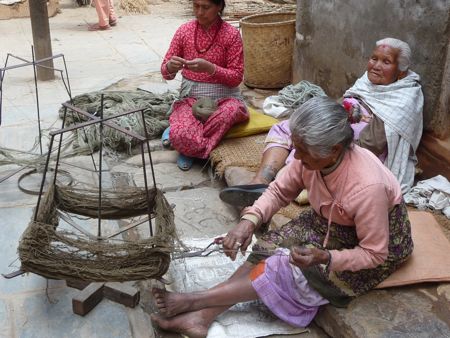
We walked the village to see village life. There were many villagers out working in the sun. All the people were friendly and full of smiles.
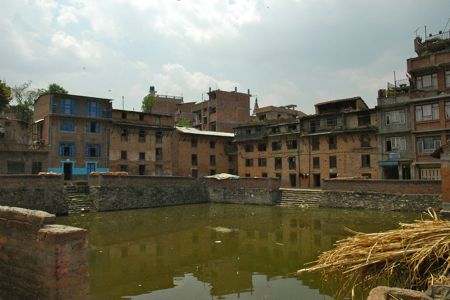
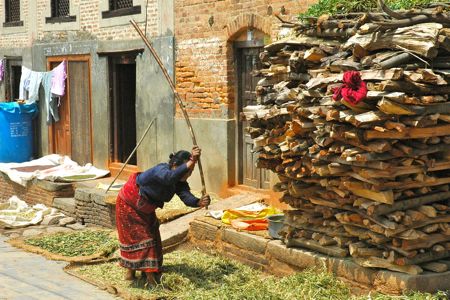
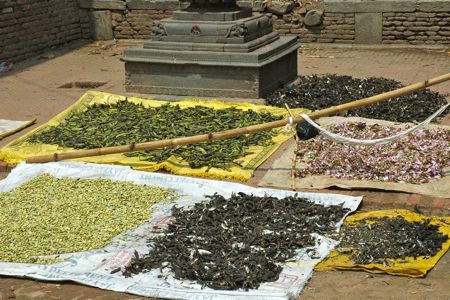
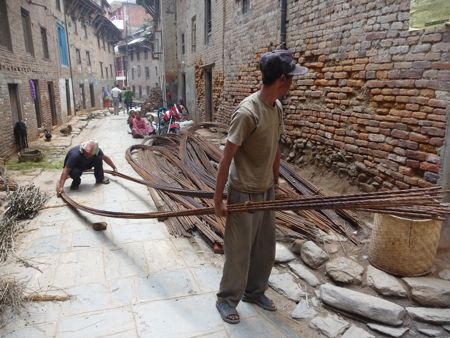
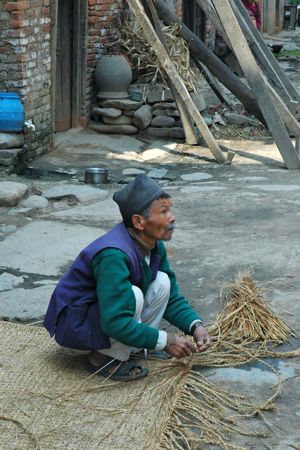
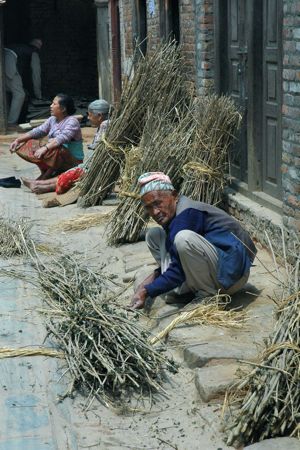
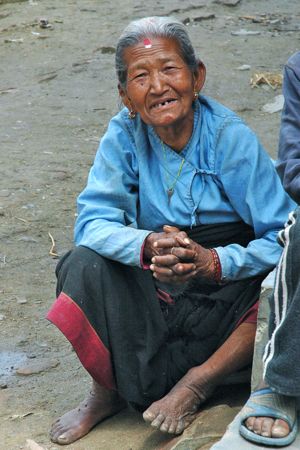
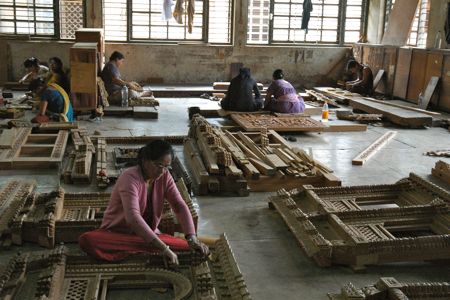
After the village, Arjun took us to a local wood working area. We spent more time than Arjun had planned, but that is what happens when four ladies are shopping. Mary found a beautiful carving she wanted to take home. They told Mary they would make her a plywood box – ok, it might be heavy, but her carving wasn’t too big. I found a carved mirror that would look nice in the kitchen in California. Again, they said no problem to make a plywood box. Yes, it would be a problem as it would be too big and too heavy. I was going to pass on buying the mirror until Jennifer decided to buy a 4-panel standing carved wood screen – very big. I threw my mirror in with her shipment. Jennifer always buys big – I tend to buy small. Judy found a small carved item to take home as we all needed something from Nepal. When they finished boxing Mary’s small carving, it was now bigger and a bit heavy!
We left the wood carving area hungry as it was late in the afternoon. Arjun said he would knew a nice roof top cafe at the next stop, Patan. Patan is one of the major cities of Nepal with approximately one million people. Patan is famous for Hindu and Buddhist temples. We went to the Patan Durbar Square
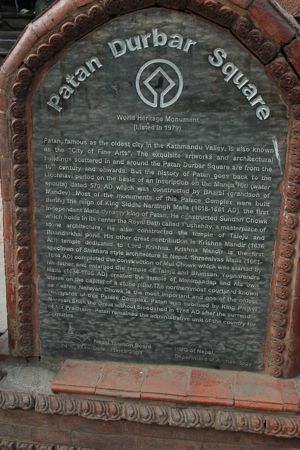
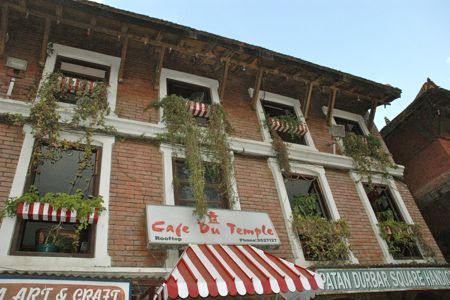
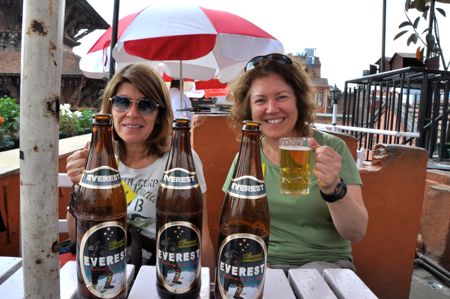
First stop was lunch and a cold drink. Arjun did take us to a lovely roof top cafe with good food along with cold drinks.
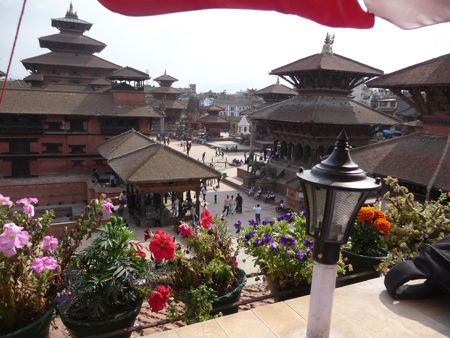
Temples in the Square.
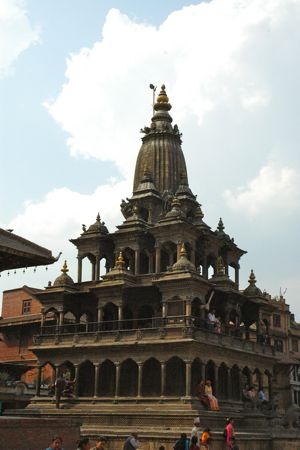
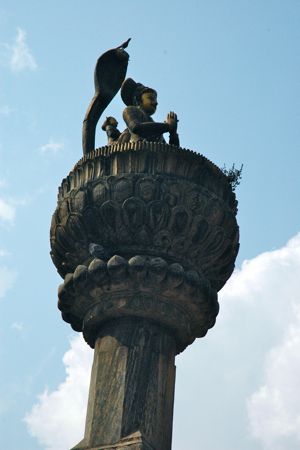
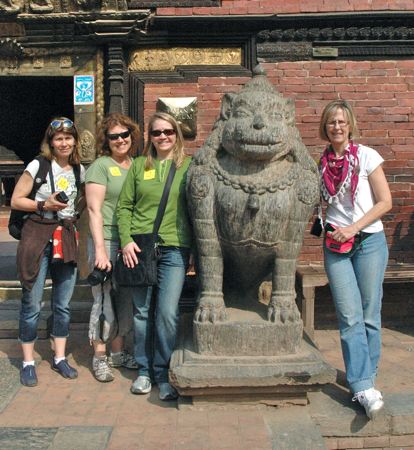
We left Patan to drive back to Kathmandu. We had dinner reservations in the Thamel area at the Thamel House. We had about 45 minutes before our reservation. We told Arjun to drop us off so we could do some shopping. The Thamel area is the backpacker shopping area. He wasn’t too confident about “dropping” four ladies off, but we assured him we would stay together and we are from China. We didn’t stay together as we had a short window to shop, but we stayed close – on the same street.
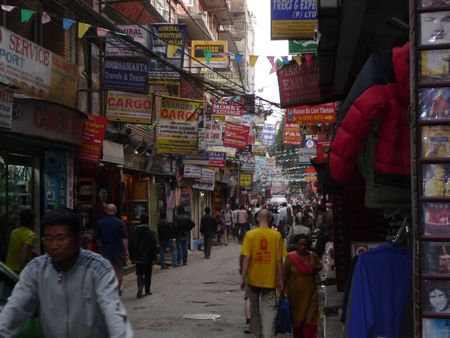
We found a lovely tea house to buy some Nepal spice tea. I found some knitted hats for me and the girls. Our reservation was at 7pm. Just as we were finishing up our shopping, the lights went out. I was in the knit shop and luckily had finished picking out my hats. Many stores have candle light once the electricity goes out. Some shops have generators with very small light bulbs to light the shop.
Arjun had told us about the rolling backouts. Every district is on an 18-hour rolling blackout schedule. The government publishes grid-by-grid calendars warning of the electricity power outage, which averages six to eight hours off every day, according to neighborhood. He said everyone gets their schedule at the beginning of the month. It is always rolling times to be fair when no power is provided. He had said Kathmandu has had this rolling black out for about seven years. At least, we knew why all the power had gone out.
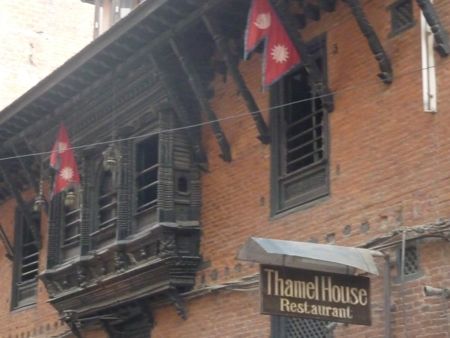
Dinner at the Thamel House was very good. We sat upstairs in a courtyard. We ordered the set meal with more food than we could eat. We have been eating expensive meals at the hotel. This was a nice change.
Day 9 – April 12: Depart Katmandu
Last night Arjun said the driver would pick us up at 6am for our 10am flight. The airport is close as we have already been there for our Everest flight. We told Arjun we would be fine with a 7am pick-up. He finally agreed, but we had to promise we would be ready to load in the van at 7am. He probably doesn’t know what to do with these American women!
We enjoyed the last good breakfast as no one wanted to miss good food before boarding a China flight. When we arrived at the airport, what a mess. Arjun was right about needing THREE hours to just check-in. After the long queue to get in the door through security scanners, we queued for tickets and check-in. Well, we had a slight problem. We were only allowed 20 kilos each. I think we arrived with more than 20 kilos each. Then, we had Mary’s carving in a PLYWOOD box weighing in at 20 kilos. They wanted to charge Mary more in over weight fees than the carving cost. We pulled items out of our luggage to carry-on bags to get most of the bags within the weight limit. We just needed to get Mary’s carving into luggage. We did the scrabble to find out who had air mile alliance with our flight to gain more luggage weight. We were able to get mile numbers from all our husbands to give us more weight. We had it covered, but the “handlers” were looking for more – a little money. We passed them some money and ran.
We thought we were cleared through security since we scanned all our luggage upon entering the building. We had to put our carry on bags through another scanner. After that scanner, we proceeded to a table to have it hand searched. We did get to our gate on time…to wait. Our flight was delayed two hours. We flew through Kunming airport before arriving in Shanghai.
The Ladies trip to Tibet was an experience worth seeing. Sharing the adventure with Mary, Jennifer and Judy made it more enjoyable. We have photos, memories and laughing moments to cherish from our trip. I am blessed to have friends to share life’s journey and adventures.