At Concordia, all middle and high school students required studies include an interim trip. Emersyn’s 6th grade interim trip is to Xian.
Xian (西安) in the name Xi’an literally mean “Western Peace”. One of the oldest cities in China, with more than 3, 100 years of history, the city was known as Chang’an before the Ming Dynasty.
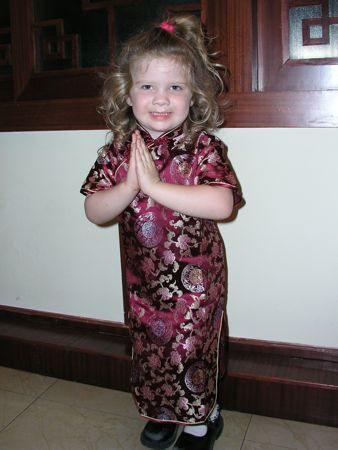
The last time we were in Xian, Emmy was four years old. Xian was part of our tour of China with Grandma & Grandpa and Terri & Andy.
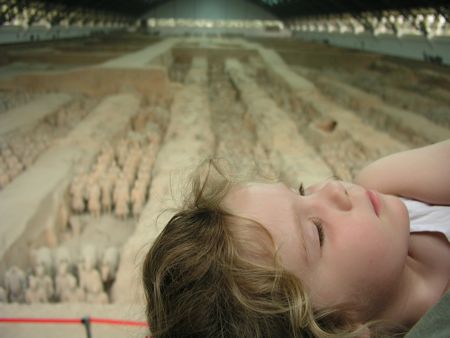
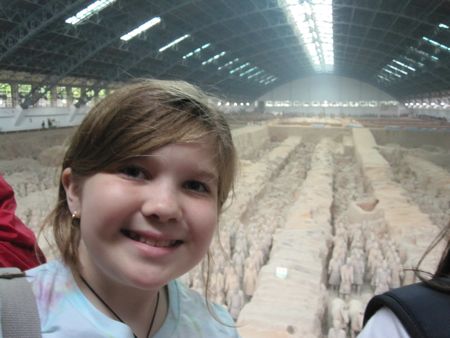
And, this is how much she saw of the Terracotta Warriors…
Andy also reminded us why at Xian was the last time Emersyn ate watermelon! On the way to the City Wall, she vomited all over the taxi. The taxi driver was not too pleased and left us along side of the road.
Day One Adventure
The departure time from Pudong airport was 9:00am. Therefore, the children were required to be at school at 6:30am. Scott took Sean and Emmy out in a taxi at 6:00am – they were ready and excited to start their adventure independent of us, the parents.
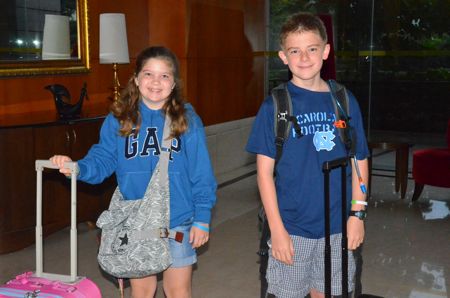
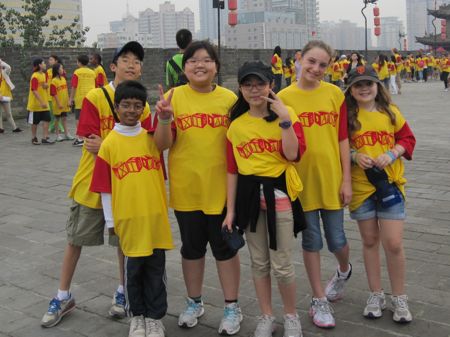
The students were put into groups of six children with an adult chaperone. Emersyn’s group created the name “Wasabi Dumplings”.
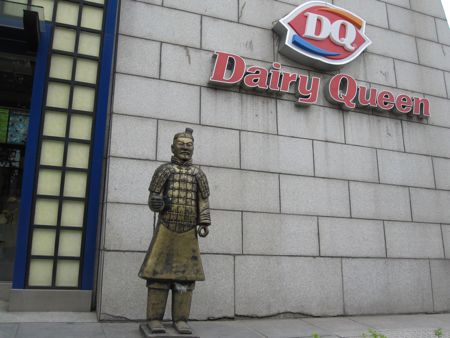
Upon on arrival, it was time to eat after collecting bags and traveling from the airport. Emersyn took this photo on the way to lunch. I love this photo as everyone has their warrior protecting their home/business. Many of our friends have warriors in their home.
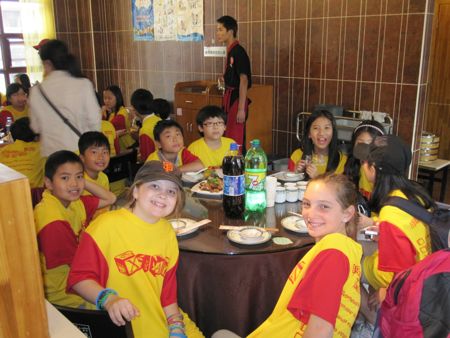
A typical Chinese lunch was served.
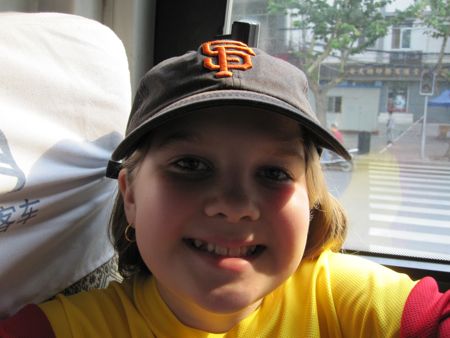
Then, it was a bus ride. The 6th grade class of about 90 students are divided up on four different buses for this trip. Emersyn would be on bus 1. The only electronics the children were allowed to bring on this trip was a mobile phone. No electronic games, no movies, no modern travel entertainment. This allows the kids to unplug and get to know fellow classmates. Of course, Emerysn is very happy to read a book.
The set schedule was changed on day one as rain was predicted for later in the week. They took advantage of the beautiful day to ride bikes on the City Wall.
The city is surrounded by a well-preserved City wall of Xi’an which was re-constructed in the 14th century during the early Ming Dynasty and was based on the inner imperial palace of Tang Dynasty. The fortifications of Xi’an represent one of the oldest and best preserved Chinese city walls. Construction of the first city wall of Chang’an (Xian) began in 194 BCE and lasted for four years. The existing wall was started by the Ming Dynasty in 1370. It encircles a much smaller city of 14 km². The wall measures 13.7 km in circumference, 12 m in height, and 15–18 m in thickness at the base.
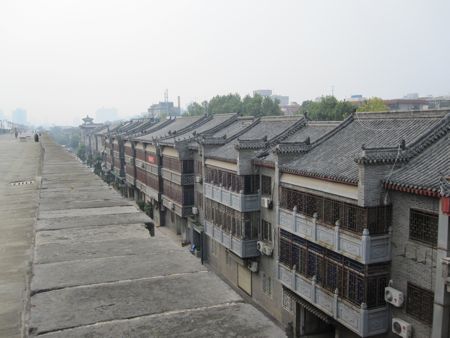
Emersyn took these photos on the City Wall.
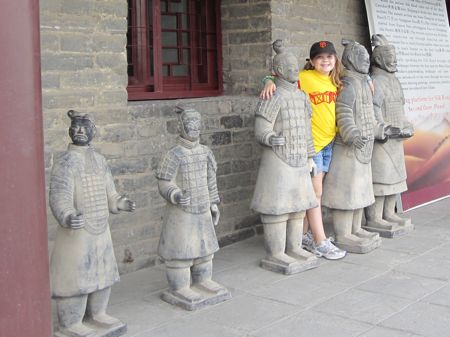
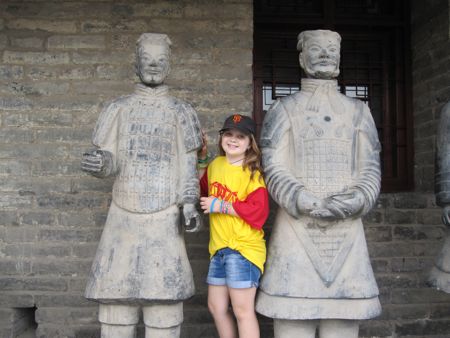
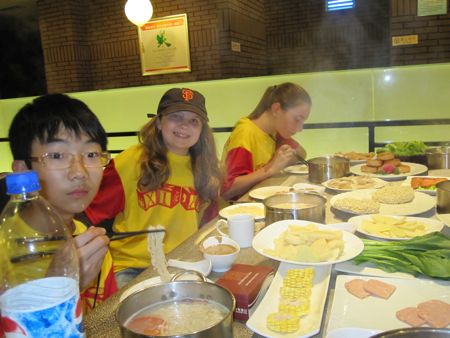
No photos of biking on the Wall. They were too busy having fun! After their ride around the City on the wall, the group checked into their hotel room. They had a 4-star Chinese hotel – never sure what that will mean in China. When Emersyn called at the end of the night, the first thing she reported was the hotel room is really, really nice. They had very “Chinese hotel rooms” last year at Nanbeihu. (See Nanbeihu 2010) They enjoyed hot pot dinner before retiring to their rooms for the night.
Day Two Adventure
After breakfast, which was reported the worst meal of the day, the group was off to Banpo Museum.
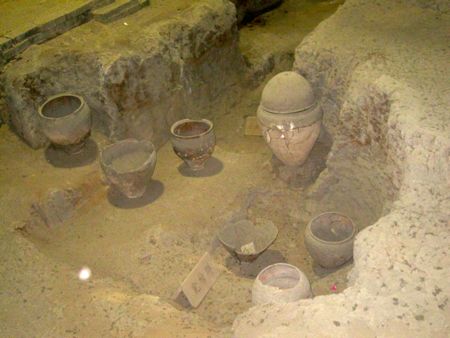
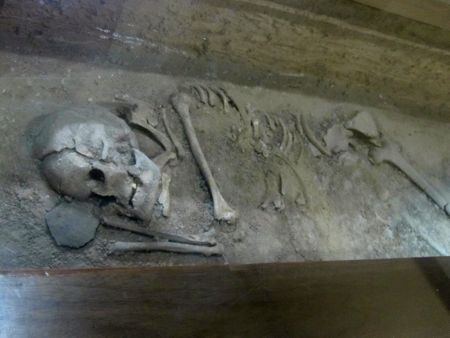
The Banpo Neolithic village is located on the outskirt of the city proper. Banpo (åŠå¡) is an archaeological remain discovered in 1953 and located in the Yellow River Valley just east of Xi’an. It contains the remains of several well organized Neolithic settlements dating from 5600 – 6700 BCE according to radiocarbon dating. It is a large area of 5-6 hectares and surrounded by a ditch, probably a defensive moat, five or six metres wide. The houses were circular, built of mud and wood with overhanging thatched roofs. They sat on low foundations. There appears to be communal burial areas. Banpo was excavated from 1954 to 1957 and covers an area of around 50, 000 square metres.
Next on the itinerary was a factory to make a terracotta warrior. Emmy enjoyed this activity and was very proud of her warrior she made. She also purchased a proper warrior to bring home.
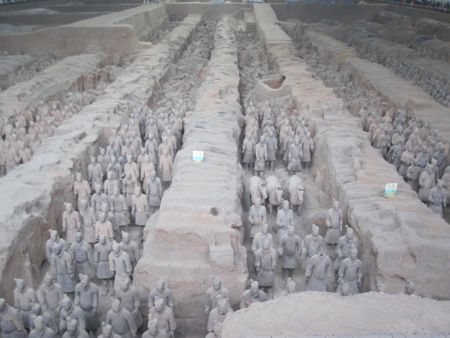
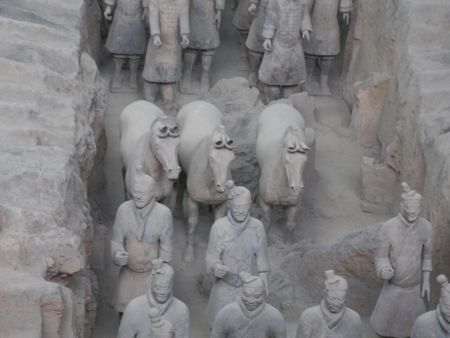
From making warriors to seeing the real thing. The afternoon was dedicated to the main attraction of the Terracotta Warriors.
The Terracotta Army (兵马俑; literally “soldier and horse funerary statues”) or the “Terra Cotta Warriors and Horses”, is a collection of terracotta sculptures depicting the armies of Qin Shi Huang, the first Emperor of China. It is a form of funerary art buried with the emperor in 210-209 BC and whose purpose was to protect the emperor in his afterlife.
The figures, dating from 3rd century BC, were discovered in 1974 by some local farmers when they were digging a water well around 1 mile (1.6 km) east of the Qin emperor’s tomb mound at Mount Li.
The terracotta army figures were manufactured in workshops by government laborers and by local craftsmen, and the material used to make the terracotta warriors originated on Mount Li. The head, arms, legs and torsos were created separately and then assembled. Studies show that eight face moulds were most likely used, and then clay was added to provide individual facial features. Once assembled, intricate features such as facial expressions were added. It is believed that their legs were made in much the same way that terracotta drainage pipes were manufactured at the time. This would make it an assembly line production, with specific parts manufactured and assembled after being fired, as opposed to crafting one solid piece and subsequently firing it. In those times of tight imperial control, each workshop was required to inscribe its name on items produced to ensure quality control. This has aided modern historians in verifying that workshops that once made tiles and other mundane items were commandeered to work on the terracotta army. Upon completion, the terracotta figures were placed in the pits in precise military formation according to rank and duty.
The terracotta figures are life-sized. They vary in height, uniform and hairstyle in accordance with rank. Most originally held real weapons such as spears, swords, or crossbows. The figures were also originally painted with bright pigments, variously coloured in pink, red, green, blue, black, brown, white and lilac. The coloured lacquer finish, individual facial features, and actual weapons used in producing these figures created a realistic appearance. Most of the original weapons were thought to have been looted shortly after the creation of the army, or have rotted away, and the colour coating has flaked off or greatly faded. However, their existence serves as a testament to the amount of labor and skill involved in their construction.
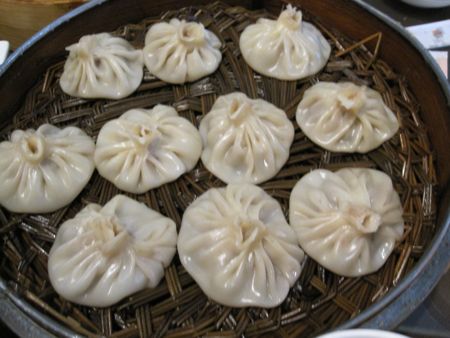
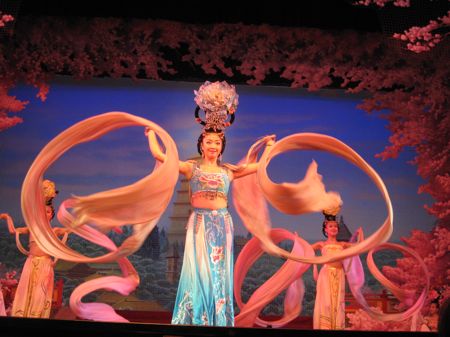
To finish off a busy day, they enjoyed a Tang Culture performance followed by a dumpling banquet. Emmy reported the dumplings were fabulous! She had one of everything!
Day Three Adventure
The city’s Muslim quarter, which is home to the Great Mosque of Xian (西安大清真寺; pinyin: Xī’Än Dà QÄ«ngzhÄ“nsì), located near the Drum Tower is the oldest and one of the most renowned mosques in the country founded in 742.
The tour included the outer chambers of the Mosque as they were not allowed in the prayer hall.
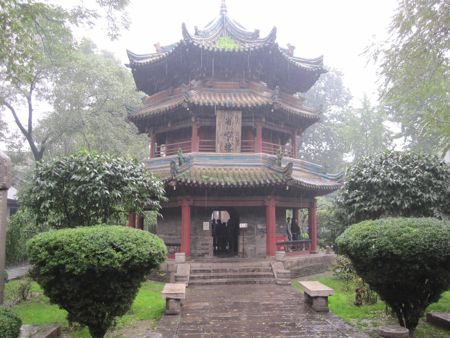
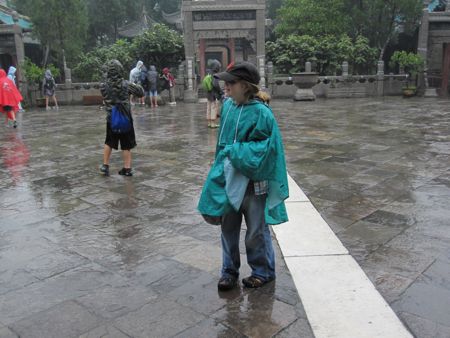
It was raining, but the kids were all prepared as rain gear was on the packing list. After visiting the Mosque, a Muslim lunch and shopping for the crew. Emersyn purchased folk tale shadow puppets for Eleri and herself. She found a pair of salt/pepper shakers for me. Dad received a large packet of postcards of Xian and the warriors.
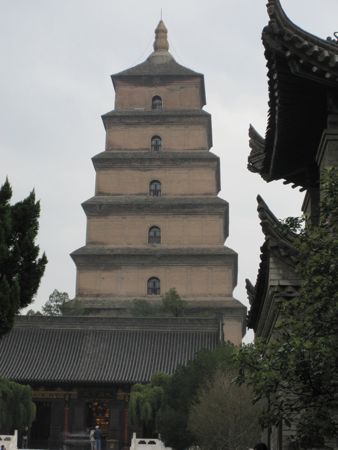
The next stop on this tour was the Big Wild Goose Pagoda.
Big Wild Goose Pagoda (大é›å¡”), is a Buddhist pagoda located in southern Xi’an. It was built in 652 during the Tang Dynasty and originally had five stories, although the structure was rebuilt in 704 during the reign of Empress Wu Zetian and its exterior brick facade was renovated during the Ming Dynasty. One of the pagoda’s many functions was to hold sutras and figurines of the Buddha that were brought to China from India by the Buddhist translator and traveler Xuanzang.
Emersyn’s group, “Wasabi Dumplings” climbed the Pagoda steps and counted 281 steps to the top.
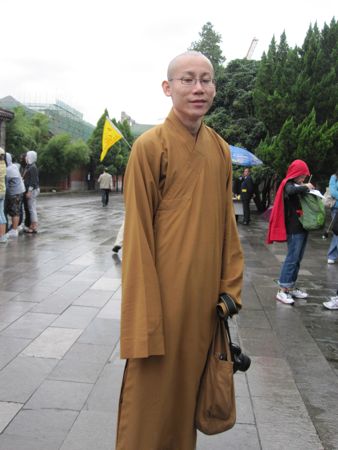
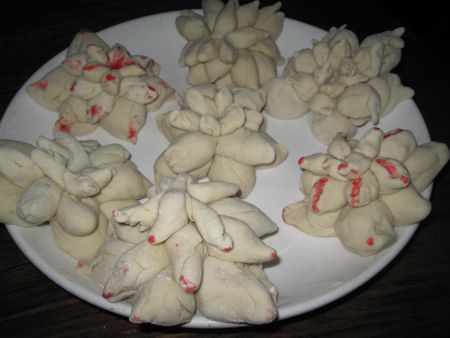
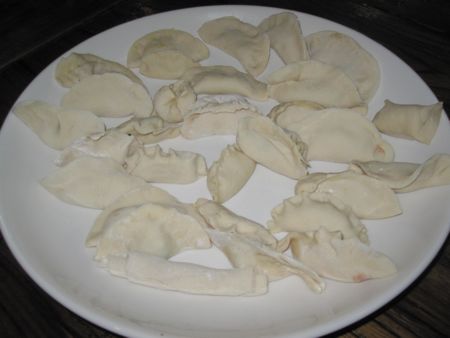
For dinner, it was dumpling making by students before dinner. Dinner was traditional dumplings and noodles. Emersyn said the noodles were yuck and most of the students did not eat them.
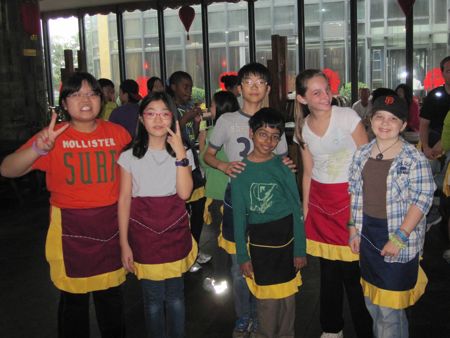
Some dumplings looked pretty than others as it takes a skill to form the dumplings.
After dinner, the students returned to their rooms to work on their journals. After quiet time, a social hour was downstairs for all the students. They shared all their snacks they brought from home, played card games and talked.
Day Four Adventure
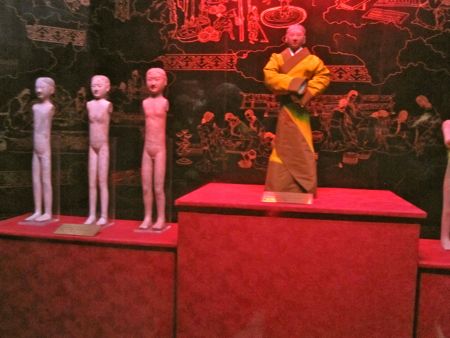
The last day of the Xian adventure included martial art school, lunch and the small terracotta warriors. The small warriors were found at the tomb. The warriors had wood arms and clothing which disintegrated over time.
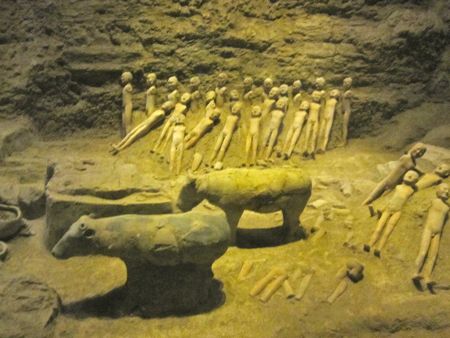
Below is an example as they would have looked in the tomb.
Their flight was scheduled to arrive in Shanghai at 7:00pm. However, this is China and the flight arrived back in Shanghai after 8:00pm. Mr. Nie delivered Sean and Emersyn home at 10:30pm. They were tired, but had a most wonderful adventure with their friends.