The study this week in the MS and HS is the Holocaust. A special guest speaker has been in the school all week talking to the students. Peter Feigl is 85 years old and a surviver of the Holocaust. Emersyn wrote one of her exceptional pieces for her writing assignment. She was asked to read her letter at the assembly on Monday. The assembly was a special assembly for Mr. Feigl.
By Emersyn Lyon
In this essay, I am to write a sympathy letter to a child Holocaust survivor, but I won’t do that. I can’t do that. In reality, I will never be able to fathom the horrors they experienced. I will never see my friends, family, and neighbors struck down like dominos. And I will never become accustomed to seeing corpses litter the ground. Furthermore, I will not write a sympathy letter.
From my experience, people don’t want sympathy – they want acceptance. Sympathy makes remembering their misfortunate harder. It makes facing reality more difficult. They don’t want your pity or for you to commiserate about their loss because you can’t begin to comprehend the loss a Holocaust survivor has faced. Instead, acceptance allows those who have experienced great lost the ability to move on. They want you to understand the Holocaust took place and there’s no way you can change it. No amount of sympathy or pity can change the historical events that occurred, but learning from the past can change our future.
* * *
Mrs. Chandler stand before us preaching about our life versus those in the Holocaust. She tells us what we already know: we have a perfect life filled with food, clothes, family, and most importantly – education. She tells of the ignorance-filled childhood bliss Jewish children had before the Holocaust and how evil stole this. She delivers the generic disquisition, a speech we’ve been told far too many times. I watch as my peers around me begin to lose focus. They begin fiddling with things – their bracelets, hems of shirts, or watches. Mrs. Chandler is also aware of the disinterest in the room, but the next thing she says impacts us all.
“You are the last generation that will ever be told the stories of the Holocaust directly from a Holocaust survivor. You are the last generation to come into contact with a Holocaust survivor, as they old and will die soon, very soon. Now it is your turn to continue their stories, knowledge and their legacy. It is your turn to tell their stories.â€
My head snaps up from the floor and an invisible hefty weight has been placed upon my shoulders. Knowledge – this is the burden I am feeling. However, I don’t want it. I don’t want the guilt and self-hatred that boils in the pit of my stomach. The contempt I feel for my perfect lifestyle even though I have little control over my fortune and others misfortune. I’m afraid of this knowledge that grows inside and possesses of me. Like the Jewish children, I want the ignorance that came before the Holocaust. I crave the bliss before the haunting images that are scarred in my brain and before the wickedness that was inflicted to Jews.
Suddenly, like a freight train, I realize I have to want it. I have to want the stories and horrors that accompany knowledge. If I ever want to make a difference in this world, if I ever want to help people and further society, and if I ever want to keep a genocide like the Holocaust from happening again, I have to want the pain whose hands are linked firmly with knowledge.
Therefore, I will trudge forward with the burden of knowledge placed firmly on my shoulders. I will travel throughout life with it, but I will not keep it all. Instead, I will share my obligation of knowledge with others, who will slowly lift the strain off my shoulders. Yet, I will still encounter and endure new erudition, which will continue the circle of knowledge. A circle that is impossible to avoid and impossible to tread lightly upon because once knowledge has you in its grasp, there is no escaping.
Peter Feigl spoke in the Rittmann Center, open to the public.
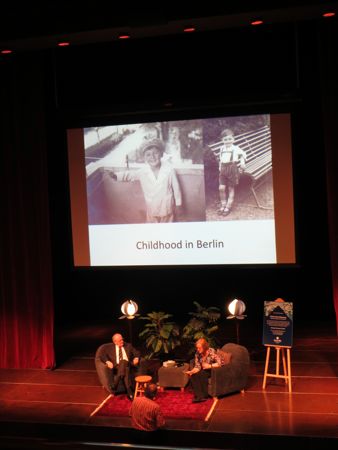
Mr. Feigl shared his childhood diary and the testimony of his rescue through the courage of the entire village of Le Chambon, France. I skipped out of the dance to listen to his story. Emersyn had a very interesting point in her story…this is the last generation to be told the stories directly by a survivor.