It October break – National Week. We had planned to stay in Shanghai, but at the last minute decided to visit the Silk Road. Of course, October is the best time for the weather and the worst time for travel. Everyone in China has this week off. It drives the airfares up which is already expensive in China and it brings crowds. We didn’t want to wait until spring break as the weather of the West can produce large sand storms. So we set off with the millions of other people for October break.
Saturday, September 29: Airports and Planes
The day is spent traveling. We left Shanghai on time at 11:35am – amazing, but true. We transferred in Urumqi to arrive in Kashgar at 7:30pm. It was a long travel day, but the girls are great travelers.
Kashgar (喀什噶尔) is located at the foot of the Pamir Mountains. Kashgar or Kashi is an oasis county-level city with approximately 350, 000 residents in the western extremity of China, near the border with Tajikistan and Kyrgyzstan. It is the westernmost town in China. Geologically and politically, Kashgar is the last town on one of the longest dead ends on the planet. On three sides, it is shielded by the Karakorum and Pamir mountain ranges, on the other by the Taklimakan Desert, whose name translates as ‘The Go In And You Won’t Come Out Desert’.
It was after 8pm when we left the airport and we were hungry as China flights have the worst food. We had eaten all the snacks I had packed for the day. China recognizes one time zone – Beijing Time. The people in the far West set their schedules back by two hours to match the sun. Dinner at 9pm is the normal. We checked into the hotel & dropped off our bags. We upgraded hotels to the Shenzhen Air International Hotel. It wasn’t the central location of the Tian Hotel, but Jennifer had nothing good to say about that hotel when she traveled here two years ago. Our driver, Mr. Dong, had a festival to attend. He dropped us off at restaurant near the hotel. The large minority group of the region are the Uyghur people (pronounced weeger).
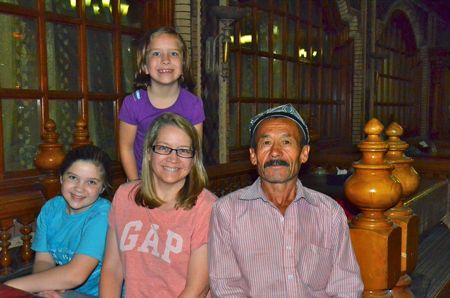
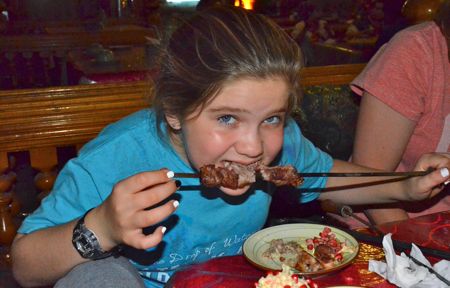
The diet of the uyghur people is meat, meat and more meat. We enjoyed delicious lamb kabobs of various types – Emersyn’s favorite. She enjoyed eating them Uyghur style – on the skew.
After dinner, we walked back to the hotel as it was a nice night in Kashgar. It was also nice to have a walk to settle the food before going to bed. By the time we arrived back at the hotel and settled for bed, it was midnight, but only 10pm by local sun time.
Sunday, September 30: The Sunday Market and Sites of Kashgar
After a very Chinese breakfast (read – not good at all), we met our guide, Alberto (his English name he received when he was studying in New Mexico) at 10am. The sun doesn’t rise until 8am. Our first stop was the Tomb of the Fragrant Princess at the Aba Khoja Mausoleum. Our guide is very nice and helpful, but he doesn’t have a lot of “tid bit” information at the tourist sites. We only have two tourist sites on this part of the trip.
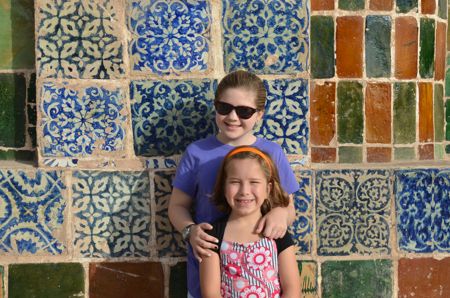
The AfÄq Khoja Mausoleum or Aba Khoja Mausoleum is the holiest Muslim site in Xinjiang. It is located some 5 km north-east from the centre of Kashgar City. The mausoleum was initially built ca. 1640 as the tomb of Muhammad YÅ«suf, a Central Asian Naqshbandi Sufi master who had come to the Altishahr region (today’s southern Xinjiang) in the early 17th century, and possibly was also active in spreading Sufism in China proper. Later, Muhammad YÅ«suf’s more famous son and successor, AfÄq Khoja, was buried there as well. All told, the beautiful tiled mausoleum contains the tombs of five generations of the AfÄqi family, providing resting places for 72 of its members.
According to the Han (Chinese minority that lives in this region), this place is called the Tomb of the Fragrant Concubine named after Abak Hoja’s grandniece that was summoned to act as a concubine for the Qing ruler in Beijing. Uyghur legend says she was so unhappy she committed suicide while the Chinese say she spent 30 years in the emperor’s palace then asked to be returned to Kashgar to die with her family.
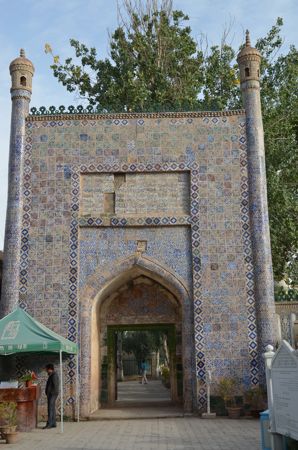
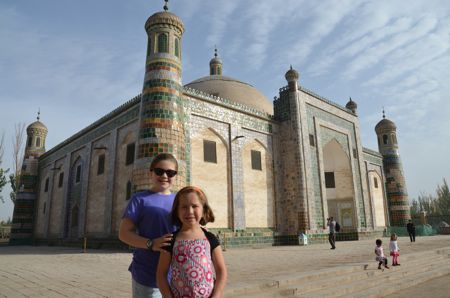
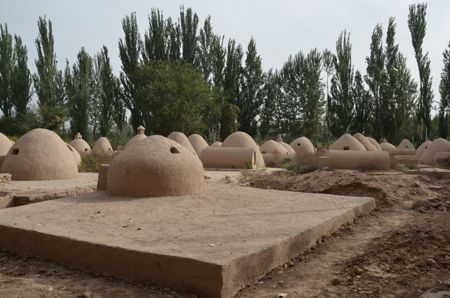
We left the site to drive across the City to the Sunday Market. A typical grave yard in the City of Kashgar.
We planned our trip around this Sunday Market – to be in Kashgar on Sunday. The Sunday Market in Kashgar makes the book “1, 000 Places to See before You Die”. Karen and Stefan gave this book to Jim for his 40th birthday.
The population of Kashgar is reputedly swelled by 100, 000 every Sunday for this market, but due to the difficulties of getting there, only a minuscule fraction of these visitors are foreigners. As a tourist, markets are not so much an interesting place to shop, as an interesting place to watch others shop.
The reason this extraordinary market takes place dates to Roman times. Until the sea route around Africa opened up in the 15th century, all trade between China and the west took place overland, along the Silk Route. Kashgar, a key oasis staging post between the desert and the mountains, was one of the most important towns on this route. In terms of international trade, this place was once of giant significance. Then, suddenly, the Silk Route was superseded and Kashgar’s prosperity ended.
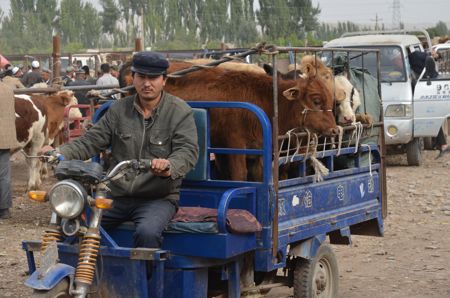
As we crossed the City, we saw people transporting their livestock to the market.
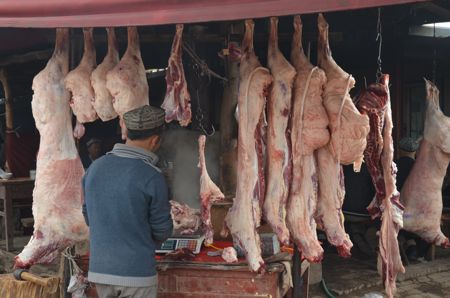
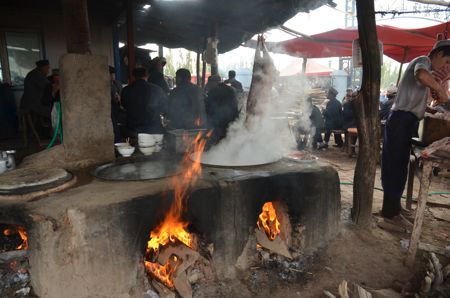
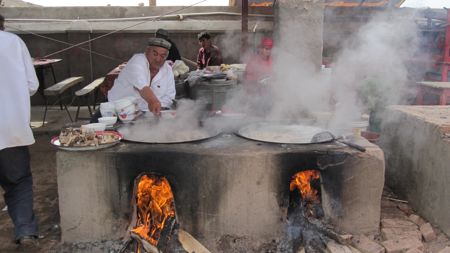
Once we arrived at the market, there were many live animals and people bidding for them. There are cows, bulls, yaks, donkeys, camels, sheep and goats all up for sale. Alberto said to be aware of the yaks and the donkeys. Upon entering the market, the food stalls are cooking fresh lamb.
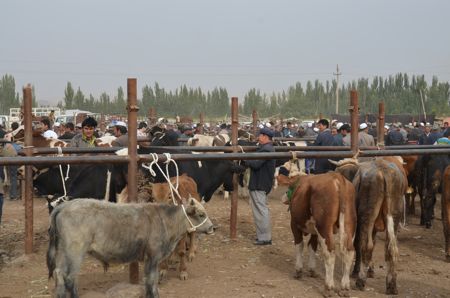
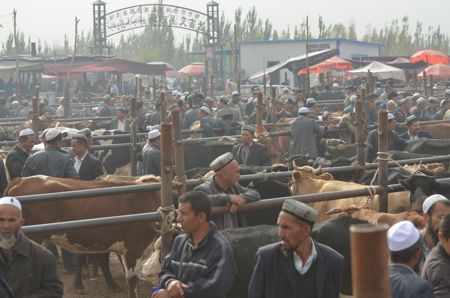
The first animals at the entrance are the cows, bulls and yaks.
And camels too, of course.
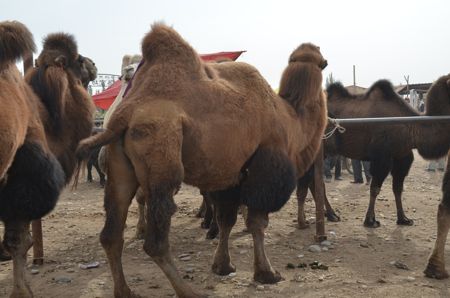
The girls and I decided they were a bit scary, so we worked our way over to the calm sheep.
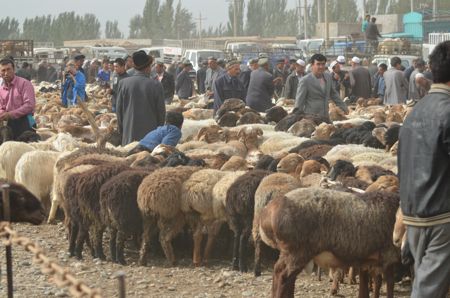
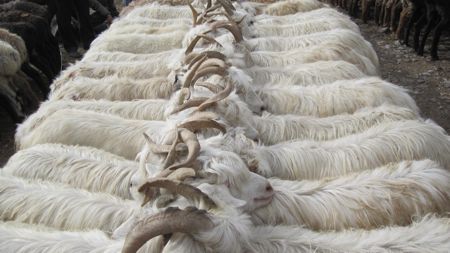
The sheep of this area having funny bottoms – some shaved for show.
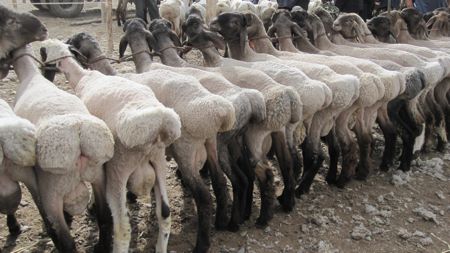
We also enjoyed how the sheep and goats looked liked their heads were on backwards due to the two rows of sheep crossing.
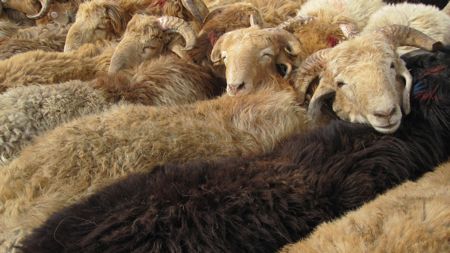
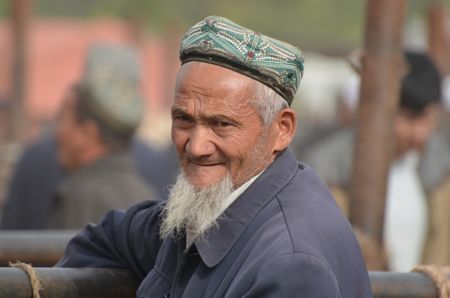
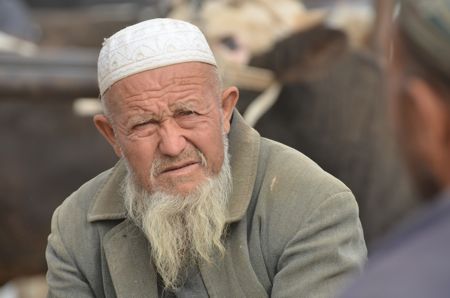
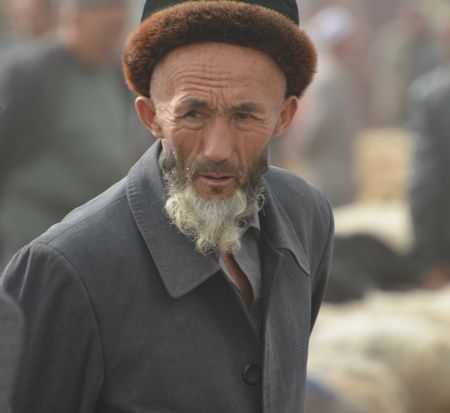
The faces of the Sunday Market.
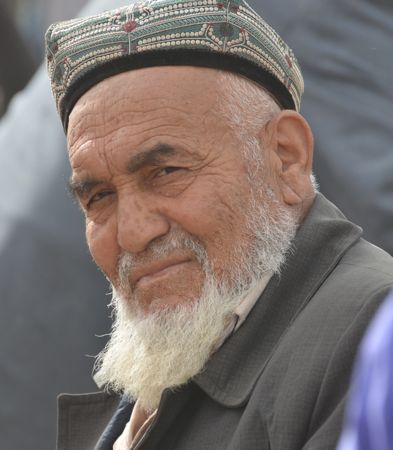
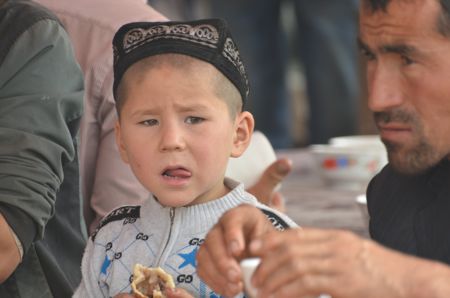
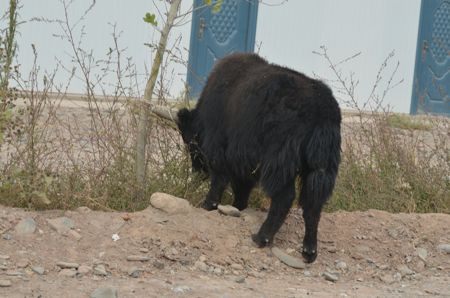
As we were leaving, a yak that was being taken out of the market was going a little crazy and we backed away from it very fast. Five minutes later, the yak was free and running down the walkway. People we running like they were in the Spanish bull run. We were behind a cart when we noticed it was free – a safe place to be. They caught the run away yak and tied it up.
The market was everything the book said it was and more. The silk road trip is becoming popular so many Westerns were at the market taking photos – especially on a Chinese Holiday.
After the Sunday Market experience, we went to the Mosque. We were dropped off to walk down the street to the Mosque. We found a bakery making the uyghur flat bread. It was fresh and hot and so very good. We ate one while walking to the Mosque.
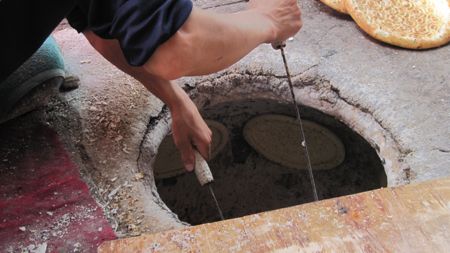
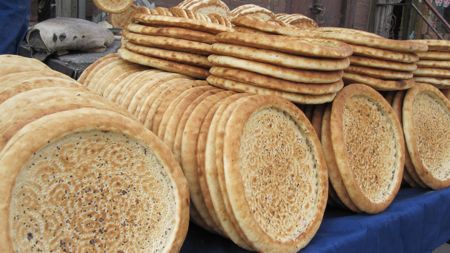
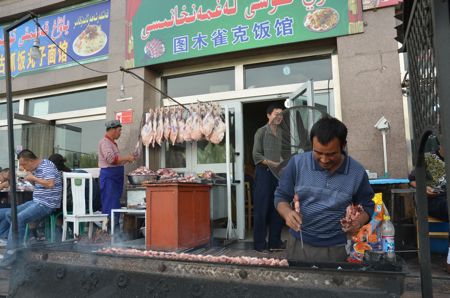
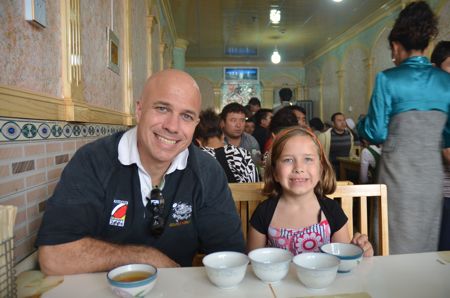
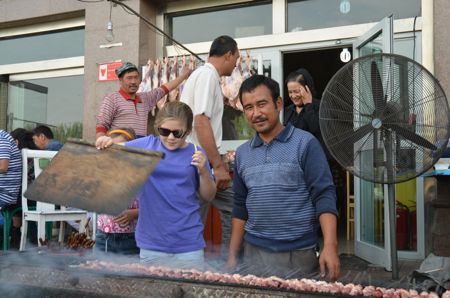
By the time we reached the Mosque, we missed our opportunity to get in as it was pray time. Lunch was a good option as it was already 2:30pm. Alberto took us to a local place – a popular spot as the line was out the door. The lamb kabobs were grilled outside…served fresh and hot.
It was time to hit the local bazaar. I always enjoy the bazaars, but I think I have been in China too long as nothing was new or exciting. We left with a few small trinkets.
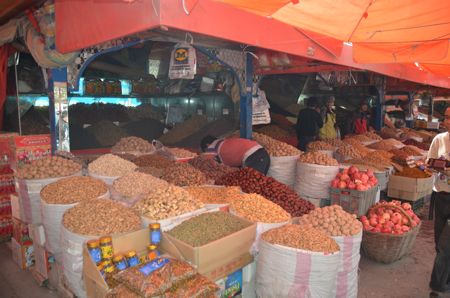
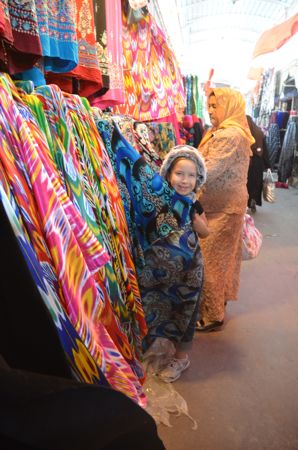
We walked through the old city which was the old style home made of clay and mud.
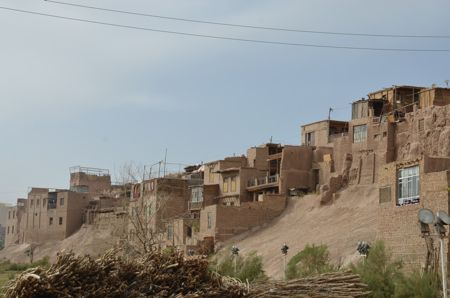
Then, back to the Mosque.
The Id Kah mosque (艾æå°•å°” means Square of festival in Uyghur) is regarded as the biggest mosque in China. This typical Uyghur structure, located in the center of Kashgar, has a history of more than five hundred years. Every Friday, it houses nearly 10, 000 worshippers and may accommodate up to 20, 000. About 100, 000 worshippers attend religious service at the same time.
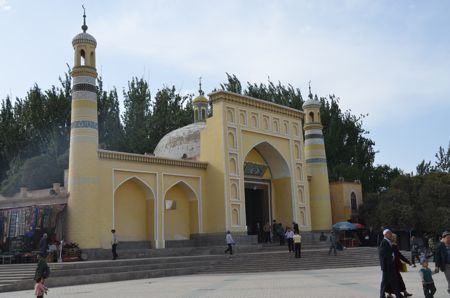
We arrived just in time to get in the Mosque before the next pray time. No photos were allowed in the Mosque.
The shops along the Mosque had interesting local crafts. One of the items of interest is the tambur instrument. A Hand crafted guitar-like instrument. We looked, but didn’t buy one. We did buy a tuyche, the tool to make the uyghur flat bread.
By the time we finished the day of markets and sites, it was 8pm when we reached the hotel. We dropped our purchases and Alberto gave us 30 minutes to rest. I didn’t let the family rest as we needed to get repacked and ready for departure tomorrow knowing we would be home late. We moved all our winter gear we would need for the night into a small suitcase.
Dinner was at another good local restaurant sitting outside enjoying the weather. More lamb kabobs and a spicy chicken dish was enjoyed by the family. Eleri was falling asleep before we left the restaurant. We grabbed a taxi home to drop her into bed at 11:30pm after a long day walking in Kashgar.
Monday, October 1: Yurt, yurt, oh where is our yurt!
Today’s adventure is driving to Lake Karakul.
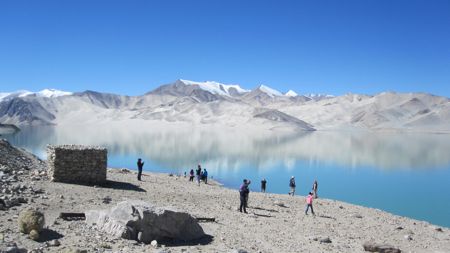
The Karakul or Karakuli (“black lake”) is a lake located 196 km from Kashgar in Akto County, before reaching Tashkurgan, the Khunjerab Pass on the China – Pakistan border. At an altitude of 3, 600 meters (11, 800 ft), it is the highest lake of the Pamir plateau, near the junction of the Pamir, Tian Shan and Kunlun mountain ranges. Surrounded by mountains which remain snow-covered throughout the year, the three highest peaks visible from the lake are the Muztagh Ata (7, 546m/24, 700ft), Kongur Tagh (7, 649m/25, 000ft) and Kongur Tiube (7, 530m/24, 700ft). The lake is popular among travellers for its beautiful scenery and the clarity of its reflection in the water, whose color ranges from a dark green to azure and light blue. There are two Kirgiz settlements along the shore of Karakul lake, a small number of yurts and a village with stone houses located on the western shores.
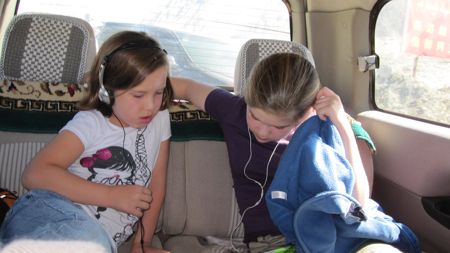
We left at 10am for the drive to Karkula lake. All the other Westerns tourist we have met on this trip are on the same tour – Sunday Market to the Lake on Monday. The road was very busy. We stopped at a local village for warm, fresh bread and fruit. The grapes and pomegranates are the fruit of the region. The girls plugged in to a movie in the back seat since we had a long drive to the mountains.
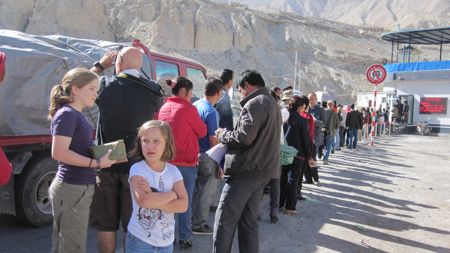
After about three hours, we arrived at a military check point. We needed a permit to entry the mountains. The queue to go through the check point was long, but moving. It took about 30 minutes to reach the guard. It took him 2 seconds to check our paper work. He didn’t even look at our passports.
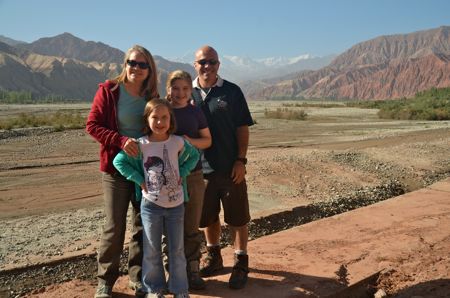
Alberto came with us to this point to verify we had no problems getting through the check point. He then took a bus back to town as his son has a medial issue he is dealing with at this time. We carried on with the driver to the mountains. The drive is beautiful with the snow cap mountains and the variation in hill color.
Another two hours of driving and we arrived at the lake around 3pm. The people of this area are Kirgiz. Each minority group wears their traditional hat. Jim wanted a Kirgiz hat as it is a fun one.
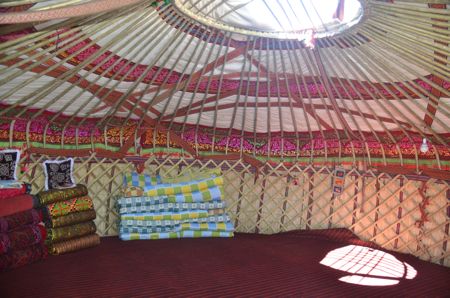
Our driver pulled into an area by the lake with yurts. We talked to the wife about the traditional yurt for the night. She said yes for 400rmb. It was perfect. The traditional yurt was next to their mud and stone one room house. The lake shore was about 30yds away.
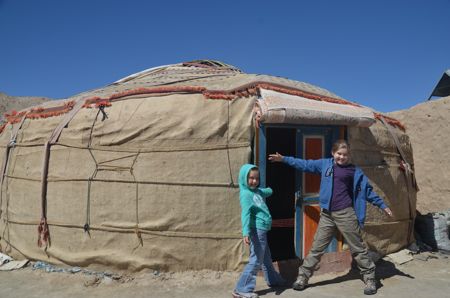
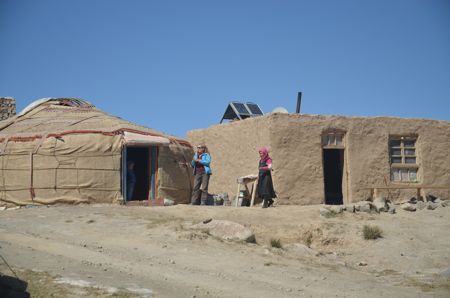
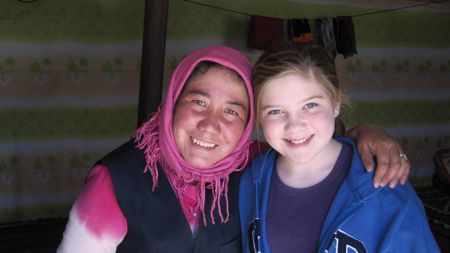
The wife was very sweet. She gave us milk tea which was too salty for me to drink.
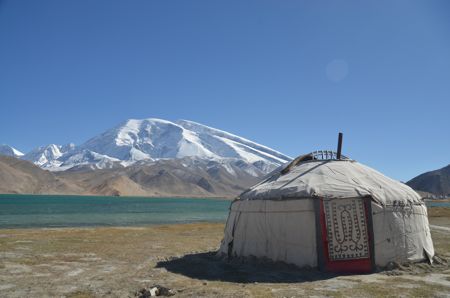
Then, our guide call to say we were at the wrong yurt. Then, the husband came to say we couldn’t have the traditional yurt as he just promised it to a group of 12 people. We understand as he could make 3 times more money from the large group. He had a tent yurt, a modern yurt made from canvas and looking more like a small circus tent.
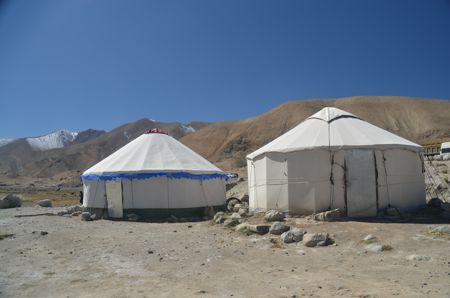
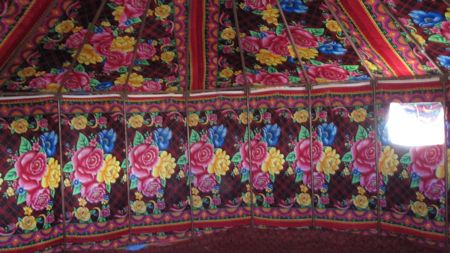
This was getting complicated! We decided to drive to check out the other yurt further down the Lake. The other yurt prepaid by the tour agency was at the “tourist center”. You had to pay 50rmb to enter. Jim and the driver walked over a fence to avoid the entrance fee to go talk to the yurt people. They said they had no room as the yurts were full. This was our prepaid yurt and we have no yurt. Our prepaid yurt has been occupied. We have been evicted from our traditional yurt for more money.
Back to the yurt family to see about the circus tent yurt. The yurt family is very nice. They tried to convince us to stay in the traditional house because the yurt is cold at night. The traditional yurts have a wood floor off the ground. The modern tent yurt has a thin fabric on the ground. The ground will be colder in the modern yurt, but we wanted to stay in a yurt. Done for 400 rmb for the 4 us – we can have a tent yurt. For 100rmb, they will give us dinner. Jim was tying to get his hat as part of the deal. Jim negotiated a hat and a couple of handicraft items the wife made for 200rmb. Perfect.
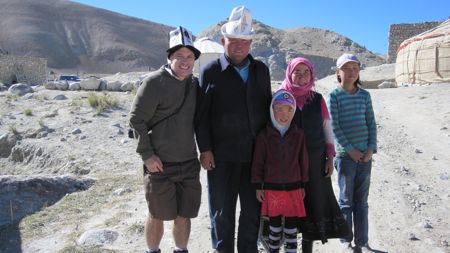
This yurt is next to the Lake and we get to spend time with a local family with two girls, ages 8 and 13. The prepaid yurt was at the tourist center with no food. Jim said the yurts were behind the restaurant building, not exactly what we wanted. By the time we settled our yurt, it was 4pm. As this is the tour most Western tourist take, the people driving to the lake for the day begin leaving for the drive back to Kashgar. It is the calm of the tour buses leaving the park!
The view from our yurt next to the lake.
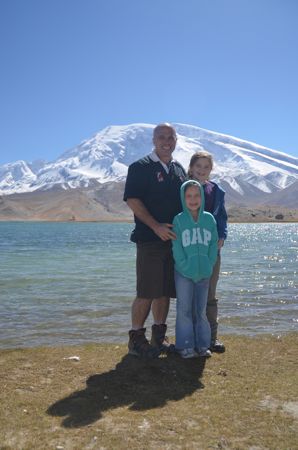
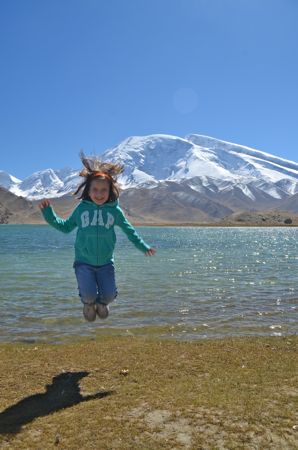
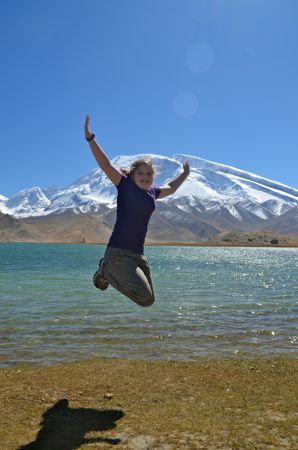
Since we had a place to sleep for the night, we went for a walk along the lake.
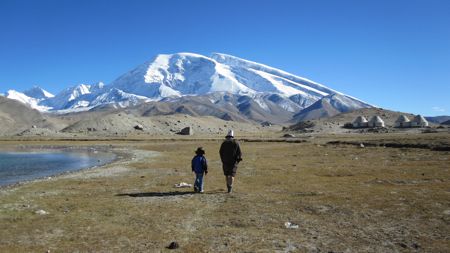
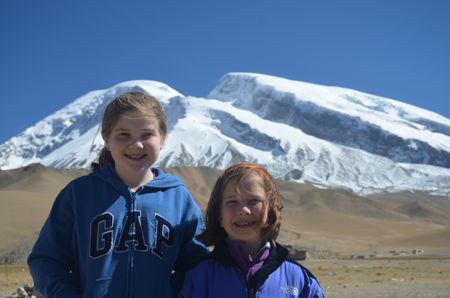
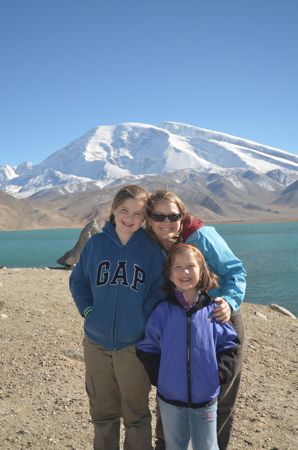
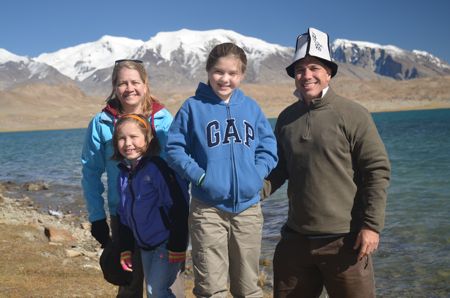
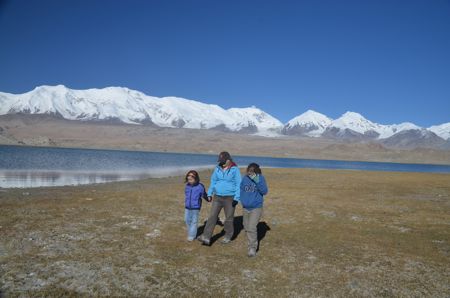
Eleri is the only one with a headache from the altitude. The last time she was at 11, 000ft at Yunnan, she was sick – A headache we can deal with. We grabbed her some medicine and continued our walk along the lake. It is amazingly beautiful. The sun was shinning with a clear, blue day.
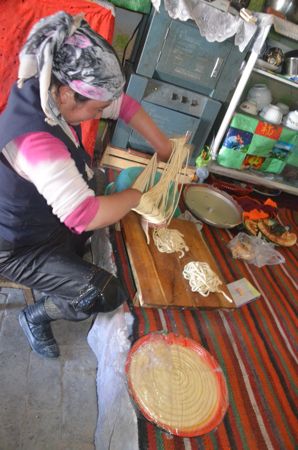
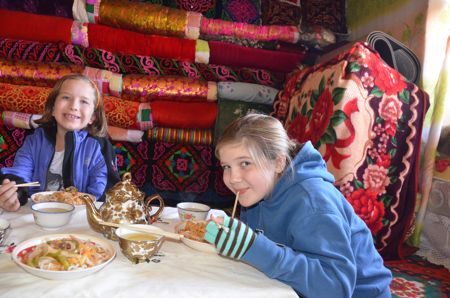
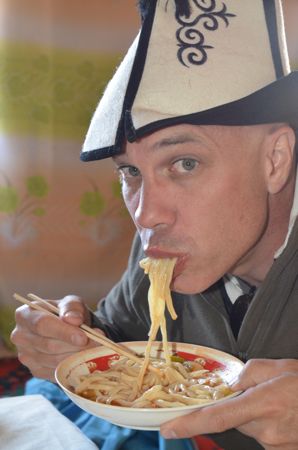
We asked for an early dinner at 7pm, which is 5pm local time. We were all hungry as we have been on a bread and grape diet all day. Just the opposite of the low-carb diet!! The wife made homemade hand pulled noodles with vegetables. The dish had a tasty, spice blend with the sauce.
After dinner, the weather was calmer and warmer with no wind. We started another walk along the lake when Eleri decided she needed to poop. Back to use the outhouse – which was very smelly. Eleri was squatting for about 15 minutes and wishing for a real toilet. As I am always the one on duty for squatty potties stuck in the smell, I was thinking soon she won’t need my help!!
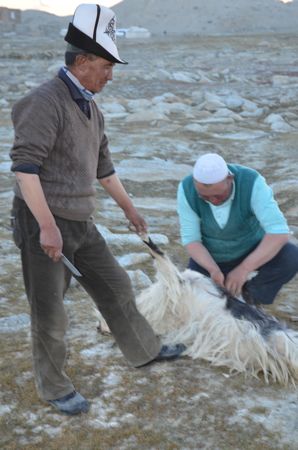
After our long toilet break, we found Jim and Emmy watching our yurt family gutting a goat. Her sister and brother-in-law had came to the house while we were having dinner. Now, we know why – it was time to kill a goat. They cut up the goat and saved every part of it. The wife was washing up the goat parts in the very cold lake. Here it was 8pm in the evening and they were skinning a goat. It added to the experience to be with a family. After watching this family work hard, you appreciate being born an American. I have it so easy…along with our children!
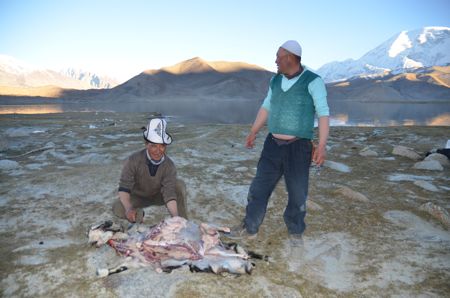
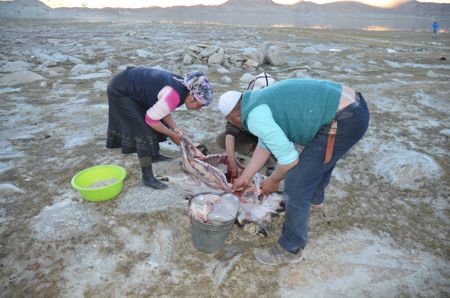
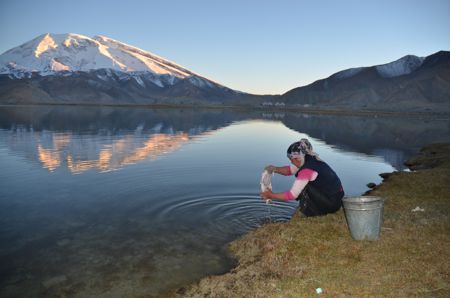
A few more fun photos before the sun sets.
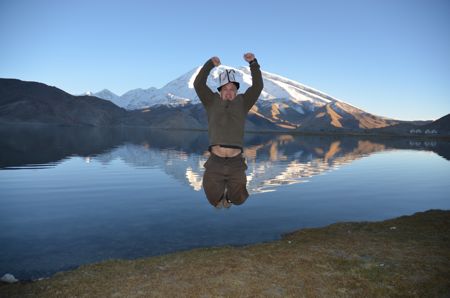
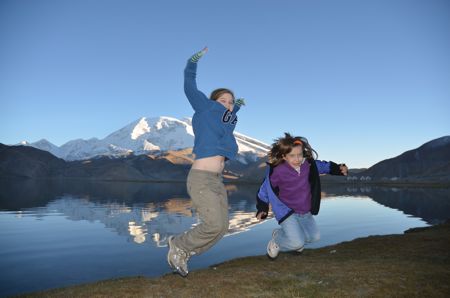
The sun setting was beautiful with the reflections on the lake. The lake was calmer as the wind had stopped blowing, which made it the warmest time at the lake.
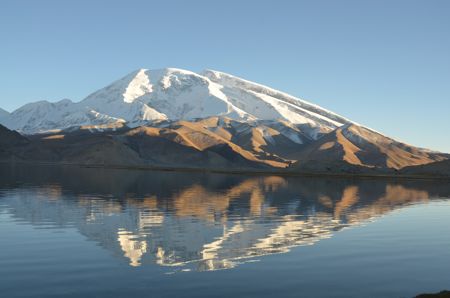
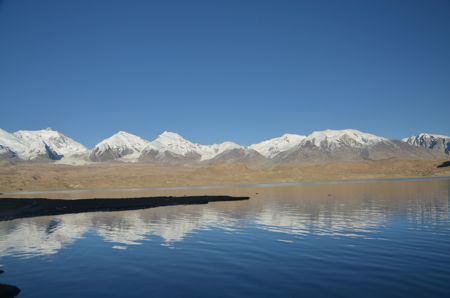
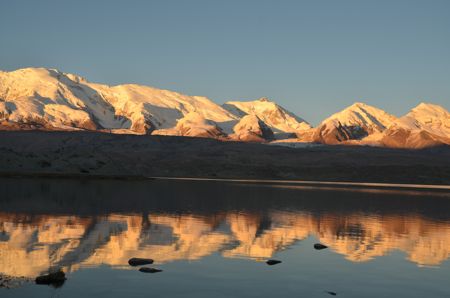
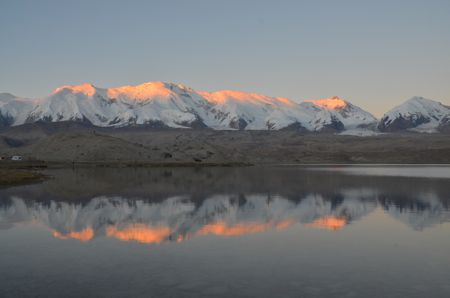
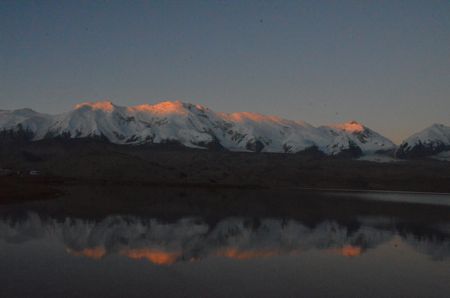
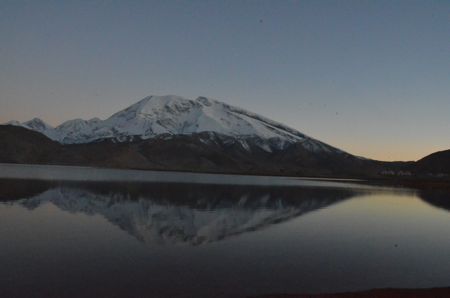
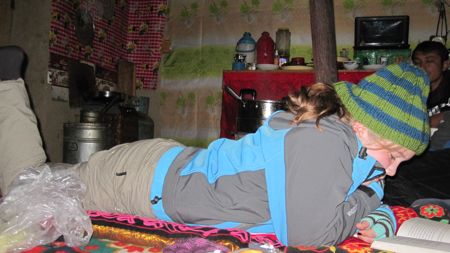
Until the sun set after 9pm, it was warm and easy to be outside. Once the sun set, it became cold fast. The family invited us in their home. Eleri played Go Fish with their 8 year old. It was good for Eleri to call numbers all in Chinese. She was doing very well. Emersyn was reading next to the stove.
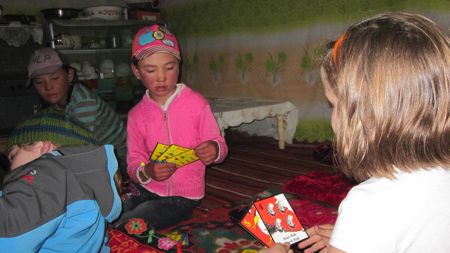
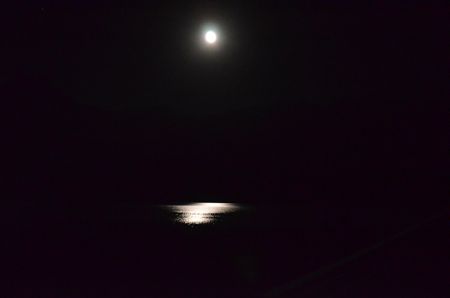
Jim was out taking photos as the night was beautiful with a full moon.
As the night was getting later, we were thinking maybe the 12 guests weren’t coming and we can sleep in the traditional yurt. But, they arrived about 10pm – a bus full of Aussies. When they arrived, the 13 year old daughter went to work with her parents to get everything ready. I think the 8 year old got a free pass since she was playing with Eleri – probably a rare treat. About this time, we were thinking it is cold out and maybe we should stay in the house. The only problem is we didn’t communicate this and they set up the tent yurt. We left the nice warm house for the yurt. They had set up a stove burning coal, but it was cold.
It was 11:30pm and I was tired. We got ourselves settled for the night. It was a long night. We had put the girls in the middle to help keep them warm. At some point in the night, I had rolled off the small matt to be sleeping on the cold ground. The ground had a thin layer of fabric, but it was cold. It has been a long time since I was this uncomfortable and cold at night. The last time was when we were hiking in Yosemite. We had set up camp above Happy Valley. It had snow in the night and a river was running through our tent. Of course, I was 20 years younger and the ground didn’t seem as hard!
Tuesday, October 2: Long night, long drive and more planes
We were up at 8:30am. Eleri had gone to bed with just her jacket on – no fleece, no hat, not gloves. She said she was very cold in the night! Our last run to the toilet in nature as we are choosing to not use the outhouse structure – nature smells better. As Emersyn finished her business, she started walking up the hill looking back talking to us…right up to the yak that had wondered over to check us out. Just a bit of a surprise at the morning bathroom!
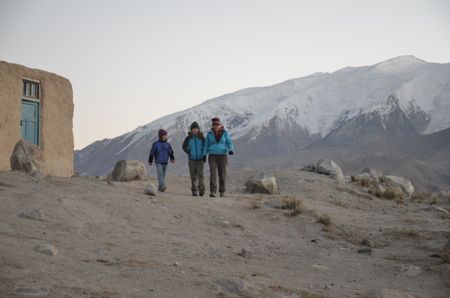
We packed our gear and loaded up the car. The water we had in the yurt had ice so we know it was at freezing temperatures in the night. Eleri climbed in the car and was ready for the heater. Our driver was more than happy to leave early as he was cold and the altitude was affecting him. The road to the lake is a hard road to drive…many parts of the road have rock slides with detours, big pot holes and one lane roads which require the driver to be alert at all times.
We took the last of the lake photos as we would not be waiting for the sun to rise above the mountains.
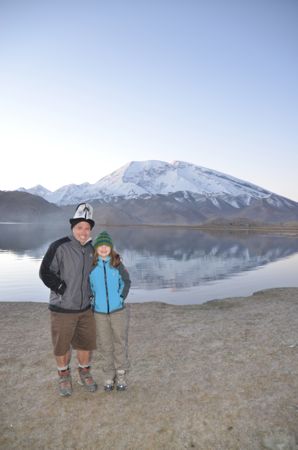
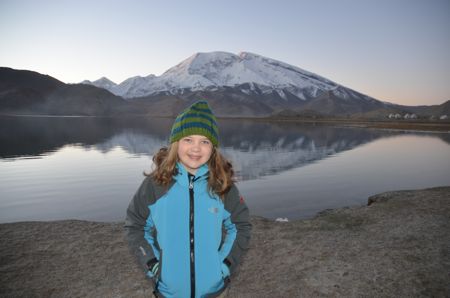
It may have been a cold, cold night, but well worth if for all the other experiences we had at the lake. The yurt family added to the adventure.
The drive back was only three and half hours. There was no queue at the checkpoint and the man actually looked at our passports and checked them to the permit. We picked Alberto up to finish the day. Alberto had said it was -8c at the Lake last night – to confirm the ice in the water bottles. We had decided to buy a Tombur musical instrument as it represents the people of Kashgar. It is a Uyghur instrument. The girls helped to pick one out, of course the more expensive one. All are handmade, but there is a difference in time and materials in each one.
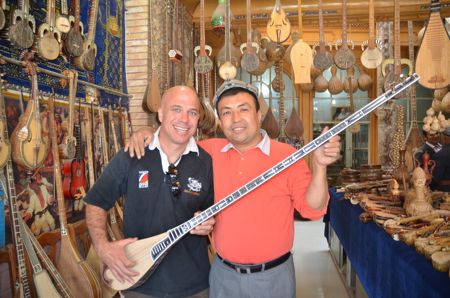
The girls with a local Uyghur man.
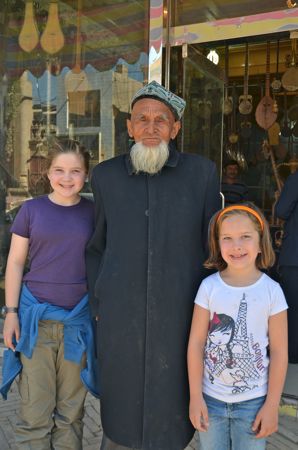
We left with our Tombur to find lunch. The plan is to have dry noodles in the room for dinner tonight. We need a nice, large meal for lunch. Alberto took us to the best restaurant of all the food we have had in Kashgar. The lamb was very tender. After lunch, we had just enough time to find a Construction Bank (no atm fees) and fresh bread for our hotel dinner tonight.
We arrived at the airport with plenty of time. Off to Urumqi for a night at the airport hotel. We arrive in Urumqi at 7pm. We are staying here only as a transfer point for tomorrow to Dunhuang. We won’t see anything of the City. Jim has been here on business one time. It said it is a typical Chinese city – enough said.
The hotel was across the road from the airport. It was actually a 5-star Chinese hotel and nice as I was expecting less. We had long, hot showers which was much needed. We had our fresh bread and package noodles for dinner. It was perfect!
Wednesday, October 3: To the Gobi Desert
We were up early for our flight to Dunhuang. A quick breakfast and a dash across the road at 7am in the airport shuttle bus…which left at 7am excatly. The airport was crazy busy for 7am which is 5am from a local sun time. We skipped the long line and checked in at group check-in…no one sent us away. When we were going through security, Jim and Emersyn had to go back due to a problem with our checked-in luggage. The tags had been attached to Emersyn’s passport. Eleri and I went through security to wait. By the time they returned, the last bus was leaving for the plane – we almost missed this flight!
We arrived in Dunhung at 8:35am. It is a holiday weekend and so far we have been on time (no later than 20 minutes which is on time for China standards). Our new guide, Kevin, picked us up at the airport. Our first stop for the day is Yanguan Pass. It is about an hours drive out of the City.
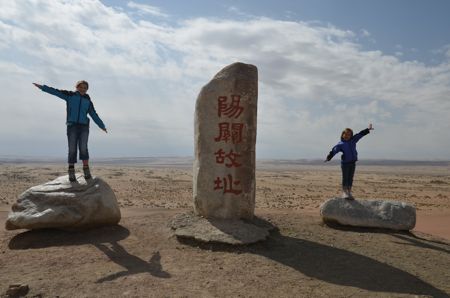
Yangguan Pass (阳关; literally “Sun Gate”)is located 70 kilometers (43 miles) southwest of Dunhuang. Yangguan was named for its location south of the Yumen Pass. It was a gateway to the Western Region and an important pass on the Silk Road. The famed poet of Tang Dynasty, Wang Wei has made the site an everlasting attraction. When He set off one of his best friends here, Wang wrote: In the central town Weicheng, it rains lightly in the morning. All the houses and the willows look fresh after the rain. I suggest you have another cup of wine, as soon as you go out of the Yangguan Pass, there are no friends.” Yangguan is associated with sad parting in Chinese literature as it is last stop before leaving the land of the Han Chinese to the Western Regions.
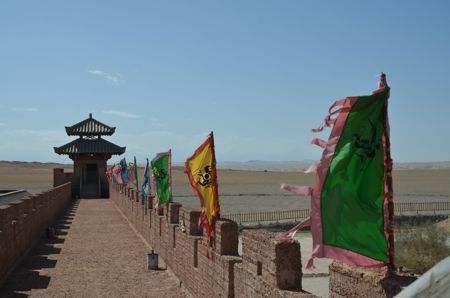
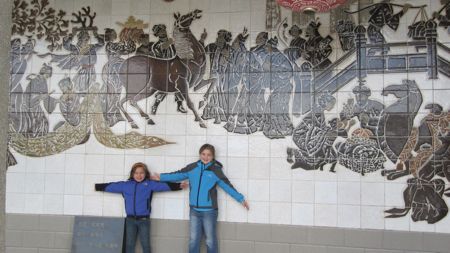
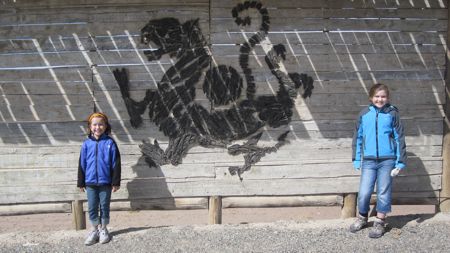
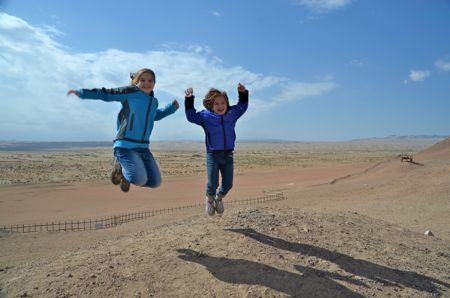
We visit the fort which the girls had fun running around. As it was early, there were not many people at the site, yet.
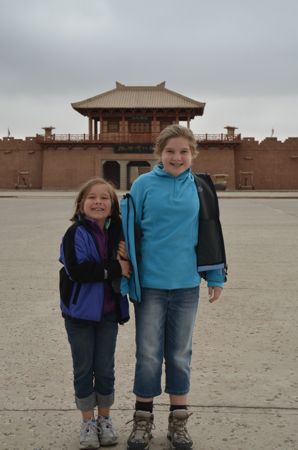
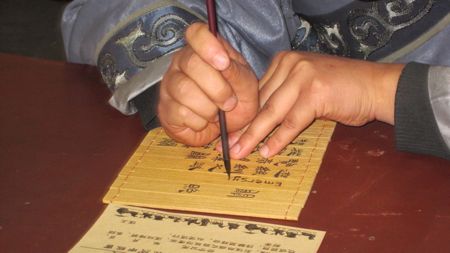
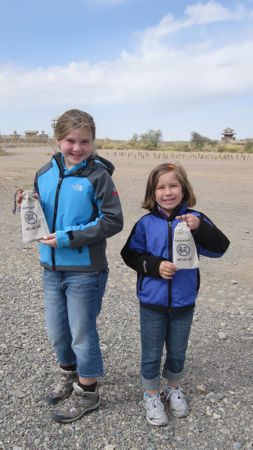
At one point in the tour, the girls could get a wood passport for 20rmb ($3). But, wait – the nicer ones with hand painting characters are 60rmb ($9)…an upgrade was required. The chinese man wrote the girls names exactly as they did. Eleri had written her name ELeri and that is how it appeared.
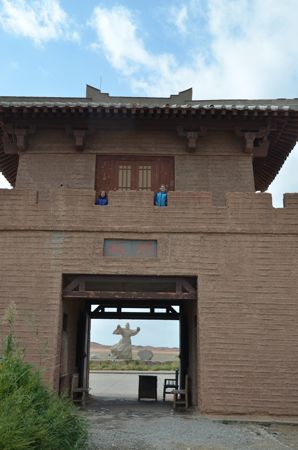
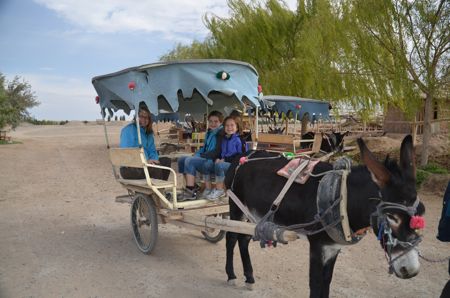
At the bottom of the hill, we had an option of walking up the hill (free), take horses (60rmb p/p) or take a donkey cart for (20rmb p/p). Eleri had wanted to do a donkey cart taxi ride in Kashgar so we went with the donkey. Hum, the old man walking the donkey was moving slower than Eleri…it took a while to get to the top!
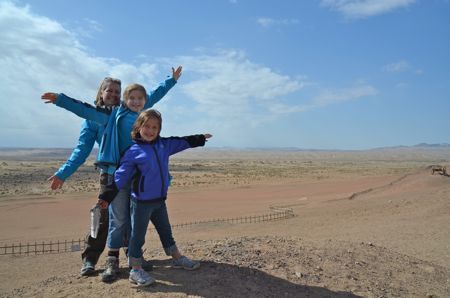
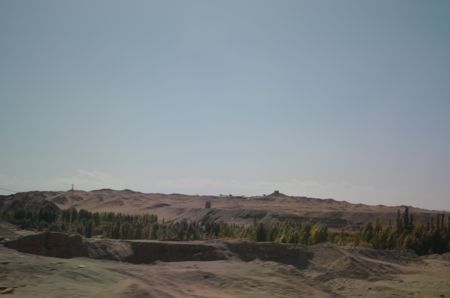
At the top of the hill, we could see out into the desert.
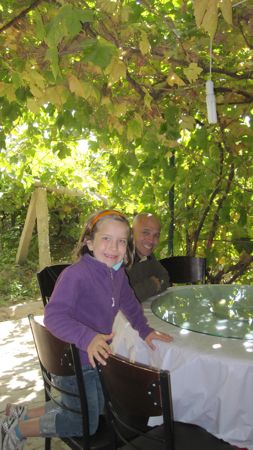
After playing at the fort longer than Kevin had planned, we grabbed lunch. The area of Yanggaon Pass is very interesting. It is this green oasis running through the desert. Grapes are the speciality of this area. We ate a Chinese lunch under the grape vines which felt like I should be in Italy. We bought a whole a crate of grapes to take home for all of 60rmb ($9). The grapes are seedless and are even better than Kashgar grapes.
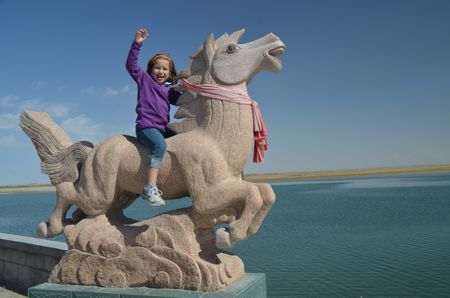
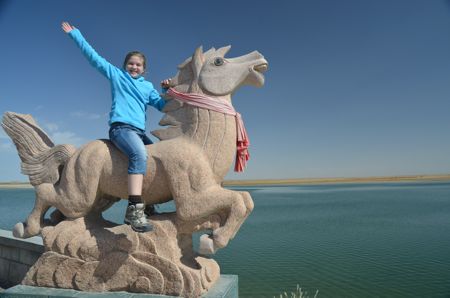
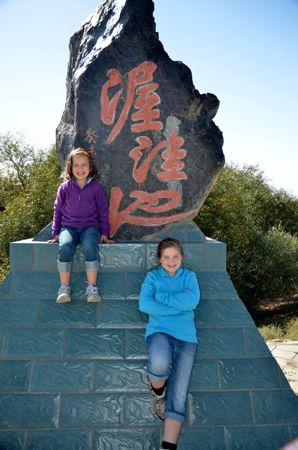
Next on our tour was a drive to a natural spring in the desert. It was 10 minutes from our location. There is this statue of the “the spirit horse” and a story, too. A story of how a man was able to catch the fastest “spirited” horse that came to the lake for water. He put a scarecrow/man next to the lake. The horse soon realized this scarecrow/man could not harm it. One day, the man replaced himself for the scarecrow/man. He reached out and grabbed the horse while it was drinking. He was famous for catching the spirited horse.
At this point, our schedule is to go back to the hotel to check in and to rest. We are staying at the Silk Road Hotel near the Gobi Desert. A charming hotel to match the desert feel. It is 4pm and prime time at the Silk Road. We decided to change our schedule to work better with our time. We would visit the Singing Sand Dunes and the Crescent Moon Lake this afternoon.
The mountain (‘Mingsha Shan’ a mountain echoes to the sound of sand in Chinese) is 5 kilometers (3 miles) away from the city of Dunhuang. Seen from afar, the mountain is just like a golden dragon winding its way over the horizon. As you approach you become aware that the sand has many colors ranging from red to yellow, green, black and white.
On days when a strong wind blows, the fast shifting sand roars; but when the wind is little more than a light breeze, the sand produces gentle, dulcet sounds akin to music. It is the same when you are sliding down the mountainside. At first, the sand under your feet just whispers; but the further you slide, the louder the sound until it reaches a crescendo like thunder or a drum beat. Some say that the sand is singing, while to others it is like an echo and this is how the mountain gets its name.
Crescent Lake, called as Yueyaquan (月牙泉), is a crescent-shaped lake in the oasis. It was named Yueyaquan since Qing Dynasty. The Crescent Lake’s water is so pure and sweet that it looks like an emerald set in the sand. Many of the visitors who have made their way down the mountain like to drink from the lake. According to historical record, the lake has been in existence for hundreds of years without ever being buried by the sand; it is really a geological wonder.
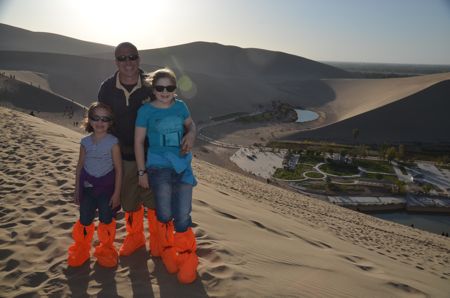
We walked to the Singing Sand Dunes. It was about a 20 minute walk from our hotel. It is National Day and the cars flowing to this tour spot are in a traffic jam so we are walking faster than they are driving. When we get to the Dunes, it is interesting. The Dunes are amazing beautiful, BUT it is National Day. The Dunes are filled with people…people everywhere. We arrived at the dunes around 4:30pm.
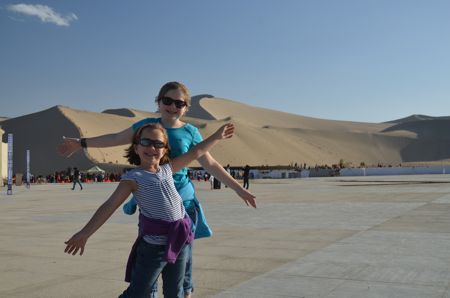
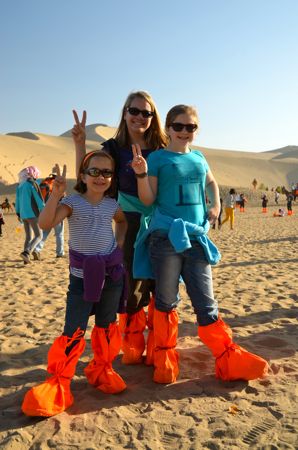
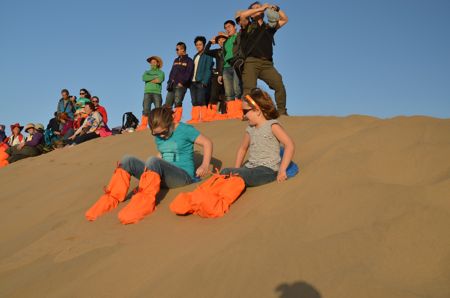
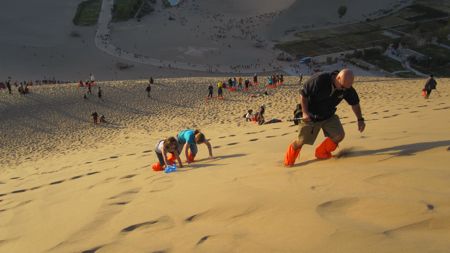
We gathered our orange booties – renting for 10rmb, but Jim just took some off the ground. There are so many people they don’t know how to handle the masses.
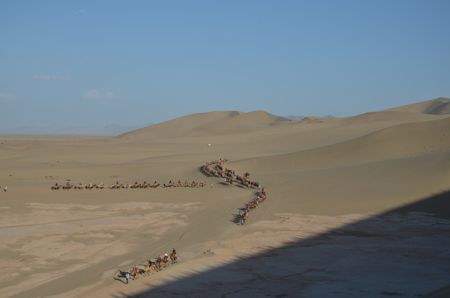
The camel rides was a long line of camels walking around the Dune.
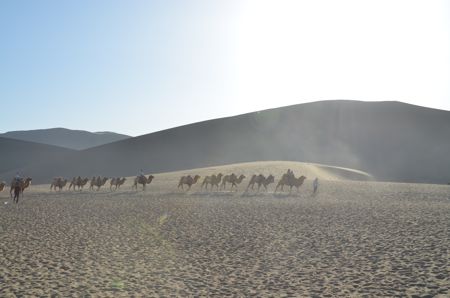
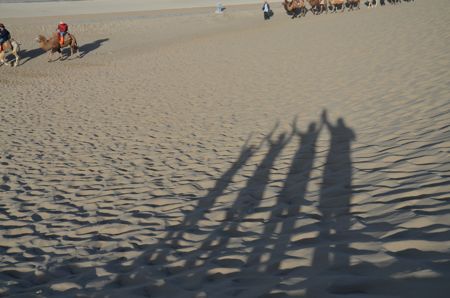
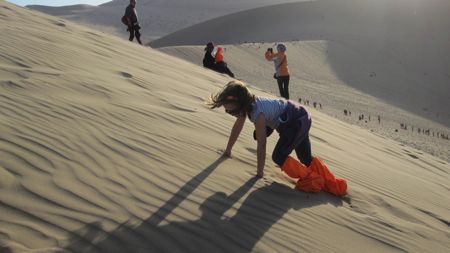
We join the crowds and began climbing the dunes. It is work climbing up the large dune. Walking along the top of the dune is easier, but the slides are like trying to walk through knee deep water. The girls were having a blast.
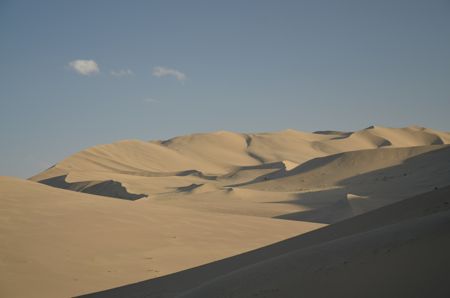
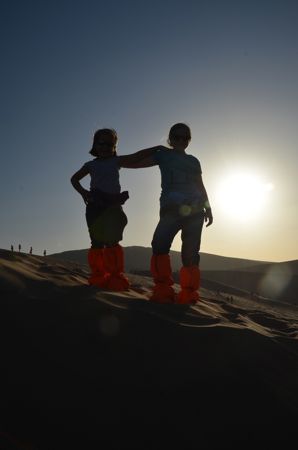
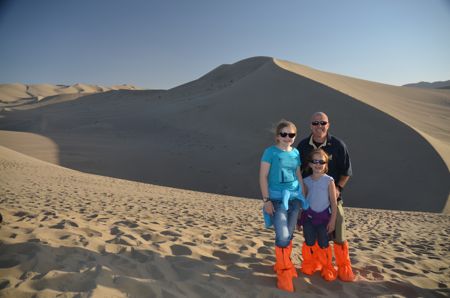
We walked along the top and across the dune until we reached the Crescent Moon Lake.
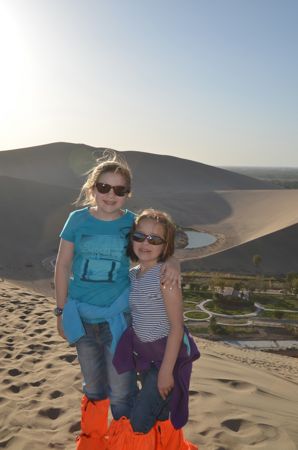
We were disappointed to discovered the slides were not running. But, with this many people, it just wouldn’t be possible. I had some bags in my backpack. We thought we would try sliding down on the bags, but it was a bust.
So, we had fun running down the dunes!
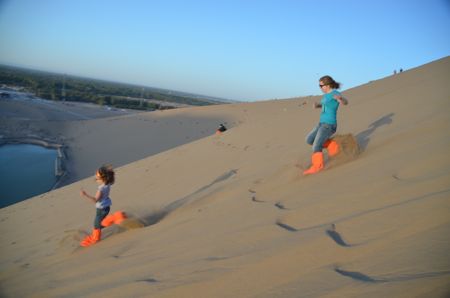
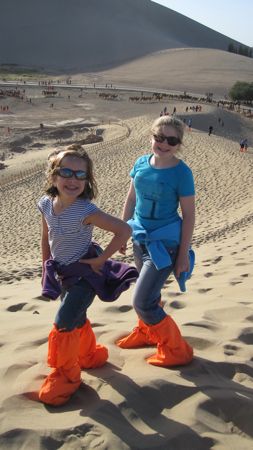
Climbing back up the face of the dune was VERY hard. We decided to run all the way to the bottom.
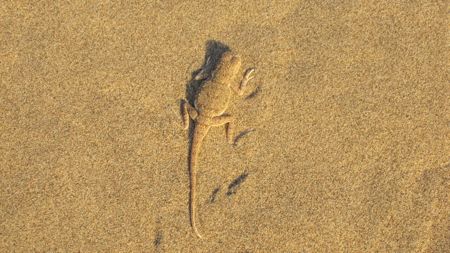
A sand lizard the girls found climbing up the face of the dune. It moved faster than us!
We left covered in a layer of sand and fun around 7:30pm. Back to the hotel for a much needed shower.
It was 9:00pm by the time everyone showered and repacked the bags for our next adventure. Eleri was lying on the bed closing her eyes. We grabbed a taxi into town to the Night Bazaar. We were eating with the locals again at 10pm! We walked to the food area to see what we could find. I saw a few people carrying these meat pitas that looked good. When I asked, the man pointed to the shop in front of us with the long queue. Ellle and I stood in line while Jim and Emmy went to find some lamb kabobs. The place was called pork burgers – Emersyn had said she could go for a hamburger – close enough. They were worth the wait!
After our fast dinner, we went rug shopping…not that we need a rug, but as Jennifer says, “how do you come home from the silk road with no rug”. Both Mary and Jennifer purchased rugs in Dunhuang. We had seen some nice rugs in Kashgar, but decided to wait. We found a few small shops with nothing of interest. The large shop had a rug pattern I liked, but not the color. It was 11:30pm and Eleri was dropping fast. We left with no rug, but it saves on the wallet!
Thursday, October 4: Caves, Camels and Desert Stars
The Mogao Grottos or Mogao Caves (the Caves of the Thousand Buddhas) are the highlight of Dunhuang and one of the famous highlights of north-west China. The story goes that the construction of these Buddhist grotto temples began in the middle of the 4th century AD by a monk Yue Zun who was traveling through the area and saw a vision of a thousand golden Buddhas. Over the next thousand years, hundreds of caves were carved into the sandstone cliffs and Dunhuang became a flourishing center of Buddhist culture on the Silk Road.
After the 14th century the grottoes were abandoned and eventually forgotten. In 1900, they were accidentally discovered by a Taoist monk, Wang Yuan, who stumbled upon what appeared to the former monastery library with its collection of scrolls, documents, embroideries and paintings that had been left behind by the Buddhist monks. Bricked up to prevent the contents falling into the hands of invaders, the dry desert air had preserved the paper and artworks.
Passing through the area in 1907, the British explorer Sir Aurel Stein heard a rumor of the hoard, tracked down the monk and was allowed to inspect the contents of the cave. It was an archaeological goldmine mainly of Buddhist texts in Chinese, Tibetan and many other Central Asian languages, some known and some long forgotten. There were paintings on silk and linen and what may be the oldest printed book in existence dating to 868 AD.
The Mogao Grottos form a system of 492 temples. The grottoes honeycomb a 1600 meters long cliff face which sits on a north-south axis. Altogether they contain over 2000 statues and over 45, 000 separate murals. Cave 17 is where Wang discovered the hoard of manuscripts and artworks.
We were to visit the caves on our way out of the desert, but we wouldn’t have much time. Kevin had thought this morning would be best. We were to be packed, had our breakfast and be ready to go at 8am. Another early morning after another late night…we will need to go home to rest from our holiday. Our hotel had a beautiful view of the desert and a large deck for eating. However, it was a cold morning so we squeezed inside the small eating area.
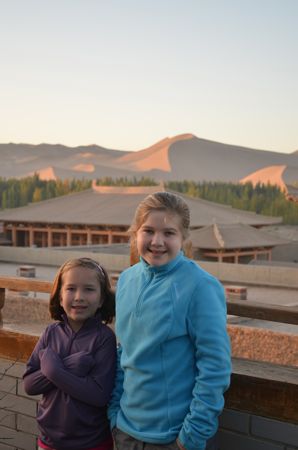
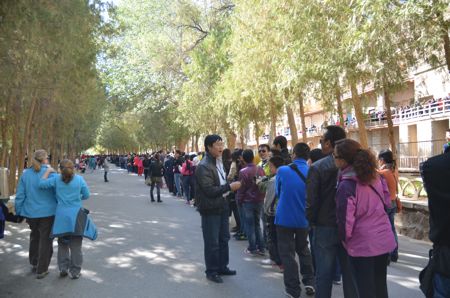
The drive to the cave was about 30 minutes. When we arrived, it was already busy for so early in the morning. We went to the Exhibit Hall while Kevin stood in line. Kevin saw a friend and was able to get tickets within 10 minutes. The tickets are 180rmb per person for a English guide or 160rmb for Chinese guide. He arranged for an English tour for us…our tour consist of the 4 of us. The guide had said normally tours are done in group of 20 to visit the caves. With the holiday, a Chinese guide is in the cave on a microphone while about 50 people squeeze in the cave to see and listen. Our guide would bring us to the corner or stand outside to tell us the story of the cave. Then, we were given a few minutes after the crowds left to see the cave. It was the best way to see the caves in this crowd. We would wait about 10 -20 minutes in a queue to see each cave. One cave, we just skipped as the ling was too long. Our guide had said the number of people yesterday was 17, 000 people. No photos are allowed in the caves to preserve the color.
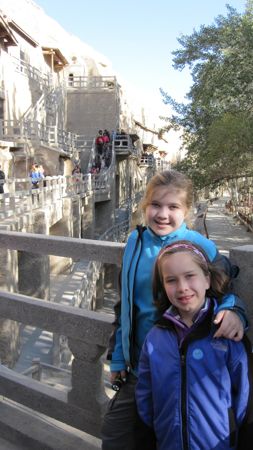
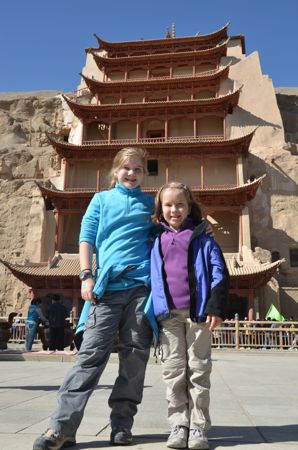
By the time we finished our cave tours, it was 11:30. The queues to get in to the area were unbelievable long. Most of the tourist will be waiting an hour or longer to just enter the cave area and then will queue for the individual caves. This would be the time we would arrive tomorrow on our original schedule.
After caving view, we went to the bookstore to buy a book and a painting that Jennifer and Mary had purchased at the cave. Emersyn found the blue one she liked to be framed and put in her room. I will have to find time to run to Eddie Tams for some framing. Framing is so very cheap in China.
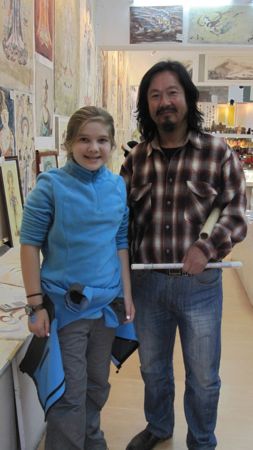
Emersyn with the artist
Jim wanted to the climb the hill and take photos of the caves from the distance.
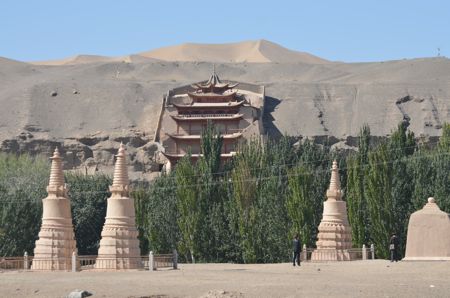
As the girls and I were standing and waiting about 10 feet from the Exhibit Center, I decided we should go back to see the exhibits as Eleri had requested. I told Kevin we were going to the Exhibit Center. When we came out, no Jim and Kevin. We waited, but they did not seem to be anywhere near. The girls found a place to sit under a tree in the shade. I left them there as I walked to the front of the exhibit Center and ticket area. No Jim and Kevin. I was gone about 5-7 minutes. When I came back, the girls were being mobbed by the tourist for their photo. Just as I reached the girls, our cave tour guide stopped to ask if I needed help. Yes, I needed help. I was looking for a needle in a haystack – the short, bald man in the crowd of 17, 000! I used her phone to call Jim. Kevin had said I went to the parking lot…that made no sense as the parking lot was about a 15 minute walk. Jim said it doesn’t sound right. But, at least I knew where he was and I should of had my phone on me. It was 1:30pm when we left and we were all hungry!
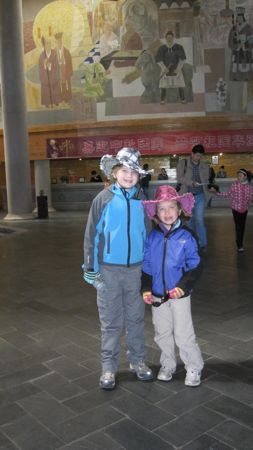
Kevin took us to a local Chinese resturant which was mamahoho (not so good). We were across the street from the bazaar. Hum, had we known that we could of had a pork burger for 7rmb for a total of 28rmb ($5). Instead, we paid 300rmb ($50) for so-so food. Our cost of most food has been about 300rmb at the restaurants. As we walked through the bazaar, I wanted to buy the cowboy hats for our desert adventure. Of course, Jim comment we have some at home from our Yunnan Leaping Tiger Gorge adventure. Yes, that would be true, but these were DIFFERENT and NEEDED for our camel adventure. Eleri found a pink one, a black and white for Emersyn and a orange and green for me…all of 50rmb ($8) in total! Now, we are ready to ride camels!
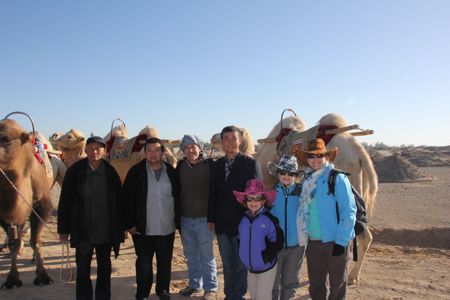
Our meeting time was 4pm to meet the camel crew near the Singing Sand Dune. We met in the dump! Our camel guide was very nice. He was 63 years old. He would be walking into the dessert while we rode. This is a fun adventure.
We walked through a very large burial grave sites. As we walked, we named our camels. Emersyn was on #183 and named her camel first – Matthew after a boy in her class because her camel was eating EVERY green plant it could reach. Jim was on #184 and named his Ralph. I named my camel Carmel based on the carmel color – #500. Eleri named her camel Picky, then Ms Sassy, then Casey and finally Campbell for #501. We had fun talking and joking as we rode along. For the most part, we were walking on the harder surface along the desert. We could see the masses of people on the back side of Singing Sand Dune.
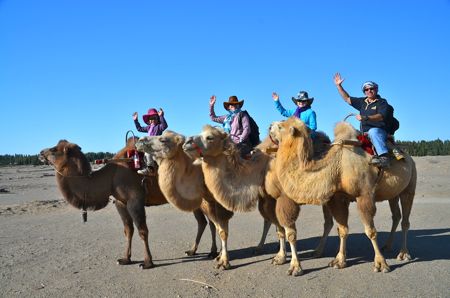
How very small Eleri looks on her camel. The camel guide fixed the foot straps so she could put her foot in the area above the metal.
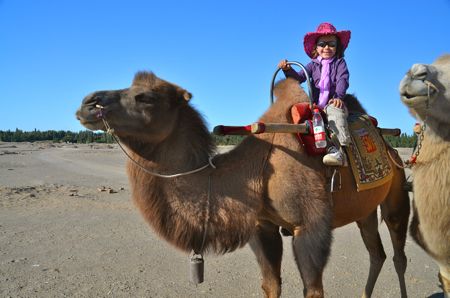
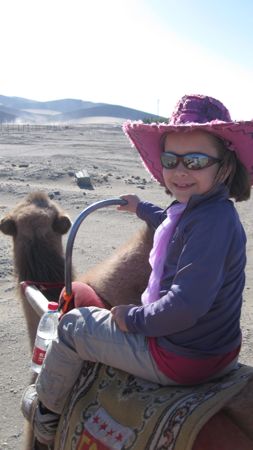
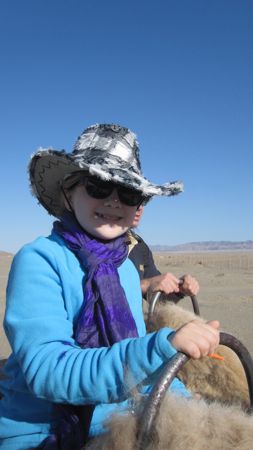
After an hour, we took a break while we waited for the other guide driving into the desert. The girls played in the desert while we waited.
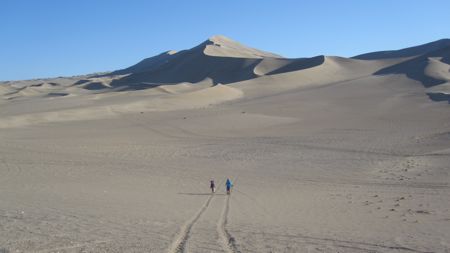
Then, we rode another 20 minutes and turned into the soft desert. Interesting how the ride changed dramatically once we hit the soft sand. The camels glide through the sand like water. On the hard surface, they seem to pounce and stomp on the dirt. The ride went from bumpy to smooth.
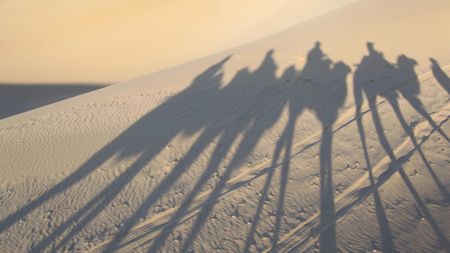
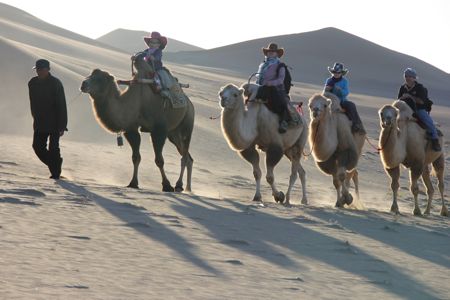
The guides set up camp while we went to play.
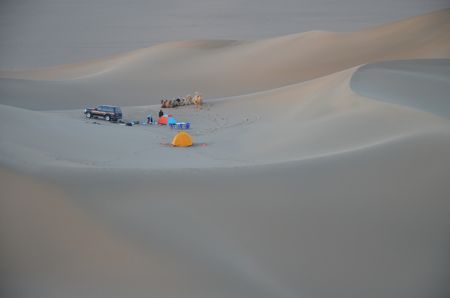
We had brought inner tubes to slide, but they didn’t really work. It was fun to climb the dunes and run down them. It was a highlight experience to feel so alone in the Gobi Desert. You could also understand getting lost in the desert. The dunes all look the same and it is hard work walking up the face.
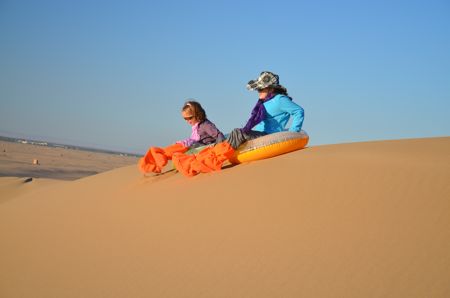
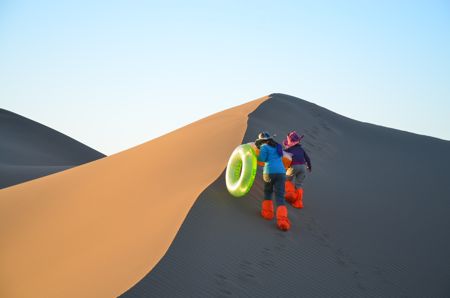
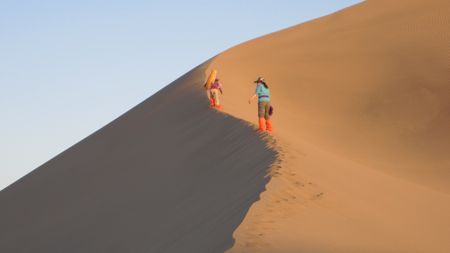
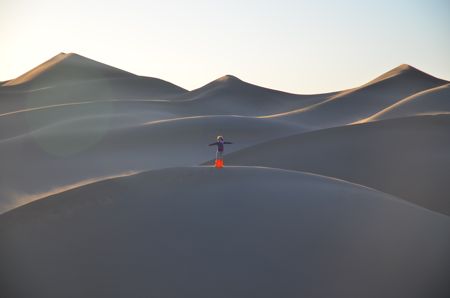
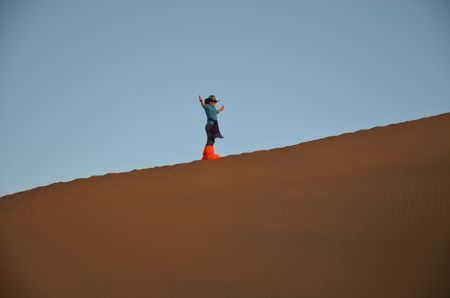
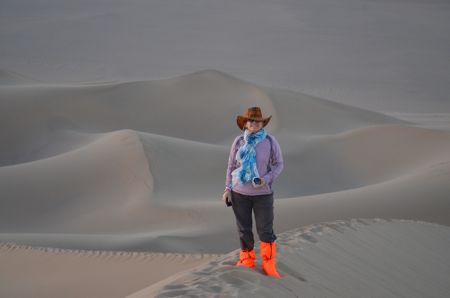
We came back when they called us for dinner. They had a propane tank to cook up a hot meal and beer for Jim.
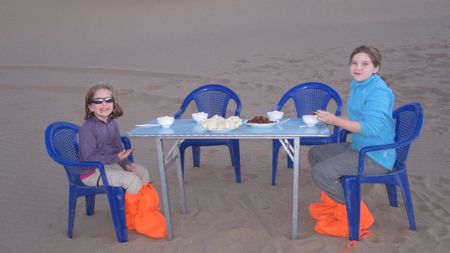
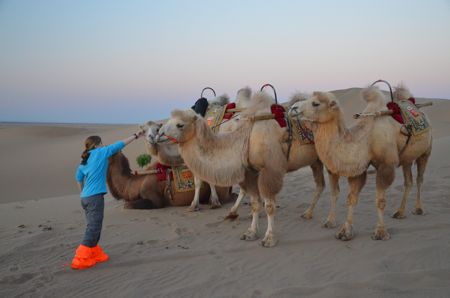
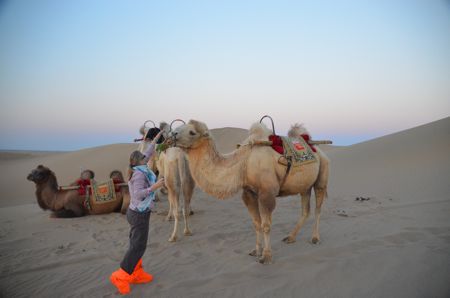
We feed the camels the green bushes the girls found for a treat.
After dinner, they built a fire – if I had known that I would have brought smores making. They might have been smashed, but they would still taste good!
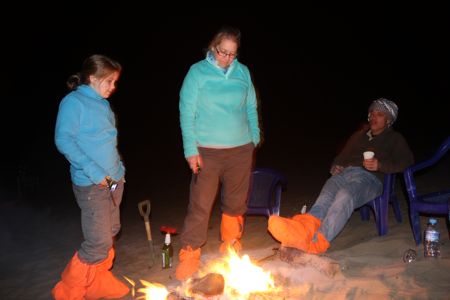
The guide had said it may be 0c tonight, but it wasn’t that cold and not as cold as the lake. We sat around the fire while Elle ran around the sand! The “bathroom” was over the dune behind the fire – a bit of a climb.
After a bit, the guides climbed the big dune and yelled at us to come and see. The moon was coming up over the dunes. It was orange and an almost full moon. It was beautiful.
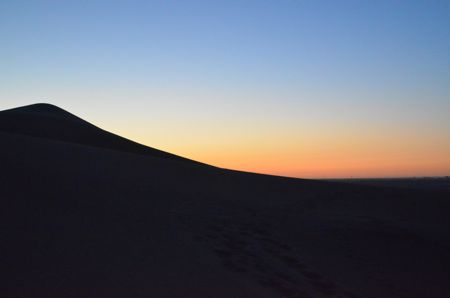
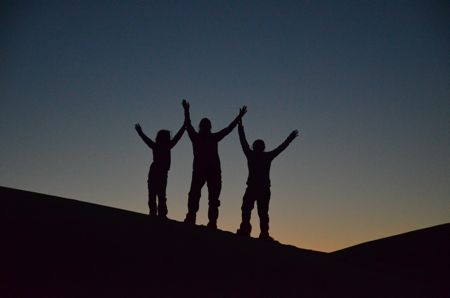
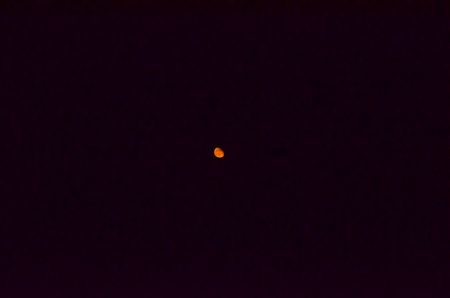
A little more fire sitting before retiring to our tent for sleep. The guides did set our tent up on a slight hill! We decided to put the girls in the middle for warmth and our feet at the bottom of the slope. They gave us sleeping bags and we climbed in. It was an early night for us as it was only 11pm. The moon was bright so it was not dark in the tent.
Friday, October 5: Desert Fun and to Shanghai
By morning, we had all slid down the tent. Jim was the only one still at the top. He said he would move himself back up in the night. My feet were sticking out the tent door. I was much warmer than the Yurt. We didn’t even wear our coats to bed, but used them as pillows. It was still hard and uncomfortable, but part of the experience. Emersyn had said she was colder than the Yurt. Eleri was warmer as she was freezing at the Yurt.
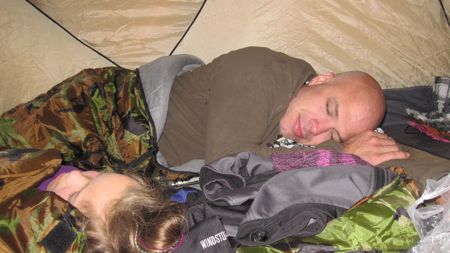
We packed up our gear by throwing it into the bag. We went off for one more play in the desert. The girls went to find green bushes for the camels. The girls walked to the next dune to get the green bushes.
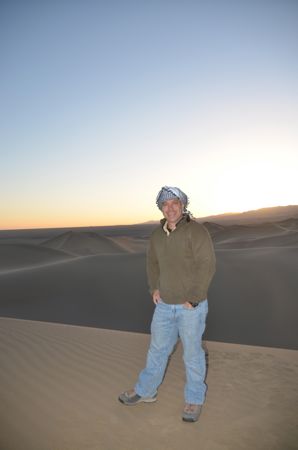
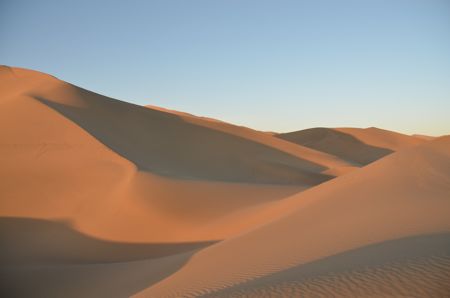
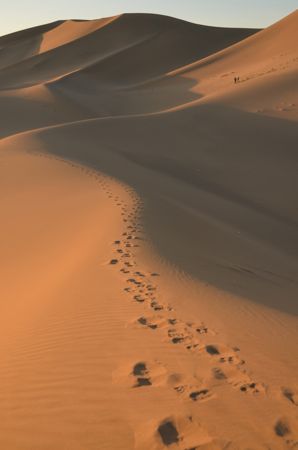
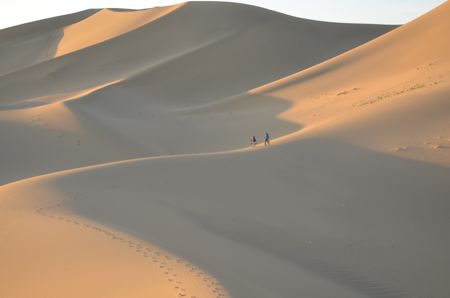
The guides feed us eggs, sausages and ham (of some sort). Not bad for a desert breakfast. One last bathroom run over the dune.
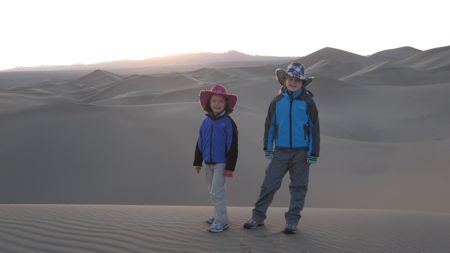
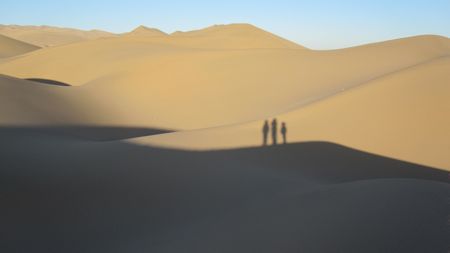
Then, it was time to go. We were to ride across the desert to the caves, but since we did them yesterday, we rode back to the Singing Sand Dunes.
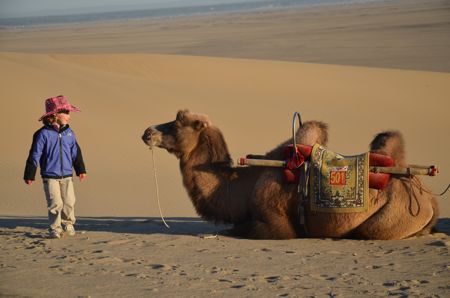
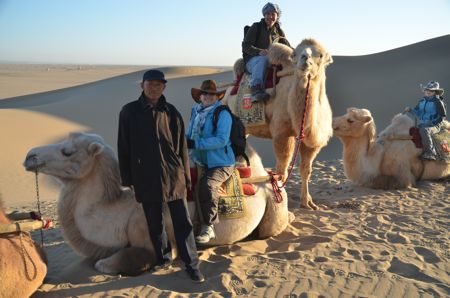
We went back to the hotel for our luggage and showers in the dormitory.
The showers were not the nicest looking (should have taken a photo), but there was hot water and we could take the layer of sand off. Clean and repacked, we were ready for an early lunch. The girls wanted another pork burger. Kevin had wanted to take us to a dumpling place. We had plenty of time so we decided to get a small portion of dumplings and then pork burgers to share. Perfect. We still had time, so we sat in the sun at the bazaar having a drink (colas for the girls and a beer for Jim).
We arrived at the airport early based on the number of travelers in this area. We arrived to sit and wait. Our flight was delayed 2 hours. No complaints as we haven’t had a long delay with all the various flight we were taking on this trip. We would wait here or in Xian as we had a layover in Xian.
Xian to Shanghai. The girls were thrilled to see Roxi. Mr. Nie brought her to the airport which makes the girls very happy. Our beds felt so GOOD. We were moving on this trip with two “camping” nights.
Another fun adventure as a family. We are so blessed to be able to see this part of the world and share it as a family.
Average Rating: 5 out of 5 based on 164 user reviews.